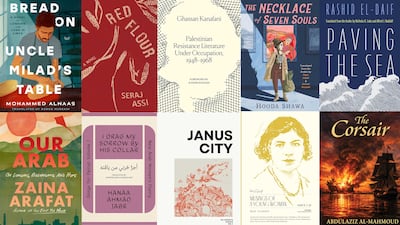

A Libyan baker takes care of the house while his wife earns their living. Two Palestinian teenagers meet at the Louvre and uncover a shared family history. In Beirut, a writer examines the city she calls home.
This month’s books by Arab writers published in English range from Mohammed Alnaas’s prize-winning Bread on Uncle Milad’s Table to new essays by Zaina Arafat and Lina Mounzer. English translations of Ghassan Kanafani, May Ziadeh and Iraqi poet Hanaa Ahmad Jabr also arrive this month, alongside a new edition of Qatari historical novel The Corsair.
Here are 10 titles to look out for.

Bread on Uncle Milad’s Table by Mohammed Alnaas

A baker struggles to meet his family’s expectations of masculinity in the Libyan novel that won the 2022 International Prize for Arabic Fiction.
Milad learns his trade from his father, who passes on firm ideas about how men should behave. After marrying Zainab, he takes on household duties while she becomes the breadwinner. The arrangement suits him, until his cousin reveals what their community thinks of it.
Set amid the social and economic upheavals of Libya during the Qaddafi years, the novel follows the consequences of that pressure on Milad and his marriage. The English edition is translated by Sawad Hussain.
October 6 in the US
Red Flour by Seraj Assi

A survivor resurrected in heaven looks back on a massacre in an unnamed town under siege in Palestinian writer and academic Seraj Assi’s latest novel.
His memories return to a camp crowded with displaced families, where hunger governs daily life and a breadline becomes the site of catastrophe. A love story develops among those waiting for flour, as bombardment and starvation threaten the camp’s residents.
Born and raised in Palestine, Assi teaches Palestinian literature at the American University in Washington. His previous books include My Life as an Alien and Rubble.
October 6
Palestinian Resistance Literature Under Occupation, 1948-1968 by Ghassan Kanafani

Ghassan Kanafani is best known internationally for novels including Men in the Sun and Returning to Haifa. This month, his extended essay on Palestinian resistance literature appears in English for the first time.
Translated by Tarif Khalidi, with an introduction by historian Rashid Khalidi, the book examines Palestinian writing during the two decades after the Nakba. Kanafani considers how writers worked to preserve their language, culture and history under Israeli occupation.
Alongside the essay, the volume includes poetry, prose and drama selected by Kanafani, with contributions from Mahmoud Darwish, Hanna Abu Hanna and Samih Al Qasim, among others.
October 13
The Necklace of Seven Souls by Hooda Shawa

Two Palestinian teenagers meet at the Louvre and discover a connection between their grandmothers, both of whom fled Palestine during the Nakba.
Farida is a young painter recreating European masterpieces for a Parisian art dealer, while Mazen has arrived in France searching for a lost family heirloom. As they investigate their family histories, a ring of art forgers takes an interest in Farida. The story moves between Paris, Haifa, Aleppo and Tangier.
Palestinian-British author Hooda Shawa lives in Kuwait and won the Sheikh Zayed Book Award for Children’s Literature in 2008 for The Birds’ Journey to Mount Qaf. Her young-adult novel is translated by Nour Jaljuli and Sawad Hussain, and illustrated by Nada Esmaeel.
October 15 in the UK; published in September in the US
Paving the Sea by Rashid El-Daif

An attempt to introduce Darwin’s theory of natural selection into a university curriculum ends in expulsion for two idealistic students in Lebanese writer Rashid El-Daif’s historical novel.
One is Jurji Zaidan, the real-life writer and intellectual associated with the Nahda, the Arab cultural renaissance. The other is his friend Fares Hashem. After their expulsion, they leave Mount Lebanon, with Fares setting out for the West.
Through their ambitions and disappointments, El-Daif examines the promises attached to modern science, education and nation-building. A narrator who comments freely on events connects their experiences in the Ottoman era with the present.
The English edition is translated by Nicholas R Lobo and Alfred J Naddaff.
October 15
Our Arab: On Longing, Belonging, and Hope by Zaina Arafat

Palestinian-American writer Zaina Arafat follows her novel You Exist Too Much with essays about family history, parenthood and maintaining a connection to Palestine while living abroad.
In one essay, she travels to the Middle East with her pregnant wife and toddler, hoping to visit her family’s home city of Nablus, before deciding the danger is too great. Another follows her father’s year as an exchange student in small-town Minnesota in the 1960s, then her experience accompanying him to his school’s 50-year reunion.
Those family journeys sit alongside accounts of raising children in the diaspora and the experience of speaking publicly as a Palestinian.
October 20 in the US; October 22 in the UK
I Drag My Sorrow by His Collar by Hanaa Ahmad Jabr

Iraqi poet Hanaa Ahmad Jabr’s first solo collection in English brings together prose poems about living in Iraq over the past two decades, including through violence involving ISIS.
Translated by Jennifer Jean and Wadaq Qais, the collection follows Jabr’s bilingual collaboration with Jean, Where Do You Live? Jabr is from Mosul and teaches at the University of Mosul.
Published by Black Ocean, the book is the first volume in Songs for Fairuz: New Arab Women’s Poetry, a series introducing contemporary Arab women poets to English-language readers.
October 27 in the US
Janus City by Lina Mounzer

Lebanese writer and translator Lina Mounzer combines personal memories with the political and mythological history of Beirut in this short book about making a home in a city repeatedly threatened by disaster.
Janus City: The Many Faces of Beirut takes its title from the Roman god depicted with two faces. Mounzer writes about a city shaped by both its legends and the political crises its residents endure.
The 120-page book features original artwork by Lebanese artist and illustrator Jana Traboulsi. It opens OR Books’ new OR Shorts series, which will publish six short books over a year.
October
Musings of a Young Woman by May Ziadeh

May Ziadeh’s Sawanih Fatat arrives in a new English translation produced and edited by a collective of women.
The Lebanese-Palestinian writer’s book combines essays, reflections, poems and a short play, addressing women’s right to think, write and be read. Contributors to this edition include translators, writers and scholars such as Marilyn Booth, Layla AlAmmar and Ranya Abdelrahman.
Published by ArabLit Books, it is the second title in the Erased, Not Forgotten series, following Samira Azzam’s Out of Time.
October
The Corsair by Abdulaziz Al-Mahmoud

Qatari writer Abdulaziz Al-Mahmoud’s debut novel returns in a new edition from Nomad Publishing, with a foreword by Gulf historian James Onley.
Set in the early 19th-century Arabian Gulf, The Corsair centres on Rahmah ibn Jabir Al Jalahimah, a seafaring tribal leader whose reputation became entangled with competing accounts of piracy, power and resistance. His story unfolds amid British naval interests, local rivalries and the struggle to control trade routes.
When the earlier English edition was released in 2013, Al-Mahmoud spoke to The National about the difficulty of separating history from legend. His research included British documents, but he found that many accounts of the central figure rested on assumptions made by people who had never met him. The novel combines that historical research with fictional intrigue.
October

