Danial Canogar's Chyron Wallpaper work. Photo: Studio Daniel Canogar

Expo 2020 Spain Pavilion artist Daniel Canogar set for regional solo debut in Dubai


Maan Jalal
  • English
  • Arabic

Spanish installation artist Daniel Canogar will hold his first solo exhibition in the region at Galloire Art Gallery in City Walk, Dubai on January 23.

The Spanish artist has previously exhibited work in the Middle East, with an interactive audiovisual project titled Dynamo in the Spain Pavilion at Expo 2020 Dubai. Produced in collaboration with the composer Francisco Lopez, the work — with three sculptural screens shaped like interlaced loops that responded to visitor input by generating audiovisual content — proved incredibly popular.

He also presented an ambitious building-sized laser projection titled Bifurcation at Saudi Arabia's annual light and art festival, Noor Riyadh, in 2021.

In his new Dubai solo show, Loose Threads, Canogar will showcase today’s technological reality, exploring the many fabrics and patterns that weave informational threads together and how vast amounts of data shape our digitised lives.

From cables, base plates and input ports to data flows, ones and zeros, the textile dimension of technology will be presented in Dubai, a city and region that Canogar believes is the perfect location for his concept.

"The Arab world has a fascinating history and deep tradition in fabrics and textiles, having led the world in artistry and quality for a time,” Canogar said.

“More than just items to be gifted or traded, fabrics represented and told the stories of culture, society, politics and economics. Combining that history with the backdrop of today's Dubai, very much a city of the future and leading the way in so many aspects of the digital age, made it the perfect place to present Loose Threads."

Over the years, Canogar has studied and explored how mobile devices have transformed the world through overstimulation and exposure to extreme and exaggerated versions of reality. He has translated these observations into a series of interactive works including Ripple in 2016, Billow in 2020 and Chyron in 2022.

Loose Threads questions many aspects of the modern world, from financial fragility, to life and death during the pandemic, through a calm and reflective experience in an attempt to allow the viewer to better process these crucial issues.

Scroll through images of public sculptures in Abu Dhabi below

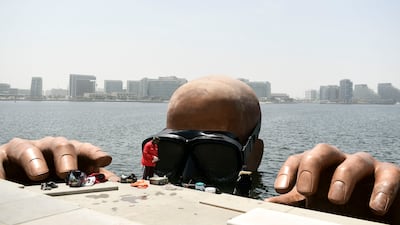
  • 'The Emerging Man' sculpture features a giant head emerging from the water located on the Yas Bay Waterfront, Abu Dhabi. Khushnum Bhandari / The National
    'The Emerging Man' sculpture features a giant head emerging from the water located on the Yas Bay Waterfront, Abu Dhabi. Khushnum Bhandari / The National
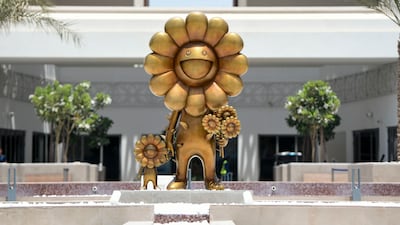
  • 'Flower Parent and Child', a golden sculpture created by Takashi Murakami on the Yas Bay Waterfront promenade, Abu Dhabi. Khushnum Bhandari / The National
    'Flower Parent and Child', a golden sculpture created by Takashi Murakami on the Yas Bay Waterfront promenade, Abu Dhabi. Khushnum Bhandari / The National
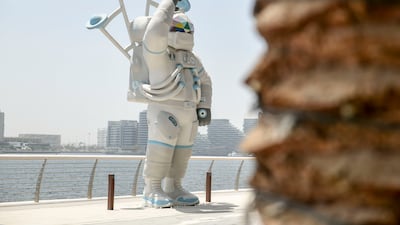
  • 'Astrocat', one of four sculptures by CoolRainLabo along the Yas Bay Waterfront, Abu Dhabi. Khushnum Bhandari / The National
    'Astrocat', one of four sculptures by CoolRainLabo along the Yas Bay Waterfront, Abu Dhabi. Khushnum Bhandari / The National
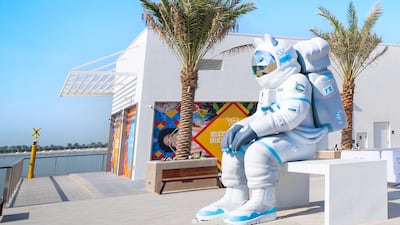
  • This seated sculpture is one of four 'Astrocat' installations at Yas Bay Waterfront. Photo: Yas Bay Waterfront
    This seated sculpture is one of four 'Astrocat' installations at Yas Bay Waterfront. Photo: Yas Bay Waterfront
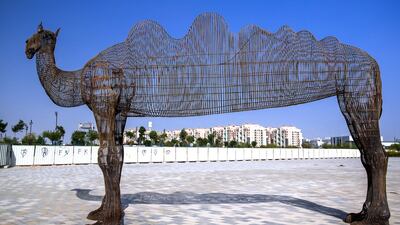
  • The Masdar Park camel art installation in Masdar City, Abu Dhabi. Victor Besa / The National
    The Masdar Park camel art installation in Masdar City, Abu Dhabi. Victor Besa / The National
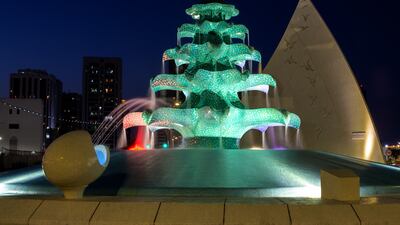
  • The Fountain Circle along Al Maryah Street and Zayed The First Street in Abu Dhabi. Victor Besa / The National
    The Fountain Circle along Al Maryah Street and Zayed The First Street in Abu Dhabi. Victor Besa / The National
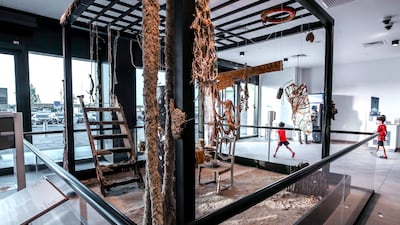
  • A multimedia installation made from items found on a shipwreck by Ayesha Hadhir Al Mheiri at the New Fish Market, Mina Zayed in Abu Dhabi. Victor Besa / The National
    A multimedia installation made from items found on a shipwreck by Ayesha Hadhir Al Mheiri at the New Fish Market, Mina Zayed in Abu Dhabi. Victor Besa / The National
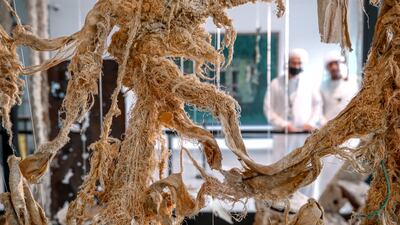
  • The work by Ayesha Hadhir Al Mheiri is made from recycled waste found in the ocean. Victor Besa / The National
    The work by Ayesha Hadhir Al Mheiri is made from recycled waste found in the ocean. Victor Besa / The National
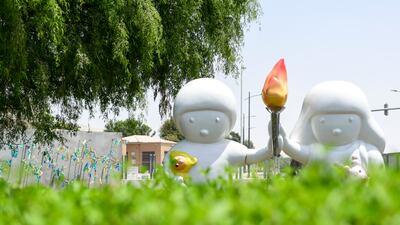
  • Noh Juno's sculpture features two figures holding the 'Flame of Hope' at the permanent exhibition Special Olympics Gardens outside Manarat Al Saadiyat, Abu Dhabi. Khushnum Bhandari / The National
    Noh Juno's sculpture features two figures holding the 'Flame of Hope' at the permanent exhibition Special Olympics Gardens outside Manarat Al Saadiyat, Abu Dhabi. Khushnum Bhandari / The National
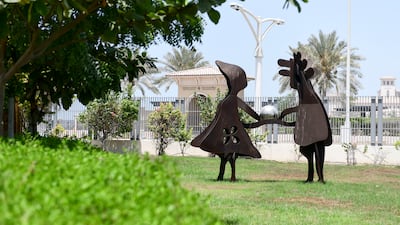
  • Lebanese artist Nadim Karam's 'Grasping the World' at the Special Olympics Gardens outside Manarat Al Saadiyat, Abu Dhabi. Khushnum Bhandari / The National
    Lebanese artist Nadim Karam's 'Grasping the World' at the Special Olympics Gardens outside Manarat Al Saadiyat, Abu Dhabi. Khushnum Bhandari / The National
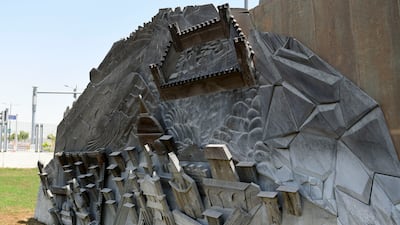
  • Wooden carvings by Wael Shawky at the Special Olympics Gardens. Khushnum Bhandari / The National
    Wooden carvings by Wael Shawky at the Special Olympics Gardens. Khushnum Bhandari / The National
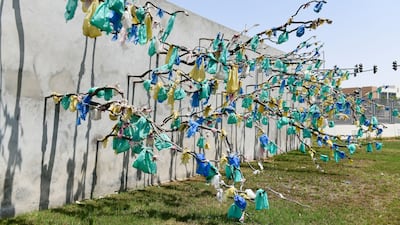
  • A plastic tree by Cameroonian artist Pascale Marthine Tayou at the Special Olympics Gardens. Khushnum Bhandari / The National
    A plastic tree by Cameroonian artist Pascale Marthine Tayou at the Special Olympics Gardens. Khushnum Bhandari / The National
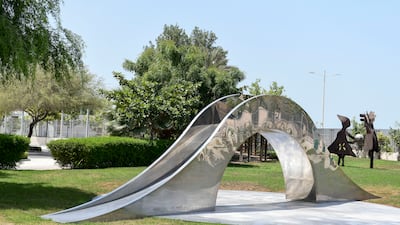
  • 'Affinity', a mirrored bridge by Mehmet Ali Uysal at the Special Olympics Gardens. Khushnum Bhandari / The National
    'Affinity', a mirrored bridge by Mehmet Ali Uysal at the Special Olympics Gardens. Khushnum Bhandari / The National
The specs

Engine: 2.0-litre 4cyl turbo

Power: 261hp at 5,500rpm

Torque: 405Nm at 1,750-3,500rpm

Transmission: 9-speed auto

Fuel consumption: 6.9L/100km

On sale: Now

Price: From Dh117,059

The five pillars of Islam

1. Fasting 

2. Prayer 

3. Hajj 

4. Shahada 

5. Zakat 

How to wear a kandura

Dos

  • Wear the right fabric for the right season and occasion 
  • Always ask for the dress code if you don’t know
  • Wear a white kandura, white ghutra / shemagh (headwear) and black shoes for work 
  • Wear 100 per cent cotton under the kandura as most fabrics are polyester

Don’ts 

  • Wear hamdania for work, always wear a ghutra and agal 
  • Buy a kandura only based on how it feels; ask questions about the fabric and understand what you are buying
RESULT

Brazil 2 Croatia 0
Brazil: 
Neymar (69'), Firmino (90' 3)    

Company profile

Name: Tharb

Started: December 2016

Founder: Eisa Alsubousi

Based: Abu Dhabi

Sector: Luxury leather goods

Initial investment: Dh150,000 from personal savings


The Details

Kabir Singh

Produced by: Cinestaan Studios, T-Series

Directed by: Sandeep Reddy Vanga

Starring: Shahid Kapoor, Kiara Advani, Suresh Oberoi, Soham Majumdar, Arjun Pahwa

Rating: 2.5/5 

Sole survivors
  • Cecelia Crocker was on board Northwest Airlines Flight 255 in 1987 when it crashed in Detroit, killing 154 people, including her parents and brother. The plane had hit a light pole on take off
  • George Lamson Jr, from Minnesota, was on a Galaxy Airlines flight that crashed in Reno in 1985, killing 68 people. His entire seat was launched out of the plane
  • Bahia Bakari, then 12, survived when a Yemenia Airways flight crashed near the Comoros in 2009, killing 152. She was found clinging to wreckage after floating in the ocean for 13 hours.
  • Jim Polehinke was the co-pilot and sole survivor of a 2006 Comair flight that crashed in Lexington, Kentucky, killing 49.
Top investing tips for UAE residents in 2021

Build an emergency fund: Make sure you have enough cash to cover six months of expenses as a buffer against unexpected problems before you begin investing, advises Steve Cronin, the founder of DeadSimpleSaving.com.

Think long-term: When you invest, you need to have a long-term mindset, so don’t worry about momentary ups and downs in the stock market.

Invest worldwide: Diversify your investments globally, ideally by way of a global stock index fund.

Is your money tied up: Avoid anything where you cannot get your money back in full within a month at any time without any penalty.

Skip past the promises: “If an investment product is offering more than 10 per cent return per year, it is either extremely risky or a scam,” Mr Cronin says.

Choose plans with low fees: Make sure that any funds you buy do not charge more than 1 per cent in fees, Mr Cronin says. “If you invest by yourself, you can easily stay below this figure.” Managed funds and commissionable investments often come with higher fees.

Be sceptical about recommendations: If someone suggests an investment to you, ask if they stand to gain, advises Mr Cronin. “If they are receiving commission, they are unlikely to recommend an investment that’s best for you.”

Get financially independent: Mr Cronin advises UAE residents to pursue financial independence. Start with a Google search and improve your knowledge via expat investing websites or Facebook groups such as SimplyFI. 

Mercer, the investment consulting arm of US services company Marsh & McLennan, expects its wealth division to at least double its assets under management (AUM) in the Middle East as wealth in the region continues to grow despite economic headwinds, a company official said.

Mercer Wealth, which globally has $160 billion in AUM, plans to boost its AUM in the region to $2-$3bn in the next 2-3 years from the present $1bn, said Yasir AbuShaban, a Dubai-based principal with Mercer Wealth.

Within the next two to three years, we are looking at reaching $2 to $3 billion as a conservative estimate and we do see an opportunity to do so,” said Mr AbuShaban.

Mercer does not directly make investments, but allocates clients’ money they have discretion to, to professional asset managers. They also provide advice to clients.

“We have buying power. We can negotiate on their (client’s) behalf with asset managers to provide them lower fees than they otherwise would have to get on their own,” he added.

Mercer Wealth’s clients include sovereign wealth funds, family offices, and insurance companies among others.

From its office in Dubai, Mercer also looks after Africa, India and Turkey, where they also see opportunity for growth.

Wealth creation in Middle East and Africa (MEA) grew 8.5 per cent to $8.1 trillion last year from $7.5tn in 2015, higher than last year’s global average of 6 per cent and the second-highest growth in a region after Asia-Pacific which grew 9.9 per cent, according to consultancy Boston Consulting Group (BCG). In the region, where wealth grew just 1.9 per cent in 2015 compared with 2014, a pickup in oil prices has helped in wealth generation.

BCG is forecasting MEA wealth will rise to $12tn by 2021, growing at an annual average of 8 per cent.

Drivers of wealth generation in the region will be split evenly between new wealth creation and growth of performance of existing assets, according to BCG.

Another general trend in the region is clients’ looking for a comprehensive approach to investing, according to Mr AbuShaban.

“Institutional investors or some of the families are seeing a slowdown in the available capital they have to invest and in that sense they are looking at optimizing the way they manage their portfolios and making sure they are not investing haphazardly and different parts of their investment are working together,” said Mr AbuShaban.

Some clients also have a higher appetite for risk, given the low interest-rate environment that does not provide enough yield for some institutional investors. These clients are keen to invest in illiquid assets, such as private equity and infrastructure.

“What we have seen is a desire for higher returns in what has been a low-return environment specifically in various fixed income or bonds,” he said.

“In this environment, we have seen a de facto increase in the risk that clients are taking in things like illiquid investments, private equity investments, infrastructure and private debt, those kind of investments were higher illiquidity results in incrementally higher returns.”

The Abu Dhabi Investment Authority, one of the largest sovereign wealth funds, said in its 2016 report that has gradually increased its exposure in direct private equity and private credit transactions, mainly in Asian markets and especially in China and India. The authority’s private equity department focused on structured equities owing to “their defensive characteristics.”

Updated: January 16, 2023, 10:32 AM