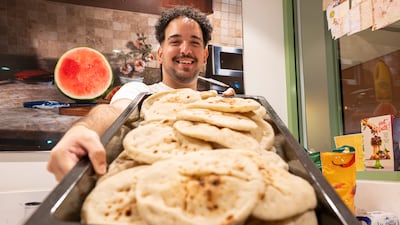

Egyptian artist Andrew Riad is a master of words. But his work goes beyond language. He brings another ingredient to his creative recipe: food.
The 26-year-old effortlessly blends his two passions through Ahlan Club, a community he has built that gathers people over shared meals and storytelling.
“The concept behind Ahlan Club is not that we’re just sitting and having dinner together,” Riad tells The National. “But our shared breaking of bread also incorporates a moment that we mark together, an act that we perform together, whether it’s archiving an oral tradition of a food gathering or a recipe that exists familiarly.”
As a Coptic Nubian, Riad sees food as more than sustenance. It is a way to explore questions of identity, heritage, and politics, often drawing on recipes his mother passed down.
“I grew up around a mother who loves to cook and loves to host and loves to feed people,” he says.
A focus on eish baladi
The latest focus of Riad's practice was eish baladi, Egypt's traditional flatbread.
“Bread is beyond being nutritious or a food item; it’s deeply a political and sociocultural object across countries and across millennia, but specifically in Egypt,” Riad tells The National. “It mirrors our people.”
For Riad, these humble loaves carry stories of his home. He left Egypt just before the 2011 revolution broke out across the country.
He and his family boarded what he recalls as the last flight out of Cairo to Dubai. The connection his work draws between the flatbread and that moment in Egyptian history is no coincidence.

At the heart of Cairo's Tahrir Square, protesters were chanting, “Eish, horeya, adala egtmaya,” which translates to, “Bread, freedom and social justice.”
It swiftly became one of the defining symbols of the January 2011 uprising.
The 1977 Bread Intifada
However, 2011 was not the first time bread had been at the centre of Egyptian resistance.
In 1977, after the Egyptian government announced cuts to food subsidies, including those on bread, protesters took to the streets of Cairo, with unrest spreading across the country.
The events have since been called Intifadet Al-Khobz, or the Bread Intifada, which inspired Riad's performance in Dubai earlier this month.
“We were looking for a person who is problematising, politicising and peeling away the layers of food,” says Kevin Jones, the acting arts director of Alserkal Arts Foundation, of working with Riad.
The independent non-profit is behind the Kitchen As Studio residency programme, which supported Riad's recent performance, Eish (Life).
Linking life and bread

With a BA in Literature and Creative Writing from NYU Abu Dhabi and an MFA from Pratt Institute, words are never far from a Riad performance.
“As a poet and artist, I have always taken language very seriously. And I have this relationship that’s been cultivated for many years around language,” Riad tells The National.
The three-letter Arabic root of eish was one of Riad's many linguistic explorations.
“Linguistically, eish means bread, but it also means life,” Riad explains. “It's the same three-letter root that means an array of things when it comes to life, in terms of your livelihood, being omnipresent and the biography of someone's life.”
A warm welcome

Ahlan wa sahlan – which means welcome in Arabic – is the ethos at the heart of Riad's work. Everyone is welcome at his table.
Strangers gather shoulder to shoulder, sharing food from communal platters, cultivating a growing community of like-minded people.
“It is something very simple, yet the simplest things are always the hardest to replicate,” Ania Poteryaeva, who is a frequent attendee of Ahlan Club, tells The National.

