The crescent moon has a famously lofty place in Arab and Islamic culture. A symbol of transformation, it signals the beginning and end of every month of the Hijri calendar.
Even now, astronomers and religious scholars wait for the arcing sliver of silver to appear in the night sky before announcing the beginning of Ramadan. The crescent is also a primary element in the Ramadan decorations that permeate homes and public spaces.
Hilal is Arabic for crescent. Al hilal al jadeed is the new crescent that signals the first of the lunar phases. The waxing crescent is also known as hilal mutazayid. Hilal akhir asshahr, meanwhile, refers to the crescent at the end of the lunar cycle. Hilal mutanaqis is a waning crescent.
There is a belief that the crescent moon became known as hilal because of the cheers people sounded at the sight of it. Looking at one of the Arabic words for cheer, hallal, it is easy to see how it may have influenced the hilal.

Hilal also has several meanings that, although they may not be colloquially used today, point to the vast symbolism associated with the crescent moon. It denotes the first rains after a dry spell and possibly borrows the name from the crescent to signal new beginnings. It also once referred to the last bits of water in a rain, perhaps as a nod to the waning crescent. A malnourished camel was also called a hilal. The bit of wood or metal that attaches two parts of a saddle is also known as hilal.
Much like the English counterpart, hilal is also used to describe the shapes of things. It has also become associated with humanitarian efforts, notably with the Red Crescent or Al Hilal Al Ahmar.
Hilal is also often used as a name, with connotations of beauty and radiance, much like the crescent moon it is inspired by. Famous figures include the Emirati footballer Hilal Saeed. Al-Hilal Saudi Football Club, which competes in the kingdom’s pro league, also derives its name from the crescent.
-

The Arabic word for sign is aya. All photos: The National -

The Arabic word for cat is qita -

Laban is the Arabic word for milk -

Mosa, or Moses in English, is mentioned 136 times in the Quran -

The Arabic word for ownership is tamalouk -

The Arabic word for mint is ne’ena’a -

Shuback is the Arabic word for window -
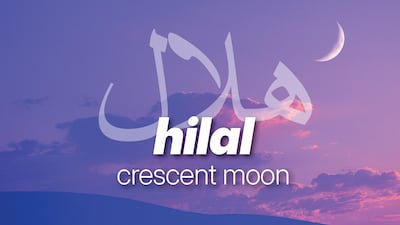
Hilal is Arabic for crescent -

Musafir, the Arabic word for traveller, is often used in music and poetry, evoking a sense of longing and passion -

Raqaba, the Arabic word for neck, can also denote caution and scrutiny -

Ithin, the Arabic word for permission, has many bureaucratic uses -
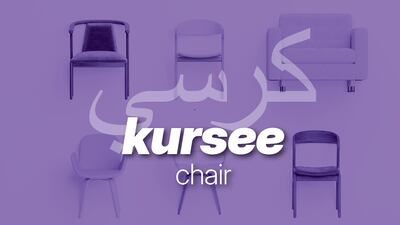
The Arabic word for chair is kursee -

Faten is Arabic name that has many spiritual and poetic meanings -

The Arabic word for embroidery is tatreez -

Zarafa is Arabic for giraffe -

The Arabic word for dignity, honour and respect is izza -

Hewi is the Emirati word for front garden -

Lahja is the Arabic word for dialect -
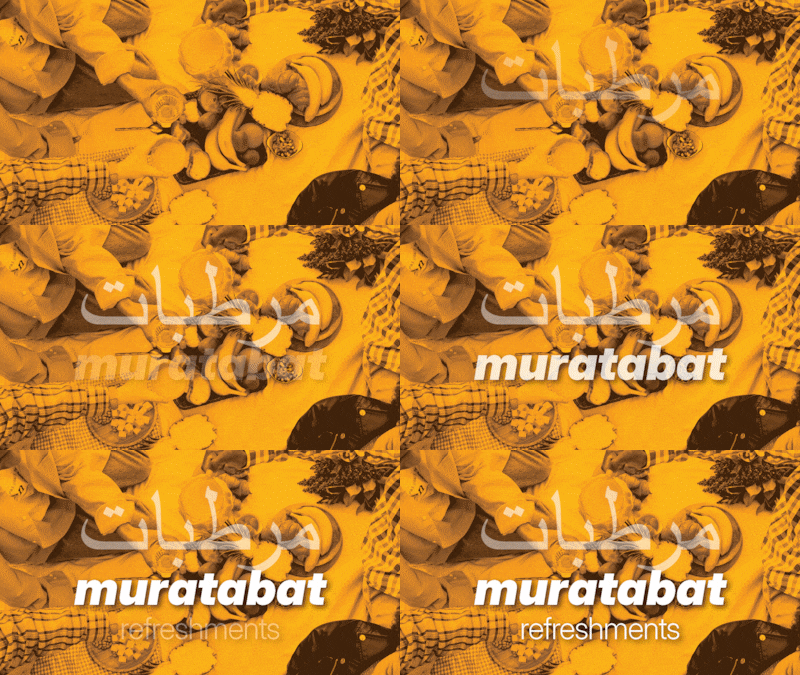
Muratabat is often translated as refreshments -

Handasa is the Arabic word for engineering -

The Arabic word for octopus is akhtaboot -

The Arabic word for mightiness is jabarut -

The Arabic word kibriyaa, often seen in Quranic verses, speaks to might and humility -

Junoon is the Arabic word for madness and obsession -

Adheem is commonly translated as great, magnificent or mighty -

Tanamor is the Arabic word for bullying -

The Arabic word for forgetfulness and oblivion is alnisyan -

Yallah, the Arabic word for 'let's go', is an expression of urgency, encouragement or even impatience -
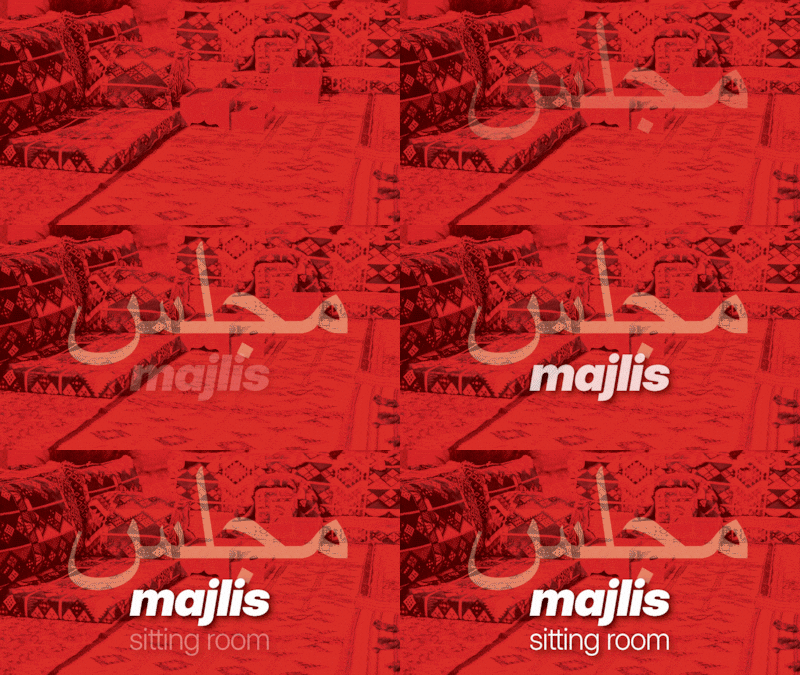
The Arabic word majlis, rooted in Bedouin tradition, refers to a space for hospitality and dialogue -

Falaj is Arabic for water channel -

Ne'meh is Arabic for blessing -

The Arabic word sumud means resilience and steadfastness -

The Arabic word for mountain is jabal -

Kibreet is Arabic for matchstick -

Sahaba means cloud in Arabic -

Qilada is the Arabic word for necklace
Living in...
This article is part of a guide on where to live in the UAE. Our reporters will profile some of the country’s most desirable districts, provide an estimate of rental prices and introduce you to some of the residents who call each area home.
The White Lotus: Season three
Creator: Mike White
Starring: Walton Goggins, Jason Isaacs, Natasha Rothwell
Rating: 4.5/5
ONCE UPON A TIME IN GAZA
Starring: Nader Abd Alhay, Majd Eid, Ramzi Maqdisi
Directors: Tarzan and Arab Nasser
Rating: 4.5/5
Tomorrow 2021
More on Quran memorisation:
More from Neighbourhood Watch:
The National Archives, Abu Dhabi
Founded over 50 years ago, the National Archives collects valuable historical material relating to the UAE, and is the oldest and richest archive relating to the Arabian Gulf.
Much of the material can be viewed on line at the Arabian Gulf Digital Archive - https://www.agda.ae/en
ESSENTIALS
The flights
Fly Etihad or Emirates from the UAE to Moscow from 2,763 return per person return including taxes.
Where to stay
Trips on the Golden Eagle Trans-Siberian cost from US$16,995 (Dh62,414) per person, based on two sharing.
The%20specs
THE BIO
Age: 33
Favourite quote: “If you’re going through hell, keep going” Winston Churchill
Favourite breed of dog: All of them. I can’t possibly pick a favourite.
Favourite place in the UAE: The Stray Dogs Centre in Umm Al Quwain. It sounds predictable, but it honestly is my favourite place to spend time. Surrounded by hundreds of dogs that love you - what could possibly be better than that?

Favourite colour: All the colours that dogs come in
Mercer, the investment consulting arm of US services company Marsh & McLennan, expects its wealth division to at least double its assets under management (AUM) in the Middle East as wealth in the region continues to grow despite economic headwinds, a company official said.
Mercer Wealth, which globally has $160 billion in AUM, plans to boost its AUM in the region to $2-$3bn in the next 2-3 years from the present $1bn, said Yasir AbuShaban, a Dubai-based principal with Mercer Wealth.
“Within the next two to three years, we are looking at reaching $2 to $3 billion as a conservative estimate and we do see an opportunity to do so,” said Mr AbuShaban.
Mercer does not directly make investments, but allocates clients’ money they have discretion to, to professional asset managers. They also provide advice to clients.

“We have buying power. We can negotiate on their (client’s) behalf with asset managers to provide them lower fees than they otherwise would have to get on their own,” he added.
Mercer Wealth’s clients include sovereign wealth funds, family offices, and insurance companies among others.
From its office in Dubai, Mercer also looks after Africa, India and Turkey, where they also see opportunity for growth.
Wealth creation in Middle East and Africa (MEA) grew 8.5 per cent to $8.1 trillion last year from $7.5tn in 2015, higher than last year’s global average of 6 per cent and the second-highest growth in a region after Asia-Pacific which grew 9.9 per cent, according to consultancy Boston Consulting Group (BCG). In the region, where wealth grew just 1.9 per cent in 2015 compared with 2014, a pickup in oil prices has helped in wealth generation.
BCG is forecasting MEA wealth will rise to $12tn by 2021, growing at an annual average of 8 per cent.
Drivers of wealth generation in the region will be split evenly between new wealth creation and growth of performance of existing assets, according to BCG.
Another general trend in the region is clients’ looking for a comprehensive approach to investing, according to Mr AbuShaban.
“Institutional investors or some of the families are seeing a slowdown in the available capital they have to invest and in that sense they are looking at optimizing the way they manage their portfolios and making sure they are not investing haphazardly and different parts of their investment are working together,” said Mr AbuShaban.
Some clients also have a higher appetite for risk, given the low interest-rate environment that does not provide enough yield for some institutional investors. These clients are keen to invest in illiquid assets, such as private equity and infrastructure.
“What we have seen is a desire for higher returns in what has been a low-return environment specifically in various fixed income or bonds,” he said.
“In this environment, we have seen a de facto increase in the risk that clients are taking in things like illiquid investments, private equity investments, infrastructure and private debt, those kind of investments were higher illiquidity results in incrementally higher returns.”
The Abu Dhabi Investment Authority, one of the largest sovereign wealth funds, said in its 2016 report that has gradually increased its exposure in direct private equity and private credit transactions, mainly in Asian markets and especially in China and India. The authority’s private equity department focused on structured equities owing to “their defensive characteristics.”
Ten tax points to be aware of in 2026
1. Domestic VAT refund amendments: request your refund within five years
If a business does not apply for the refund on time, they lose their credit.
2. E-invoicing in the UAE
Businesses should continue preparing for the implementation of e-invoicing in the UAE, with 2026 a preparation and transition period ahead of phased mandatory adoption.
3. More tax audits
Tax authorities are increasingly using data already available across multiple filings to identify audit risks.
4. More beneficial VAT and excise tax penalty regime
Tax disputes are expected to become more frequent and more structured, with clearer administrative objection and appeal processes. The UAE has adopted a new penalty regime for VAT and excise disputes, which now mirrors the penalty regime for corporate tax.
5. Greater emphasis on statutory audit
There is a greater need for the accuracy of financial statements. The International Financial Reporting Standards standards need to be strictly adhered to and, as a result, the quality of the audits will need to increase.
6. Further transfer pricing enforcement
Transfer pricing enforcement, which refers to the practice of establishing prices for internal transactions between related entities, is expected to broaden in scope. The UAE will shortly open the possibility to negotiate advance pricing agreements, or essentially rulings for transfer pricing purposes.
7. Limited time periods for audits
Recent amendments also introduce a default five-year limitation period for tax audits and assessments, subject to specific statutory exceptions. While the standard audit and assessment period is five years, this may be extended to up to 15 years in cases involving fraud or tax evasion.
8. Pillar 2 implementation
Many multinational groups will begin to feel the practical effect of the Domestic Minimum Top-Up Tax (DMTT), the UAE's implementation of the OECD’s global minimum tax under Pillar 2. While the rules apply for financial years starting on or after January 1, 2025, it is 2026 that marks the transition to an operational phase.
9. Reduced compliance obligations for imported goods and services
Businesses that apply the reverse-charge mechanism for VAT purposes in the UAE may benefit from reduced compliance obligations.
10. Substance and CbC reporting focus
Tax authorities are expected to continue strengthening the enforcement of economic substance and Country-by-Country (CbC) reporting frameworks. In the UAE, these regimes are increasingly being used as risk-assessment tools, providing tax authorities with a comprehensive view of multinational groups’ global footprints and enabling them to assess whether profits are aligned with real economic activity.
Contributed by Thomas Vanhee and Hend Rashwan, Aurifer
THURSDAY'S FIXTURES
4pm Maratha Arabians v Northern Warriors
6.15pm Deccan Gladiators v Pune Devils
8.30pm Delhi Bulls v Bangla Tigers
UPI facts
More than 2.2 million Indian tourists arrived in UAE in 2023
More than 3.5 million Indians reside in UAE
Indian tourists can make purchases in UAE using rupee accounts in India through QR-code-based UPI real-time payment systems
Indian residents in UAE can use their non-resident NRO and NRE accounts held in Indian banks linked to a UAE mobile number for UPI transactions
The Vile
Starring: Bdoor Mohammad, Jasem Alkharraz, Iman Tarik, Sarah Taibah
Director: Majid Al Ansari
Rating: 4/5
While you're here
Hussein Ibish: America's attitude to Palestine and Israel has subtly shifted
Con Coughlin: With every missile fired in Israel-Gaza, Biden's clout reduces
Anwar Mhajne: The moral burden of being a Palestinian citizen of Israel
SPEC%20SHEET%3A%20APPLE%20IPHONE%2014%20PRO%20MAX
While you're here
Nasser bin Nasser: Is US-China conflict in West Asia inevitable?
Sholto Byrnes: Time for an uninhibited China to lead Asia
Damien McElroy: BRI has changed the rules of the game
A Bad Moms Christmas
Dir: John Lucas and Scott Moore
Starring: Mila Kunis, Kathryn Hahn, Kristen Bell, Susan Sarandon, Christine Baranski, Cheryl Hines
Two stars