


In his poem Black Tulips in my Palm, the Palestinian poet and writer Mahmoud Darwish writes: “A stray hit in the sand, and another in the clouds … I think I'm angry, the beginning of fire is anger.”
While in the poem Become Angry by the Syrian poet Nizar Qabani, in which he explores anger from a different facet, he writes: “Become angry as you like, and hurt my feelings as you like.”
This week’s Arabic Word of the week, ghathab, which means anger, is a complex, nuanced emotion. Ghathab has its roots in the three Arabic letters Gha, Tha and Bah, derived from the verb ghatheeba. It means to be or become angry. Or, if pronounced differently, as yagthabu, it can indicate a continuing action of anger.
To feel ghathab one must be angry at a situation, at another person or even at themselves. It is also described as a strong feeling of irritation that occurs when a person feels that a situation is wrong or unfair.
Ghathab is also described as one of the emotions that can cause an extreme and very visible physical reaction. The western term and idea of “blood boiling” also exists in Arabic in connection to ghathab. The physical reactions of ghathab from this perspective include a change of how fast your heart pumps blood in and out to your body and a sensation in one’s chest.
There is another word derived from the same root word of ghathab: Bagath. It means someone who is tiring and is difficult to deal with. And while the two words aren’t directly related in meaning, they both describe negative feelings and an emotion that is challenging to deal with.
-
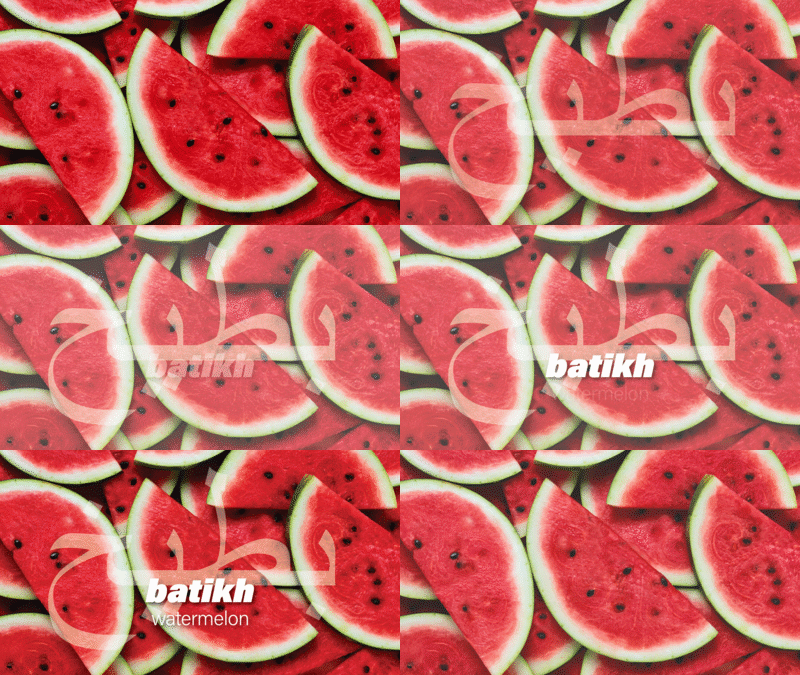
The Arabic word for watermelon, batikh, has become a symbol of Palestine. All photos: The National -

The Arabic word for union, etihad, is intrinsically connected to the UAE -

The Arabic for water, ma'a, is a universal symbol for rebirth -

The Arabic for echo, sada, is a literary device in poetry -

Aasal, the Arabic word for honey can also be used in a complimentary manner -

Jisim, the Arabic word for body extends across chemistry, medicine and aphorisms -

Jawab, the Arabic for answer resonates with knowledge -

Fikir is the Arabic word for think or to think -

The Arabic word for hissan or horse can have more than one origin -

The Arabic word shaghaf or passion refers to intense love -
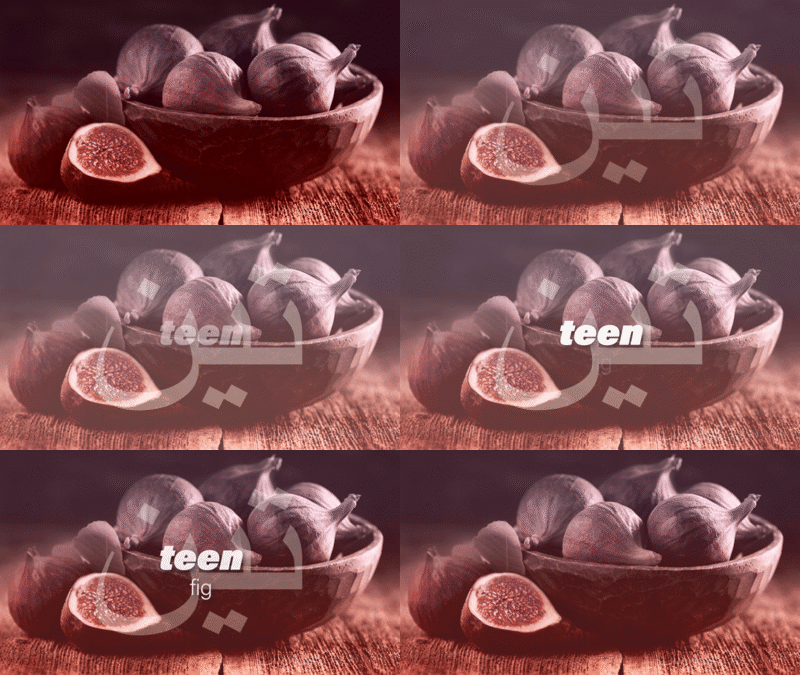
The Arabic word teen or onion doesn't have a clear Arabic source -

The Arabic word saraha means honesty -

Tamir, the Arabic word for date is a fruit that has over 400 variations -

The Arabic word for tongue, lisan, is connected to the idea of truth -

The Arabic word for olive, zaytoon, is also the word for olive tree -

The Arabic word for sign, alama, has several meanings


Ghathban describes a man who is very angry generally or is experiencing anger in that moment. Ghathbana is the feminine version of that.
While predominantly meaning anger, ghathab can also imply passion in certain contexts. However, the Arabic word shaghaf is often used for intense feelings of passion.
It’s interesting to note that in Arabic, the opposite of the word ghathab is ritha, which means to be satisfied or to be accepting of a situation. This indicates that ghathab can also have the meaning or come from the feeling of not being accepted or satisfied in a number of different contexts.
The symptoms of extreme anger can result in several symptoms such as having fast reactions, raising one’s voice, becoming physical by either damaging objects around you or getting in a physical altercation with someone.
Feeling constant ghathab or having common bursts of it can also have a lasting effect on one’s health, from headaches to blood pressure issues and even heart attacks.
Ghathab is mentioned several times in the Quran as an emotion one should attempt to control. In the third chapter, Surah Al-e-Imran in passage 133-134, emphasis is placed on letting go of anger and forgiving those who have wronged them. Once again in the 42nd chapter, Surah Al-Shurah Allah, the idea of forgiveness is highlighted and the need to restrain one's anger and not say anything, which cannot be taken back.

