


In March 1977, Jimmy Carter made an unexpected remark that continues to reverberate to this day. "There has to be a homeland provided for the Palestinian refugees who have suffered for many, many years,” Mr Carter said at a Massachusetts town hall, two months into his presidency.
The former president, who was elected in 1976, died on Sunday, his family said. He was 100.
The comment was unprecedented for a US leader and caught his staff off guard, recalls William Quandt, who was on the White House National Security Council under Mr Carter and was his primary Middle East adviser from 1977 to 1979.
“He said that without anybody prompting him,” Mr Quandt told The National. “I think it had to do with a sense that there's a kind of injustice, that there is a party to this conflict that has no voice and nobody speaks for them.”
The next day, the headline of The Washington Post read: “A 'Homeland' for Palestinians Seen as a Noteworthy Shift of Language.”
That notion would become the foundation of the two-state solution, which is a cornerstone of long-term US policy for Israel and Palestine under President Joe Biden. The Biden administration says a credible pathway to a future Palestinian state is key to ending the Israel-Gaza war, which is by far the deadliest in the conflict's 76-year history.
Soon after the October 7 Hamas-led attacks, the Carter Centre defended Israel's right to defend itself but was quick to call for a ceasefire.
Jimmy Carter's life - in pictures
-
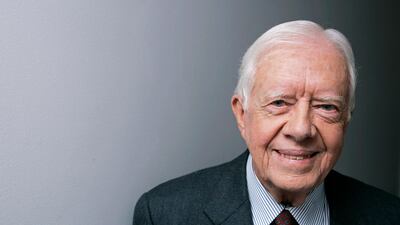
Former US president Jimmy Carter at the Toronto International Film Festival, September 10, 2007, in Toronto. AP -
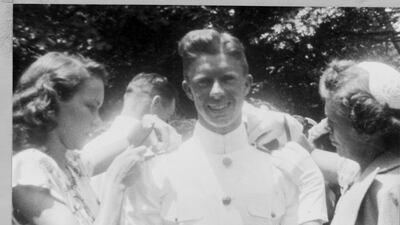
Jimmy Carter's mother, Miss Lillian, right, and his fiancée, Rosalynn Smith, left, at his graduation from the Naval Academy in Annapolis, Maryland, US, on June 5, 1946. EPA -
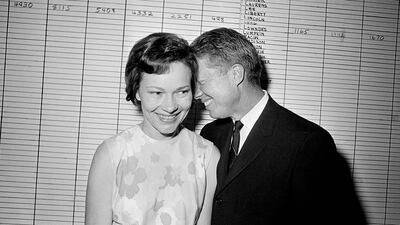
Mr Carter hugs his wife, Rosalynn, at his Atlanta campaign headquarters, September 15, 1966. AP -
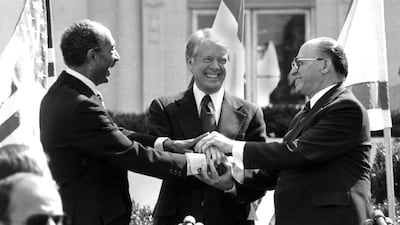
Egyptian President Anwar Sadat, left, Mr Carter, centre, and Israeli Prime Minister Menachem Begin at the White House after signing the peace treaty between Egypt and Israel, March 26, 1979, in Washington. AP -
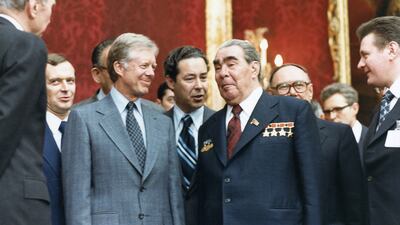
Mr Carter, left, and USSR Secretary General Leonid Brezhnev during a meeting before the signing the SALT II nuclear arms treaty in Vienna, Austria, 15 June 1979. EPA -
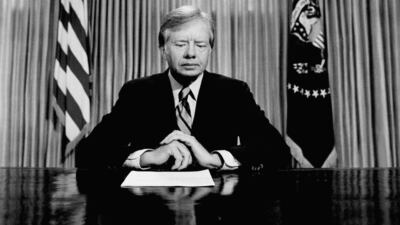
Mr Carter prepares to make a national television address from the Oval Office at the White House, April 25, 1980, in Washington. AP -
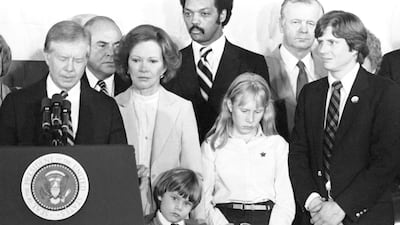
Mr Carter, with his wife Rosalynn, daughter Amy and grandson Jason tells supporters at a Washington hotel that he has conceded the election to challenger Ronald Reagan, November 4, 1980. AP -
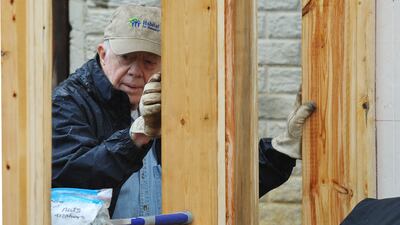
Mr Carter helps erect a frame during a Habitat for Humanity project October 4, 2010 in Washington, DC. AFP


“Israeli forces moved into Gaza and intensified their devastating attacks. Israel, like all nations, has a right to defend itself; it also has the obligation of proportionality under international law. Violence will only beget more violence,” Mr Carter's organisation said.
Mr Carter never made much headway on the Israeli-Palestinian conflict during his single term in the Oval Office. His remarks on a Palestinian homeland, however, were decades before their time.
Instead of tackling Palestinian-Israeli relations, Mr Carter chose to pursue peace between Israel and Egypt. Mr Quandt believes that decision arose during a private meeting between Mr Carter and Egypt's then-president, Anwar Sadat, at Camp David. He remembers seeing Mr Carter's eyes light up as he began to formulate a way forward.
“I think this is the moment when Carter concluded that Sadat primarily cares about getting a bilateral agreement with Israel and maintaining a close relationship with the United States, and doesn't need much else in the way of covering for the Palestinians,” Mr Quandt recounted.
Shortly after that meeting, Mr Carter invited Israel's prime minister at the time, Menachem Begin, and Mr Sadat to Camp David, where over the course of several days, he brokered peace between Israel and Egypt, in an agreement that helped shape the region for decades to come.
“The peace treaty took a crucial bargaining chip off the table for Palestinians,” said Jeremy Pressman, director of Middle East Studies at the University of Connecticut. But he believes that despite this, Mr Carter moved the discussion on Palestinians forward.
“I think Carter even as president starts to break the rhetorical ice in United States discussion,” Mr Pressman told The National.
“He's clearly publicly, and definitely privately, more open to the possibility that Palestinians are not just a humanitarian refugee crisis – there's a political-national-territorial question there as well.”
Mr Carter, a deeply religious man who had the longest post-presidential career in US history, devoted much of his retirement to conquering the Palestinian-Israeli conflict.
“I sensed it from time to time when I was with him,” said Mr Quandt. “He brought to this region a different sensitivity and that was as somebody who genuinely believed in the Bible, and the Holy Land, and the idea that he might make a contribution to peace in the Holy Land mattered to him.”
In his post-presidency years, he wrote several books on the region, including his seminal 2006 work Palestine: Peace not Apartheid, in which he criticised Israel for obstructing peace with its settlement activity in the West Bank.
Carter's legacy
- Jimmy Carter's obituary: Nobel-winning president who championed humanitarian causes
- Tributes pour in after death of former US president Jimmy Carter
- Why Jimmy Carter was the rock 'n' roll feminist president
- Jimmy Carter: The green energy pioneer
Putting the word “apartheid” in the title, a term that has become a fairly common criticism of Israel, was hugely controversial in 2006 and he remains the only US president to have come close to suggesting that the situation could be viewed through such a lens.
“In the early 2000s, when Carter brought up the possible use of the term, I think it was sort of beyond the pale of the discussion,” explained Mr Pressman.
He said it is only in the past five or 10 years that the concept of apartheid – strenuously rejected by Israel – has come to form “part of the core of the public debate about the issue”.
Through words and deeds, Mr Carter remained devoted to the Palestinian people and the broader Middle East, leaving a lasting legacy in a region he cared deeply about.

