'Enough is enough': Syrian-American doctor returns from Gaza with plea for ceasefire


Ellie Sennett
  • English
  • Arabic

Live updates: Follow the latest from Israel-Gaza

Steady hands needed for surgery were often shaken by Israeli bombs falling close by, complicating the already dire conditions at the European Hospital in Khan Younis, where Dr Mohammed Hisham Naji was volunteering.

The Syrian-American anaesthesiologist describes moments in which it was impossible to hide his anxiety as ceilings trembled under the sounds of Israeli planes.

But developing a calm bedside manner became a mutual practice between patient and doctor.

“The people of Gaza, they look at us and say, 'What's wrong? That's normal, it's OK. We get used to it.' So we got our calmness and comfort from them,” Dr Naji tells The National.

Like that of many people around the world, Dr Naji's social media feed has been flooded with images of anguish in Gaza as Israel continues its war against Hamas in the densely populated enclave.

Seeing the destruction unfold online compelled him to leave the safety of his home in the Washington suburbs for what is now one of the most dangerous places to practise medicine.

A viral video of a fellow doctor in Gaza who was forced to amputate his own daughter's leg without anaesthesia served as the final push.

“I said to myself, I'm an anaesthesiologist. My job is to help people, and I'm going to take the risk and go.”

Dr Naji has volunteered his medical services in dangerous corners of the world before. An active member of the Syrian-American Medical Society, he travelled to Turkey following last year's earthquake, went on several tours of northern Syria amid the continuing civil war, and lent his services to refugee camps in Jordan and Lebanon.

But none of this, Dr Naji stresses, compared to the horror he witnessed during his two weeks in Gaza. He entered the territory at the Rafah border crossing with Egypt.

While he considers himself to be a “shy man”, his experience in Gaza mandates a decidedly loud return to the US.

“The world needs to say enough is enough. We need to have complete ceasefire and rebuild the life of those people,” he says.

“This is not a war between two armies. This is a campaign of bombing and killing by the most powerful army in the world.”

Israel's military campaign, which began after the October 7 Hamas attack, has killed almost 30,000 Palestinians, according to local health authorities.

But Dr Naji, a rare outside witness to the situation in the increasingly isolated enclave, believes that toll to be much higher, as “so many people are buried deep in the ground under the rubble”.

As a physician, however, he stresses that “the most important ones are the ones who didn't die”.

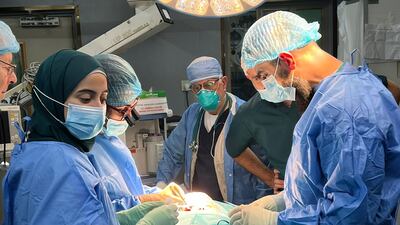
  • Dr Naji served as an anesthesiologist in the operating room. All photos: Dr Mohammed Hisham Naji
    Dr Naji served as an anesthesiologist in the operating room. All photos: Dr Mohammed Hisham Naji
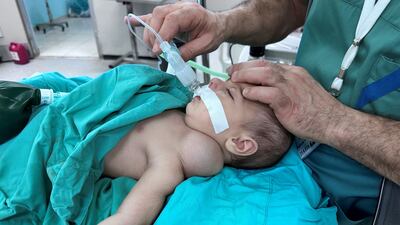
  • An infant in Gaza undergoes anesthesia for treatment on a tumor in Gaza.
    An infant in Gaza undergoes anesthesia for treatment on a tumor in Gaza.
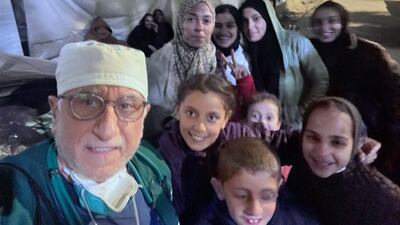
  • Dr Naji takes a selfie with young people in tents in Gaza.
    Dr Naji takes a selfie with young people in tents in Gaza.
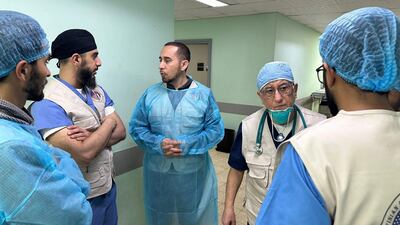
  • Dr Naji with fellow medical staff at the European hospital.
    Dr Naji with fellow medical staff at the European hospital.
  • A Palestinian child with severe burns under treatment in Khan Younis.
    A Palestinian child with severe burns under treatment in Khan Younis.
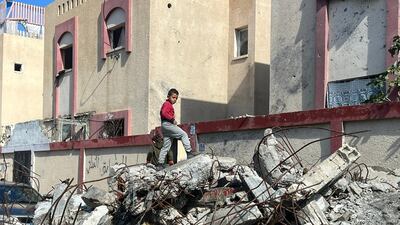
  • A child stands on top of rubble in Gaza.
    A child stands on top of rubble in Gaza.
  • Dr Naji poses with children in Gaza
    Dr Naji poses with children in Gaza
  • Dr Naji in Gaza.
    Dr Naji in Gaza.
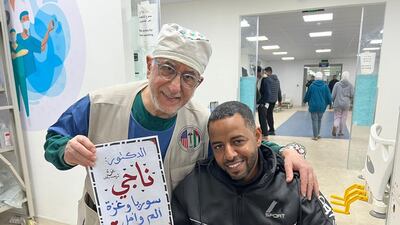
  • A patient sends Dr Naji off with a farewell thank you card.
    A patient sends Dr Naji off with a farewell thank you card.
  • Medical staff in the European Hospital in Khan Younis pose with Dr Naji before he departs back for America.
    Medical staff in the European Hospital in Khan Younis pose with Dr Naji before he departs back for America.
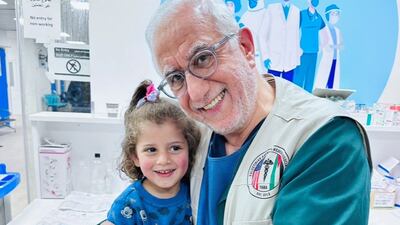
  • Dr Naji poses with a child inside the European Hospital in Khan Younis, Gaza.
    Dr Naji poses with a child inside the European Hospital in Khan Younis, Gaza.
  • Amid near-constant Israeli bombardment, death, and destruction: The patients of the European Hospital Khan Younis threw a party for Dr Naji on his last day in the hospital.
    Amid near-constant Israeli bombardment, death, and destruction: The patients of the European Hospital Khan Younis threw a party for Dr Naji on his last day in the hospital.
  • Dr Naji's family welcomes him back from Gaza after landing at the Dulles International Airport in Virginia.
    Dr Naji's family welcomes him back from Gaza after landing at the Dulles International Airport in Virginia.

“They live with amputated leg, amputated arms, severe deformities, burns – we've seen kids that their body is burnt from top to toes,” he says.

“Those people have no medical facility to take care of them, no physical therapy, no rehabilitation.

“Who's going to take care of them?”

He becomes emotional as he describes treating one patient, who, along with her son, had been severely injured.

The mother's arm had to be amputated after it “shattered into pieces”, while her teenage son arrived with zero blood pressure and several injuries to his abdomen.

“We give him blood, we gave him plasma, all that we can, for about 45 minutes – we thought he was going to live,” he says, choking up.

“But he didn't make it. He died that night. And then his mother, when she woke up from the anaesthesia, she lost her arm. But the first thing she asked was, 'My son, how's my son?'”

Dr Naji recalls the words of a Palestinian anaesthesiologist, among those continuing to work amid the raging siege, that “he will never forget”.

“We know we're going to be killed, but we don't know when,” the Gazan doctor said.

“We are here like somebody who was sentenced to death in a prison.”

Patients moved from besieged Nasser Hospital in Gaza – video

But the doctor told Dr Naji: “We're not afraid.”

Hope and despair, acceptance and anxiety, loss and life – all are in a constant state of collision in Gaza. The through line, however, is resilience.

“What we learnt there, actually, from the people of Gaza is their resilience that is unbelievable, especially the young ones,” Dr Naji says.

“There will be frequent bombing and they will continue to talk with each other and laugh and play and walk around.”

There are moments of joy and celebration, with the locals even throwing Dr Naji a going-away party on his last night in Gaza.

The Syrian-American doctor returned home to his anxious family two weeks ago, though the experience has left him “feeling like I am still living there”.

“The impression that it gets inside you, it's hard to erase it. I think that feeling will slowly get less but I think this is the most impressive trip that I've ever made in my life.”

He has a call for fellow doctors, too.

“I would tell all physicians who can hear me: don't hesitate to go,” he says.

“We all believe, whether Muslim or Christians, your day, when it comes it comes, regardless of whether you're in your own bed or under bombing.”

Now at home, Dr Naji is grappling with his own form of survivor's guilt.

“Actually the worst feeling in my heart is when I was leaving and saying goodbye … They look at your face and they say, 'Wow, you're able to leave, we cannot leave. We're here waiting for our destiny,'” he says.

“And I wish I could stay longer. And I would not even hesitate to go back again.”

THE BIO: Martin Van Almsick

Hometown: Cologne, Germany

Family: Wife Hanan Ahmed and their three children, Marrah (23), Tibijan (19), Amon (13)

Favourite dessert: Umm Ali with dark camel milk chocolate flakes

Favourite hobby: Football

Breakfast routine: a tall glass of camel milk

Fifa%20World%20Cup%20Qatar%202022%20
%3Cp%3E%3Cstrong%3EFirst%20match%3A%20%3C%2Fstrong%3ENovember%2020%0D%3Cbr%3E%3Cstrong%3EFinal%2016%20round%3A%20%3C%2Fstrong%3EDecember%203%20to%206%0D%3Cbr%3E%3Cstrong%3EQuarter-finals%3A%20%3C%2Fstrong%3EDecember%209%20and%2010%0D%3Cbr%3E%3Cstrong%3ESemi-finals%3A%20%3C%2Fstrong%3EDecember%2013%20and%2014%0D%3Cbr%3E%3Cstrong%3EFinal%3A%20%3C%2Fstrong%3EDecember%2018%3C%2Fp%3E%0A
UPI facts

More than 2.2 million Indian tourists arrived in UAE in 2023
More than 3.5 million Indians reside in UAE
Indian tourists can make purchases in UAE using rupee accounts in India through QR-code-based UPI real-time payment systems
Indian residents in UAE can use their non-resident NRO and NRE accounts held in Indian banks linked to a UAE mobile number for UPI transactions

Ten tax points to be aware of in 2026

1. Domestic VAT refund amendments: request your refund within five years

If a business does not apply for the refund on time, they lose their credit.

2. E-invoicing in the UAE

Businesses should continue preparing for the implementation of e-invoicing in the UAE, with 2026 a preparation and transition period ahead of phased mandatory adoption. 

3. More tax audits

Tax authorities are increasingly using data already available across multiple filings to identify audit risks. 

4. More beneficial VAT and excise tax penalty regime

Tax disputes are expected to become more frequent and more structured, with clearer administrative objection and appeal processes. The UAE has adopted a new penalty regime for VAT and excise disputes, which now mirrors the penalty regime for corporate tax.

5. Greater emphasis on statutory audit

There is a greater need for the accuracy of financial statements. The International Financial Reporting Standards standards need to be strictly adhered to and, as a result, the quality of the audits will need to increase.

6. Further transfer pricing enforcement

Transfer pricing enforcement, which refers to the practice of establishing prices for internal transactions between related entities, is expected to broaden in scope. The UAE will shortly open the possibility to negotiate advance pricing agreements, or essentially rulings for transfer pricing purposes. 

7. Limited time periods for audits

Recent amendments also introduce a default five-year limitation period for tax audits and assessments, subject to specific statutory exceptions. While the standard audit and assessment period is five years, this may be extended to up to 15 years in cases involving fraud or tax evasion. 

8. Pillar 2 implementation 

Many multinational groups will begin to feel the practical effect of the Domestic Minimum Top-Up Tax (DMTT), the UAE's implementation of the OECD’s global minimum tax under Pillar 2. While the rules apply for financial years starting on or after January 1, 2025, it is 2026 that marks the transition to an operational phase.

9. Reduced compliance obligations for imported goods and services

Businesses that apply the reverse-charge mechanism for VAT purposes in the UAE may benefit from reduced compliance obligations. 

10. Substance and CbC reporting focus

Tax authorities are expected to continue strengthening the enforcement of economic substance and Country-by-Country (CbC) reporting frameworks. In the UAE, these regimes are increasingly being used as risk-assessment tools, providing tax authorities with a comprehensive view of multinational groups’ global footprints and enabling them to assess whether profits are aligned with real economic activity. 

Contributed by Thomas Vanhee and Hend Rashwan, Aurifer

WOMAN AND CHILD

Director: Saeed Roustaee

Starring: Parinaz Izadyar, Payman Maadi

Rating: 4/5

THE%20STRANGERS'%20CASE
%3Cp%3E%3Cstrong%3EDirector%3C%2Fstrong%3E%3A%20Brandt%20Andersen%3Cbr%3E%3Cstrong%3EStarring%3A%20%3C%2Fstrong%3EOmar%20Sy%2C%20Jason%20Beghe%2C%20Angeliki%20Papoulia%3Cbr%3E%3Cstrong%3ERating%3A%3C%2Fstrong%3E%204%2F5%3C%2Fp%3E%0A
Company Profile

Name: Thndr
Started: 2019
Co-founders: Ahmad Hammouda and Seif Amr
Sector: FinTech
Headquarters: Egypt
UAE base: Hub71, Abu Dhabi
Current number of staff: More than 150
Funds raised: $22 million

Civil%20War
%3Cp%3E%3Cstrong%3EDirector%3A%3C%2Fstrong%3E%20Alex%20Garland%C2%A0%3C%2Fp%3E%0A%3Cp%3E%3Cstrong%3EStarring%3A%3C%2Fstrong%3E%20Kirsten%20Dunst%2C%20Cailee%20Spaeny%2C%20Wagner%20Moura%2C%20Nick%20Offerman%3C%2Fp%3E%0A%3Cp%3E%3Cstrong%3ERating%3A%3C%2Fstrong%3E%204%2F5%3C%2Fp%3E%0A
What is graphene?

Graphene is a single layer of carbon atoms arranged like honeycomb.

It was discovered in 2004, when Russian-born Manchester scientists Andrei Geim and Kostya Novoselov were "playing about" with sticky tape and graphite - the material used as "lead" in pencils.

Placing the tape on the graphite and peeling it, they managed to rip off thin flakes of carbon. In the beginning they got flakes consisting of many layers of graphene. But as they repeated the process many times, the flakes got thinner.

By separating the graphite fragments repeatedly, they managed to create flakes that were just one atom thick. Their experiment had led to graphene being isolated for the very first time.

At the time, many believed it was impossible for such thin crystalline materials to be stable. But examined under a microscope, the material remained stable, and when tested was found to have incredible properties.

It is many times times stronger than steel, yet incredibly lightweight and flexible. It is electrically and thermally conductive but also transparent. The world's first 2D material, it is one million times thinner than the diameter of a single human hair.

But the 'sticky tape' method would not work on an industrial scale. Since then, scientists have been working on manufacturing graphene, to make use of its incredible properties.

In 2010, Geim and Novoselov were awarded the Nobel Prize for Physics. Their discovery meant physicists could study a new class of two-dimensional materials with unique properties. 


MATCH INFO:

Second Test

Pakistan v Australia, Tuesday-Saturday, 10am​​ daily​​​​​ at Zayed Cricket Stadium, Abu Dhabi

Entrance is free

COMPANY%20PROFILE
%3Cp%3ECompany%20name%3A%20Znap%3C%2Fp%3E%0A%3Cp%3EStarted%3A%202017%3C%2Fp%3E%0A%3Cp%3EFounder%3A%20Uday%20Rathod%3C%2Fp%3E%0A%3Cp%3EBased%3A%20Dubai%2C%20UAE%3C%2Fp%3E%0A%3Cp%3EIndustry%3A%20FinTech%3C%2Fp%3E%0A%3Cp%3EFunding%20size%3A%20%241m%2B%3C%2Fp%3E%0A%3Cp%3EInvestors%3A%20Family%2C%20friends%3C%2Fp%3E%0A
The Sand Castle

Director: Matty Brown

Stars: Nadine Labaki, Ziad Bakri, Zain Al Rafeea, Riman Al Rafeea

Rating: 2.5/5

TECH%20SPECS%3A%20APPLE%20WATCH%20SERIES%208
%3Cp%3E%3Cstrong%3EDisplay%3A%3C%2Fstrong%3E%2041mm%2C%20352%20x%20430%3B%2045mm%2C%20396%20x%20484%3B%20Retina%20LTPO%20OLED%2C%20up%20to%201000%20nits%2C%20always-on%3B%20Ion-X%20glass%3C%2Fp%3E%0A%3Cp%3E%3Cstrong%3EProcessor%3A%3C%2Fstrong%3E%20Apple%20S8%2C%20W3%20wireless%2C%20U1%20ultra-wideband%3C%2Fp%3E%0A%3Cp%3E%3Cstrong%3ECapacity%3A%3C%2Fstrong%3E%2032GB%3C%2Fp%3E%0A%3Cp%3E%3Cstrong%3EMemory%3A%3C%2Fstrong%3E%201GB%3C%2Fp%3E%0A%3Cp%3E%3Cstrong%3EPlatform%3A%3C%2Fstrong%3E%20watchOS%209%3C%2Fp%3E%0A%3Cp%3E%3Cstrong%3EHealth%20metrics%3A%3C%2Fstrong%3E%203rd-gen%20heart%20rate%20sensor%2C%20temperature%20sensing%2C%20ECG%2C%20blood%20oxygen%2C%20workouts%2C%20fall%2Fcrash%20detection%3B%20emergency%20SOS%2C%20international%20emergency%20calling%3C%2Fp%3E%0A%3Cp%3E%3Cstrong%3EConnectivity%3A%3C%2Fstrong%3E%20GPS%2FGPS%20%2B%20cellular%3B%20Wi-Fi%2C%20LTE%2C%20Bluetooth%205.3%2C%20NFC%20(Apple%20Pay)%3C%2Fp%3E%0A%3Cp%3E%3Cstrong%3EDurability%3A%3C%2Fstrong%3E%20IP6X%2C%20water%20resistant%20up%20to%2050m%2C%20dust%20resistant%3C%2Fp%3E%0A%3Cp%3E%3Cstrong%3EBattery%3A%3C%2Fstrong%3E%20308mAh%20Li-ion%2C%20up%20to%2018h%2C%20wireless%20charging%3C%2Fp%3E%0A%3Cp%3E%3Cstrong%3ECards%3A%3C%2Fstrong%3E%20eSIM%3C%2Fp%3E%0A%3Cp%3E%3Cstrong%3EFinishes%3A%3C%2Fstrong%3E%20Aluminium%20%E2%80%93%20midnight%2C%20Product%20Red%2C%20silver%2C%20starlight%3B%20stainless%20steel%20%E2%80%93%20gold%2C%20graphite%2C%20silver%3C%2Fp%3E%0A%3Cp%3E%3Cstrong%3EIn%20the%20box%3A%3C%2Fstrong%3E%20Watch%20Series%208%2C%20magnetic-to-USB-C%20charging%20cable%2C%20band%2Floop%3C%2Fp%3E%0A%3Cp%3E%3Cstrong%3EPrice%3A%3C%2Fstrong%3E%20Starts%20at%20Dh1%2C599%20(41mm)%20%2F%20Dh1%2C999%20(45mm)%3C%2Fp%3E%0A
The Orwell Prize for Political Writing

Twelve books were longlisted for The Orwell Prize for Political Writing. The non-fiction works cover various themes from education, gender bias, and the environment to surveillance and political power. Some of the books that made it to the non-fiction longlist include: 

  • Appeasing Hitler: Chamberlain, Churchill and the Road to War by Tim Bouverie
  • Some Kids I Taught and What They Taught Me by Kate Clanchy
  • Invisible Women: Exposing Data Bias in a World Designed for Men by Caroline Criado Perez
  • Follow Me, Akhi: The Online World of British Muslims by Hussein Kesvani
  • Guest House for Young Widows: Among the Women of ISIS by Azadeh Moaveni
Updated: February 26, 2024, 3:27 AM