
US President Joe Biden and Indian Prime Minister Narendra Modi on Friday met top American and Indian executives, as the leaders look to increase co-operation on artificial intelligence, semiconductor production and space.
The leaders are putting a spotlight on the “Innovation Handshake” – a new initiative aimed at addressing regulatory hurdles that stand in the way of co-operation between the two countries and promoting job growth in emerging technologies.
“Our countries are taking innovation and co-operation to new levels,” Mr Biden told meeting attendees, which included Apple chief Tim Cook, Google's top executive Sundar Pichai and Microsoft head Satya Nadella.
“We’re going to see more technological change … in the next 10 years than we’ve seen in the last 50 years,” he added, echoing sentiments expressed during a meeting with industry experts in San Francisco this week.
“We need your help, and I’m talking to CEOs around this table, Indian and American, we need your help to seize the moment, to help manage the risks to our societies, our economies, and to our nation’s national security.
“Innovation and collaboration are rarely without obstacles, and so you raise our ambitions and I want you to let us know what stands in the way of our ambitions.”
White House officials say India's deep talent pool will be crucial in building stronger supply chains and developing technology to address climate change.
-

Indian Prime Minister Narendra Modi speaks at a lunch held in his honor hosted by US Vice President Kamala Harris and Secretary of State Antony Blinken at the State Department. Reuters -
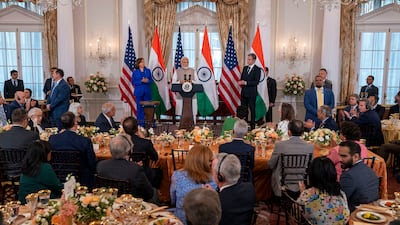
In a toast, Ms. Harris spoke of her Indian-born late mother, Shyamala Gopalan, who came to the United States at age 19 and became a leading breast cancer researcher. AP Photo -
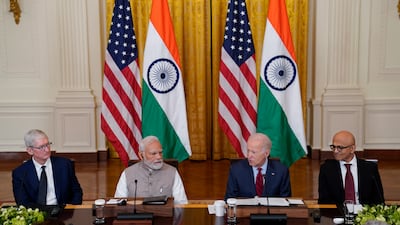
US President Joe Biden speaks during a meeting with Mr. Modi and American and Indian business leaders in the East Room of the White House. From left, Tim Cook, CEO of Apple, Mr. Modi, Mr. Biden, and Satya Nadella, CEO of Microsoft. AP Photo -
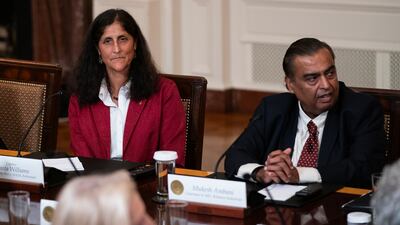
Sunita Williams, NASA astronaut, left, listens as Mukesh Ambani, Chairman and Managing Director of Reliance Industries, right, speaks during the meeting. AP Photo -
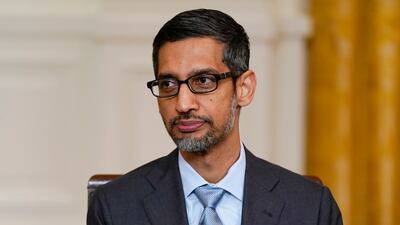
Sundar Pichai, CEO of Google, is also present. AP Photo -

President Joe Biden talks with India's Prime Minister Narendra Modi at a state dinner at the White House in Washington. AP -

Doug Emhoff, US second gentleman, third left, attends the official state dinner. AFP -
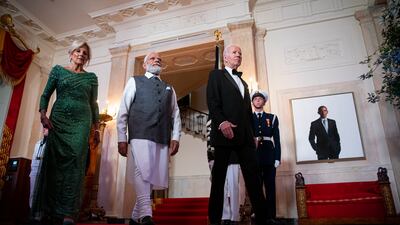
Mr Biden, Mr Modi and first lady Jill Biden at the Grand Staircase of the White House. EPA -
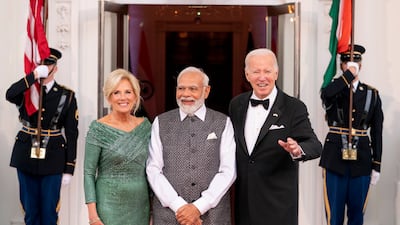
The Bidens and Mr Modi arrive for a state dinner. AP -
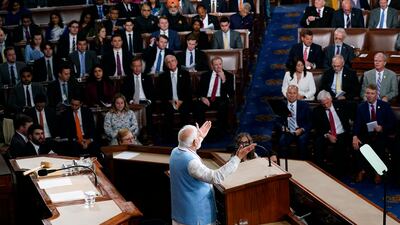
Mr Modi addresses a joint session of the US Congress. AP -
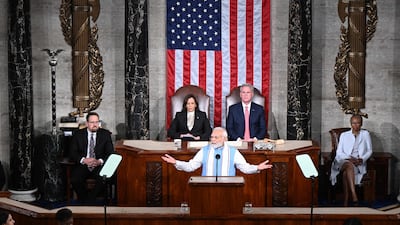
Mr Modi speaks to the Congress. AFP -
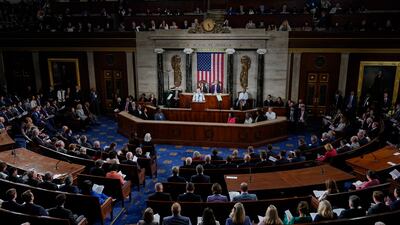
Mr Modi speaks to a joint session of the US Congress. AP -
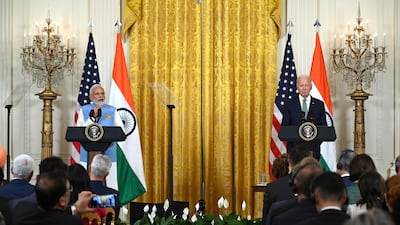
Mr Biden and Mr Modi speak during a joint press conferences in the East Room of the White House in Washington. AFP -
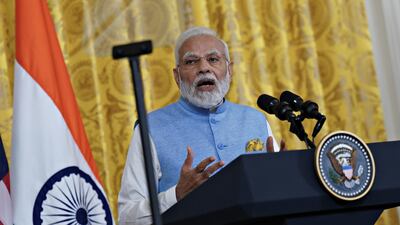
Mr Modi and Mr Biden are expected to announce a series of defence and commercial deals designed to improve military and economic ties. Bloomberg -
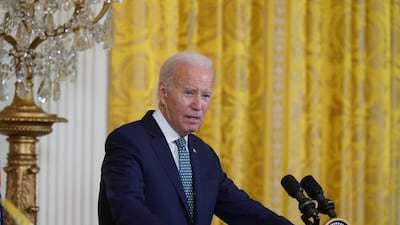
Mr Biden speaks at the news conference at the White House. Bloomberg -

Mr Biden and Mr Modi speak in the Oval Office of the White House. EPA -
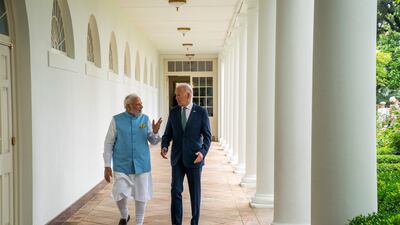
Mr Biden walks with Mr Modi at the White House during the Indian Prime Minister's official visit to Washington. Reuters -

Mr Modi is welcomed to the White House. EPA -
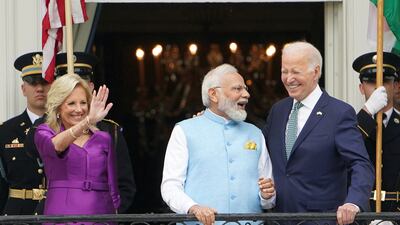
Mr Biden, first lady Jill Biden and Mr Modi attend an official state arrival ceremony at the White House. Reuters -
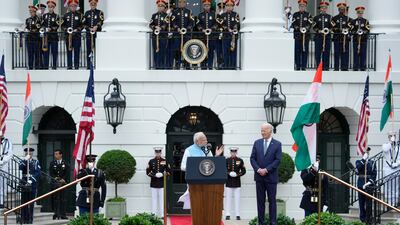
Mr Modi speaks from the South Lawn. He is in the US on a four-day state visit. AP -

Mr Modi and Mr Biden watch a performance by the US Army Old Guard Fife and Drum Corps. AP -
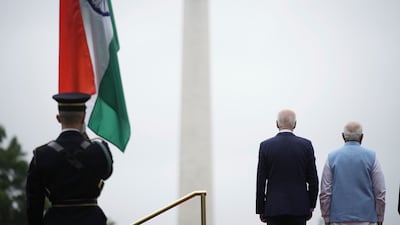
Mr Modi has said ties between the countries are 'one of the defining relationships of the 21st century'. AP -

Mr Biden greets Mr Modi in Washington. AP -
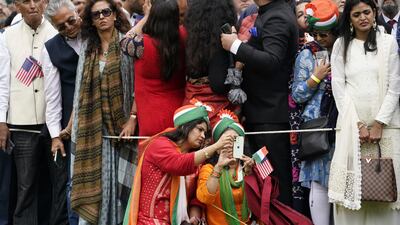
Indian Americans gather for the visit. AP -
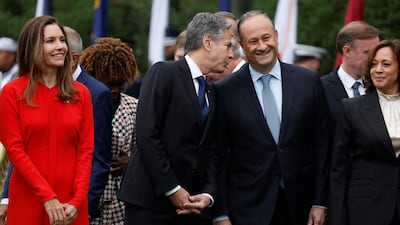
US Vice President Kamala Harris, right, and US Secretary of State Antony Blinken, second left, were among the senior officials at the event. Reuters -
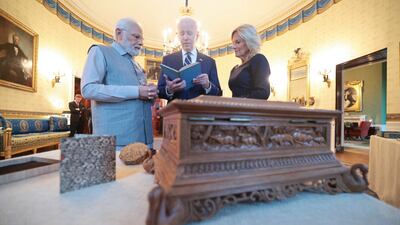
Mr Biden and Mr Modi exchange gifts at the White House. Reuters -
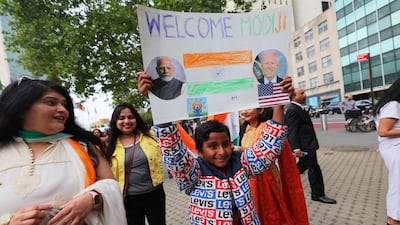
A child raises a homemade poster in front of the UN headquarters in New York to welcome Mr Modi. AFP -
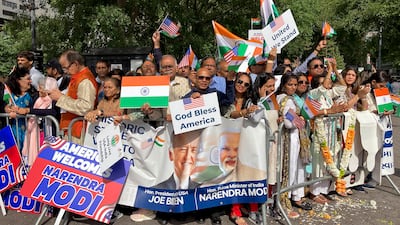
People gather near UN headquarters to welcome Mr Modi. AP -
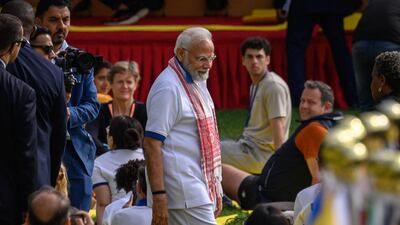
Mr Modi attends a yoga event on the International Day of Yoga, hosted at the UN. AFP -
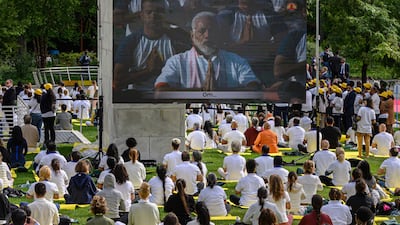
Mr Modi, seen on screen, leads a yoga session. AFP -
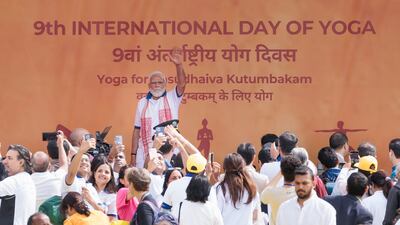
Mr Modi waves to the crowd after participating in a yoga class. EPA -

Mr Modi gestures to participants as he arrives at the ninth International Day of Yoga event. Reuters -
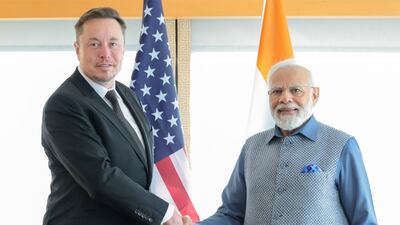
Mr Modi shakes hand with Tesla chief executive Elon Musk during their meeting in New York. Reuters -

Mr Modi greets supporters as he arrives in New York. AP -
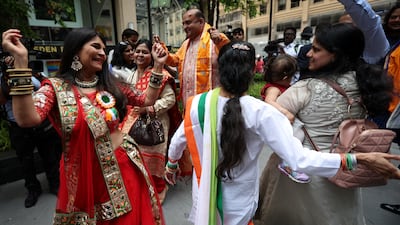
Supporters dance ahead of the arrival of Mr Modi in New York. Reuters -
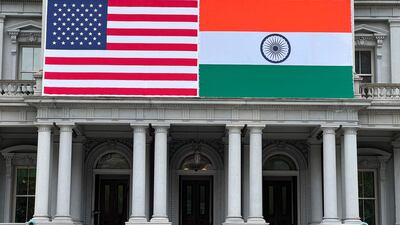
The flags of India and the US adorn the Eisenhower Executive Office Building in Washington. AP


This comes as the administration seeks to put the US-India relationship on a higher plane in the face of an ascendant China in the Indo-Pacific.
The Biden administration is increasingly courting India as a key ballast against China, particularly amid Covid-19-related supply chain disruptions, intellectual property theft and concerns that Beijing may push forward with efforts to reunify with tech and semiconductor hub Taiwan.
New Delhi is also eager to become a key partner on critical technologies, with Mr Modi announcing this week he was working to remove regulatory constraints, particularly for tech companies, in a bid to make it easier for US firms to invest there.
Mr Modi commended Mr Biden for seeing “the possibility that India represents”.
“This is definitely a guarantee for a bright future,” Mr Modi said.
Artificial intelligence
The discussion also touched on concerns over the use of AI, as the Biden administration is preparing regulatory safeguards related to the emerging technology.
Generative AI tools have come under increased scrutiny as their popular use has exploded in recent months following the debut of OpenAI’s ChatGPT. OpenAI chief executive Sam Altman was among the participants at the meeting.
“We need your help to build guardrails around emerging technologies so they’re trustworthy, they’re secure and uphold our shared values and human rights,” said Mr Biden.
India's Narendra Modi arrives at the White House for official visit – video
The Federal Trade Commission says it’s also monitoring the use of AI tools, and the White House has backed efforts on Capitol Hill to introduce legislation directly governing the technology.
New investment deals
As part of Mr Modi's state's visit – the first by an Indian leader since 2009 – the two leaders announced several major investments by US-based companies in India.
Micron Technology has agreed to build a $2.75 billion semiconductor assembly and test facility in India, with the company spending about $800 million and India financing the rest.
US-based Applied Materials will launch a new semiconductor centre for commercialisation and innovation in India, and Lam Research, another semiconductor manufacturing equipment company, will start a training programme for 60,000 Indian engineers.
And as to space, India signed on to the Artemis Accords, a blueprint for space exploration co-operation among nations participating in Nasa’s lunar exploration plans. Nasa and the Indian Space Research Organisation also agreed to make a joint mission to the International Space Station next year.
Earlier this year, the two countries launched the Initiative on Critical and Emerging Technologies, which sets the path for collaboration on semiconductor production, developing AI and a loosening of export control rules.
The initiative was critical in sealing a deal, announced on Thursday, that will allow US-based General Electric to join up with India's Hindustan Aeronautics to produce jet engines in India.

