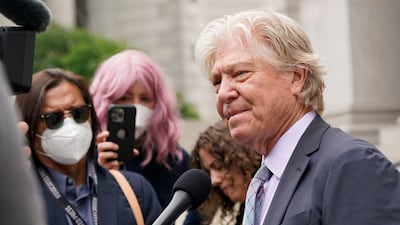
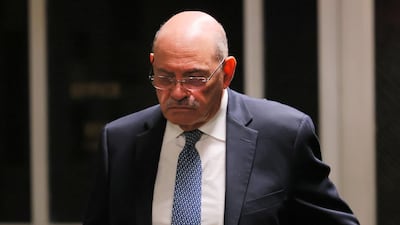
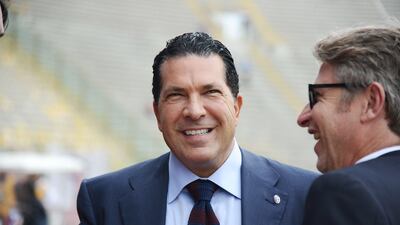
Former US President Donald Trump with his defence team during his arraignment at the court in New York. AFP

What has Donald Trump been charged with?


  • English
  • Arabic

Read the latest news on Donald Trump's arraignment

Former US president Donald Trump on Tuesday was charged with 34 felony counts for falsifying business records in New York, making him the first president to face criminal charges.

The National takes a look at what they are:

What was Trump charged with?

The indictment, unsealed after his court appearance along with a statement of facts, alleges that Mr Trump and others breached election laws through a scheme to suppress the publication of negative information about him ahead of the 2016 US election.

It contains details about payoffs to three people, with the help of Mr Trump's former lawyer Michael Cohen, who conducted the payoffs; and American Media, the publisher of the National Enquirer, which co-ordinated "catch and kill" operations.

They were adult film star Stormy Daniels and former Playboy model Karen McDougal, who said they had extramarital sexual encounters with him years earlier.

The third was a Trump Tower doorman who claimed to have a story about a child he alleged the former president had out of of wedlock.

Mr Trump denies having encounters with either woman and has denied any wrongdoing involving payments.

How were the payments falsifying business records?

Manhattan District Court Attorney Alvin Bragg said the way reimbursements for Cohen were itemised in business records, and how payments were made through another company, in this case American Media, led to illegal falsehoods.

"To make these payments, they set up shell companies and they made yet more false statements," Mr Bragg said after the arraignment.

Why was it illegal to reimburse Cohen?

Cohen, who served prison time for campaign finance offences, had a part in paying Ms Daniels $130,000 on behalf of Mr Trump.

Mr Trump's reimbursement cheques to Cohen for the suppression payments falsely stated that the money was for a "retainer agreement", prosecutors said.

Why was it illegal to pay people like Stormy Daniels?

Mr Bragg says the payment breaks a New York state law that prohibits benefiting a campaign through illegal efforts.

"Less than two weeks before the presidential election, Mr Cohen wired $130,000 to Stormy Daniels' lawyer," he said.

"That payment was to hide damaging information from the voting public. The participants scheme was illegal.

"The scheme violated New York election law, which makes it a crime to conspire to promote a candidacy by unlawful means."

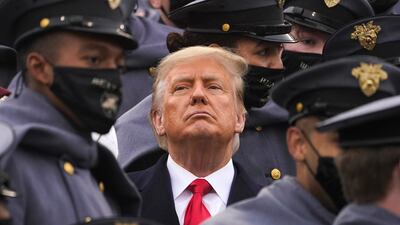
  • Donald Trump. AP
    Donald Trump. AP
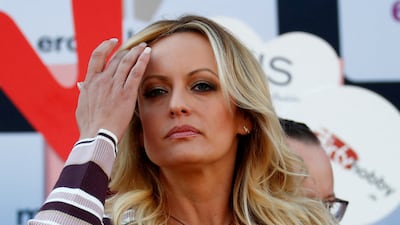
  • Adult film actress Stormy Daniels. Reuters
    Adult film actress Stormy Daniels. Reuters
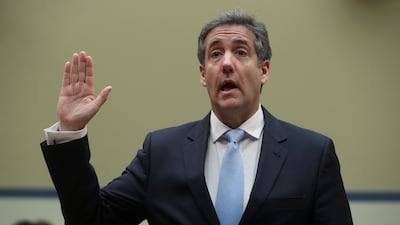
  • Michael Cohen. Reuters
    Michael Cohen. Reuters
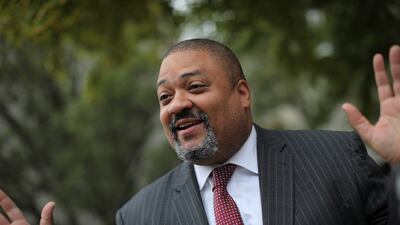
  • Alvin Bragg. Reuters
    Alvin Bragg. Reuters
  • Clark Brewster. AP
    Clark Brewster. AP
  • David Pecker. AP
    David Pecker. AP
  • Karen McDougal. Getty
    Karen McDougal. Getty
  • Allen Weisselberg. AFP
    Allen Weisselberg. AFP
  • Joe Tacopina. Getty
    Joe Tacopina. Getty
  • Judge Juan Merchan. Reuters
    Judge Juan Merchan. Reuters

How directly was Trump involved?

Mr Bragg said there was evidence that Mr Trump was part of the scheme despite claims he did not take part in any wrongdoing.

In one instance, the court's statement of facts claims Mr Trump "asked, 'So what do we got to pay for this? One fifty?'" in order to suppress a story by a woman with their American Media partner.

The court also alleges Mr Trump was constantly in communication with American Media about their "catch and kill" efforts.

The statement of facts says Mr Trump "met with the AMI CEO privately in Trump Tower in Manhattan".

"The defendant thanked the AMI CEO for handling the stories of the doorman and woman 1, and invited the AMI CEO to the inauguration".

Agencies contributed to this report

Mercer, the investment consulting arm of US services company Marsh & McLennan, expects its wealth division to at least double its assets under management (AUM) in the Middle East as wealth in the region continues to grow despite economic headwinds, a company official said.

Mercer Wealth, which globally has $160 billion in AUM, plans to boost its AUM in the region to $2-$3bn in the next 2-3 years from the present $1bn, said Yasir AbuShaban, a Dubai-based principal with Mercer Wealth.

Within the next two to three years, we are looking at reaching $2 to $3 billion as a conservative estimate and we do see an opportunity to do so,” said Mr AbuShaban.

Mercer does not directly make investments, but allocates clients’ money they have discretion to, to professional asset managers. They also provide advice to clients.

“We have buying power. We can negotiate on their (client’s) behalf with asset managers to provide them lower fees than they otherwise would have to get on their own,” he added.

Mercer Wealth’s clients include sovereign wealth funds, family offices, and insurance companies among others.

From its office in Dubai, Mercer also looks after Africa, India and Turkey, where they also see opportunity for growth.

Wealth creation in Middle East and Africa (MEA) grew 8.5 per cent to $8.1 trillion last year from $7.5tn in 2015, higher than last year’s global average of 6 per cent and the second-highest growth in a region after Asia-Pacific which grew 9.9 per cent, according to consultancy Boston Consulting Group (BCG). In the region, where wealth grew just 1.9 per cent in 2015 compared with 2014, a pickup in oil prices has helped in wealth generation.

BCG is forecasting MEA wealth will rise to $12tn by 2021, growing at an annual average of 8 per cent.

Drivers of wealth generation in the region will be split evenly between new wealth creation and growth of performance of existing assets, according to BCG.

Another general trend in the region is clients’ looking for a comprehensive approach to investing, according to Mr AbuShaban.

“Institutional investors or some of the families are seeing a slowdown in the available capital they have to invest and in that sense they are looking at optimizing the way they manage their portfolios and making sure they are not investing haphazardly and different parts of their investment are working together,” said Mr AbuShaban.

Some clients also have a higher appetite for risk, given the low interest-rate environment that does not provide enough yield for some institutional investors. These clients are keen to invest in illiquid assets, such as private equity and infrastructure.

“What we have seen is a desire for higher returns in what has been a low-return environment specifically in various fixed income or bonds,” he said.

“In this environment, we have seen a de facto increase in the risk that clients are taking in things like illiquid investments, private equity investments, infrastructure and private debt, those kind of investments were higher illiquidity results in incrementally higher returns.”

The Abu Dhabi Investment Authority, one of the largest sovereign wealth funds, said in its 2016 report that has gradually increased its exposure in direct private equity and private credit transactions, mainly in Asian markets and especially in China and India. The authority’s private equity department focused on structured equities owing to “their defensive characteristics.”

Frankenstein in Baghdad
Ahmed Saadawi
​​​​​​​Penguin Press

CREW
%3Cp%3E%3Cstrong%3EDirector%3A%20%3C%2Fstrong%3ERajesh%20A%20Krishnan%3C%2Fp%3E%0A%3Cp%3E%3Cstrong%3EStarring%3A%20%3C%2Fstrong%3ETabu%2C%20Kareena%20Kapoor%20Khan%2C%20Kriti%20Sanon%26nbsp%3B%3C%2Fp%3E%0A%3Cp%3E%3Cstrong%3ERating%3A%3C%2Fstrong%3E%203.5%2F5%3C%2Fp%3E%0A
Tax authority targets shisha levy evasion

The Federal Tax Authority will track shisha imports with electronic markers to protect customers and ensure levies have been paid.

Khalid Ali Al Bustani, director of the tax authority, on Sunday said the move is to "prevent tax evasion and support the authority’s tax collection efforts".

The scheme’s first phase, which came into effect on 1st January, 2019, covers all types of imported and domestically produced and distributed cigarettes. As of May 1, importing any type of cigarettes without the digital marks will be prohibited.

He said the latest phase will see imported and locally produced shisha tobacco tracked by the final quarter of this year.

"The FTA also maintains ongoing communication with concerned companies, to help them adapt their systems to meet our requirements and coordinate between all parties involved," he said.

As with cigarettes, shisha was hit with a 100 per cent tax in October 2017, though manufacturers and cafes absorbed some of the costs to prevent prices doubling.

Company Profile

Company name: NutriCal

Started: 2019

Founder: Soniya Ashar

Based: Dubai

Industry: Food Technology

Initial investment: Self-funded undisclosed amount

Future plan: Looking to raise fresh capital and expand in Saudi Arabia

Total Clients: Over 50

UPI facts

More than 2.2 million Indian tourists arrived in UAE in 2023
More than 3.5 million Indians reside in UAE
Indian tourists can make purchases in UAE using rupee accounts in India through QR-code-based UPI real-time payment systems
Indian residents in UAE can use their non-resident NRO and NRE accounts held in Indian banks linked to a UAE mobile number for UPI transactions

The five pillars of Islam

1. Fasting 

2. Prayer 

3. Hajj 

4. Shahada 

5. Zakat 

The 12 Syrian entities delisted by UK 

Ministry of Interior
Ministry of Defence
General Intelligence Directorate
Air Force Intelligence Agency
Political Security Directorate
Syrian National Security Bureau
Military Intelligence Directorate
Army Supply Bureau
General Organisation of Radio and TV
Al Watan newspaper
Cham Press TV
Sama TV

Updated: April 05, 2023, 10:53 AM