
Russia on Friday vetoed a US-backed UN Security Council resolution “deploring” Russia for its “illegal” referendums held in four Ukrainian regions.
While 10 of the 15 Council members, including the UAE, voted in favour of the text, China, India, Gabon and Brazil abstained.
The “no” vote from Russia, one of five permanent members of the Security Council that have veto power, killed the measure.
The US and Albanian-sponsored resolution was put forward in response to the ballot measures, widely criticised by the West, that set the stage for Russian President Vladimir Putin to annex four regions in eastern Ukraine on Friday.
The US ambassador to the UN Linda, Thomas-Greenfield, told council members the resolution would now head to the 193-member General Assembly.
“We will take further steps in the General Assembly to send an unmistakable message to Moscow that the world is still on the side of defending sovereignty and protecting territorial integrity,” she said.
The resolution notes that Ukraine did not authorise the so-called referendums in Luhansk, Donetsk, Kherson and Zaporizhzhia and demands the withdrawal of all Russian troops from Ukraine.
The resolution also reaffirms UN commitment to Ukraine's sovereignty, territorial integrity and independence within its internationally recognised borders.
Many changes were made to the draft to accommodate other council members, UN director at the International Crisis Group Richard Gowan told The National.
“The US has watered down its draft, for example, by removing a reference to Russia's occupation of Crimea, so that China and India will abstain rather than oppose it,” he said.
“Western diplomats have been planning for this scenario for months as they always knew Russia was likely to play the annexation card.”
-
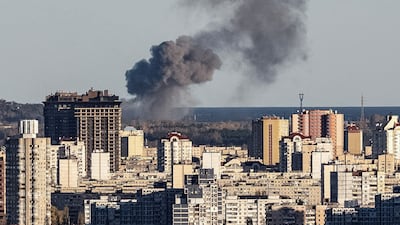
Smoke rises on the outskirts of the city during a Russian missile attack in Kyiv. Reuters -

Workers surround the Monument to the Heroes of the Heavenly Hundred with sandbags against damage from shelling in Mykolaiv. EPA -

Russian President Vladimir Putin welcomes Azerbaijan President Ilham Aliyev for talks before a meeting between the Russian president and the leaders of Armenia and Azerbaijan in the Black Sea resort city of Sochi, Russia. AFP -
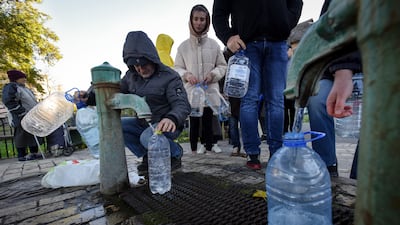
People take water from a water pump in Kyiv. EPA -
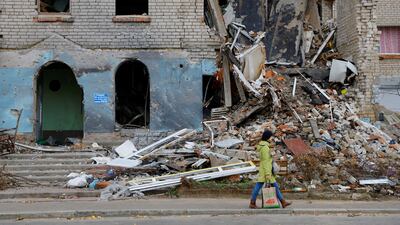
A woman walks past a damaged building in the town of Nova Kakhovka. Reuters -
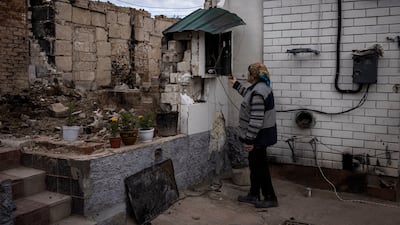
A woman outside her home, which was destroyed during battles at the start of the conflict, in Yahidne, Chernihiv. Getty Images -

People shelter inside a subway station during a Russian missile attack in Kyiv. Reuters -
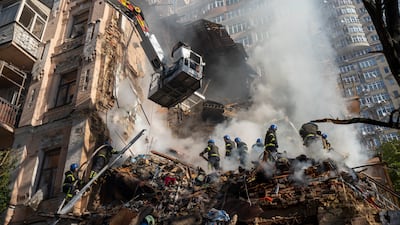
Firefighters at the site of a drone attack in Kyiv, Ukraine. AP -
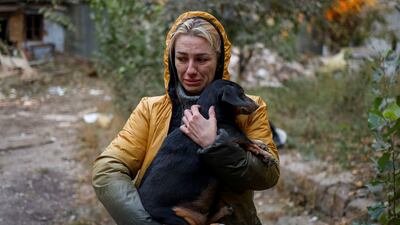
A woman walks past the site of a Russian missile strike in the southern Ukrainian city of Mykolaiv. Reuters -
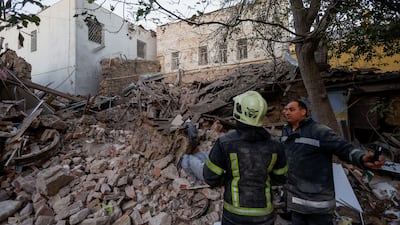
Rescuer workers at a building destroyed in an attack in Mykolaiv. Reuters -
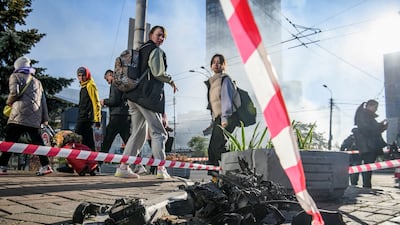
Parts of a drone lie on a street in Kyiv. Reuters -
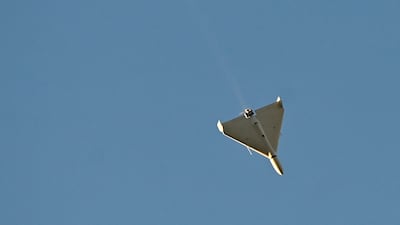
A drone flies over the Ukrainian capital during an attack. AFP -
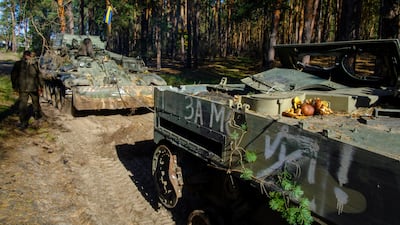
Ukrainian servicemen tow a captured Russian armoured vehicle in Rudneve village, Kharkiv. EPA -
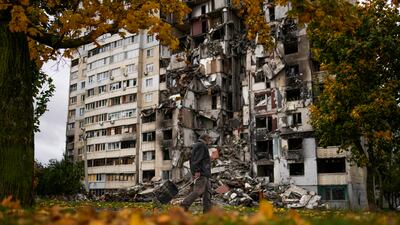
A partially destroyed residential building in Saltivka, in Kharkiv. AP -
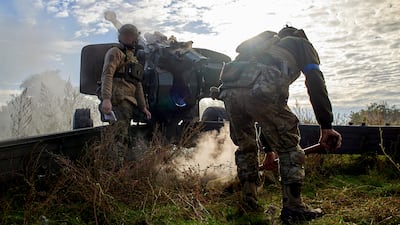
Ukrainian servicemen fire a captured Russian howitzer on a front line near Kupyansk city, Kharkiv. EPA -
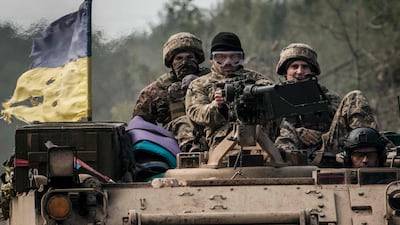
Ukrainian servicemen near the recently retaken town of Lyman in Donetsk region. AFP -
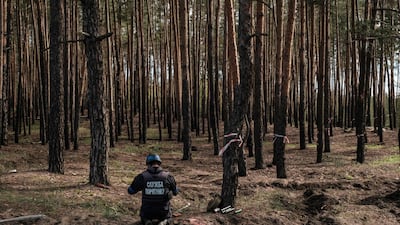
An officer from a Ukrainian national police emergency demining team prepares to detonate collected anti-tank mines and explosives near Lyman, in the Donetsk region. AFP -
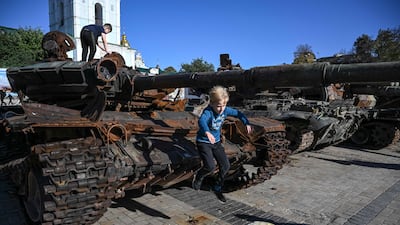
A boy playing on a destroyed Russian tank on display in Kyiv. AFP -

A young couple hiding underground during an air alert in Zaporizhzhia. AFP -
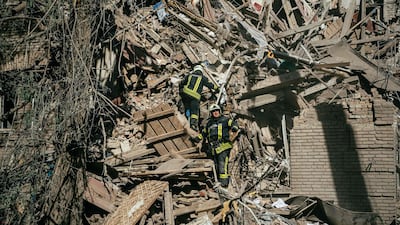
Ukrainian firefighters looking for survivors after a strike in Zaporizhzhia. AFP -
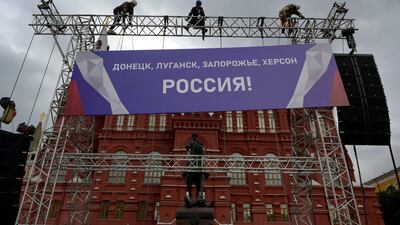
Workers fix a banner reading 'Donetsk, Luhansk, Zaporizhzhia, Kherson - Russia!' to the State Historical Museum near Red Square in Moscow. AFP -

Residents try to cross a destroyed bridge in the Kharkiv region of Ukraine. AFP -

Alyona Kishinskaya helps to clean up a shop as it prepares to reopen in Balakiya, Ukraine, after a six-month Russian occupation. Getty Images -
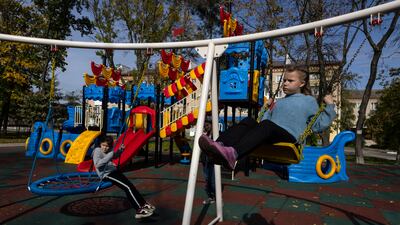
Alla, 12, has a swinging time in Balakiya, Ukraine, as life goes on despite the war. Getty Images -
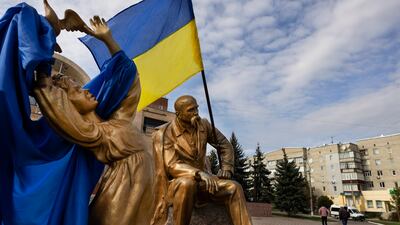
Ukrainian flags in the town square in Balakiya. Getty Images -
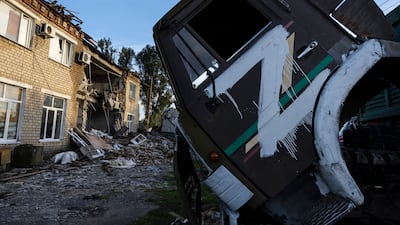
A destroyed Russian command centre in Izium, Ukraine. Getty Images -

In what may be a final farewell, young Russian recruits - escorted by their wives - walk to a train station in Volgograd before being sent to war in Ukraine. AP -
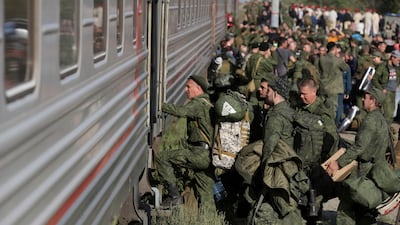
Russian recruits board the train to Ukraine in Volgograd. AP -

Ukrainian soliders drive a tank at the recently retaken eastern side of the Oskil River in Kharkiv region, Ukraine. AFP -
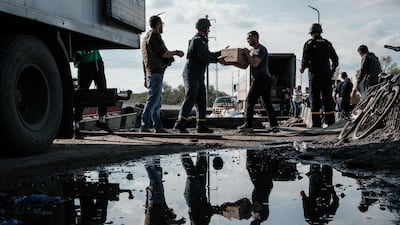
Volunteers pass boxes of food aid on a destroyed bridge over the Oskil River. AFP -

Ukrainian soliders rest on an armoured personnel carrier. AFP -
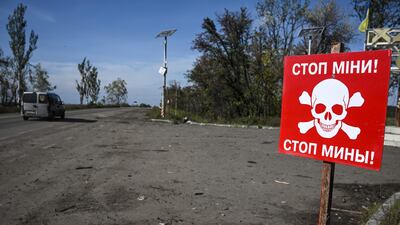
A sign warns of landmines in Izyum, eastern Ukraine. AFP -
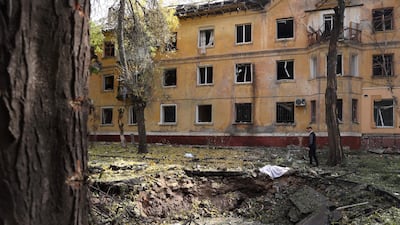
This crater was left after a missile strike in the Donetsk region of Ukraine. AFP
SECRET%20INVASION
Moral education needed in a 'rapidly changing world'
Moral education lessons for young people is needed in a rapidly changing world, the head of the programme said.
Alanood Al Kaabi, head of programmes at the Education Affairs Office of the Crown Price Court - Abu Dhabi, said: "The Crown Price Court is fully behind this initiative and have already seen the curriculum succeed in empowering young people and providing them with the necessary tools to succeed in building the future of the nation at all levels.
"Moral education touches on every aspect and subject that children engage in.
"It is not just limited to science or maths but it is involved in all subjects and it is helping children to adapt to integral moral practises.
"The moral education programme has been designed to develop children holistically in a world being rapidly transformed by technology and globalisation."
First Person
Richard Flanagan
Chatto & Windus
Our legal consultant
Name: Hassan Mohsen Elhais
Position: legal consultant with Al Rowaad Advocates and Legal Consultants.
While you're here
Sholto Byrnes: Here's how this century can still belong to Asia
Brahma Chellaney: South China Sea is Asean's Achilles heel
The National Editorial: Territorial disputes require a mediator
How%20to%20avoid%20getting%20scammed
BEETLEJUICE BEETLEJUICE
Starring: Winona Ryder, Michael Keaton, Jenny Ortega
Director: Tim Burton
Rating: 3/5
The biog
Favourite book: You Are the Placebo – Making your mind matter, by Dr Joe Dispenza
Hobby: Running and watching Welsh rugby
Travel destination: Cyprus in the summer
Life goals: To be an aspirational and passionate University educator, enjoy life, be healthy and be the best dad possible.
Ten tax points to be aware of in 2026
1. Domestic VAT refund amendments: request your refund within five years
If a business does not apply for the refund on time, they lose their credit.
2. E-invoicing in the UAE
Businesses should continue preparing for the implementation of e-invoicing in the UAE, with 2026 a preparation and transition period ahead of phased mandatory adoption.
3. More tax audits
Tax authorities are increasingly using data already available across multiple filings to identify audit risks.
4. More beneficial VAT and excise tax penalty regime
Tax disputes are expected to become more frequent and more structured, with clearer administrative objection and appeal processes. The UAE has adopted a new penalty regime for VAT and excise disputes, which now mirrors the penalty regime for corporate tax.
5. Greater emphasis on statutory audit
There is a greater need for the accuracy of financial statements. The International Financial Reporting Standards standards need to be strictly adhered to and, as a result, the quality of the audits will need to increase.
6. Further transfer pricing enforcement
Transfer pricing enforcement, which refers to the practice of establishing prices for internal transactions between related entities, is expected to broaden in scope. The UAE will shortly open the possibility to negotiate advance pricing agreements, or essentially rulings for transfer pricing purposes.
7. Limited time periods for audits
Recent amendments also introduce a default five-year limitation period for tax audits and assessments, subject to specific statutory exceptions. While the standard audit and assessment period is five years, this may be extended to up to 15 years in cases involving fraud or tax evasion.
8. Pillar 2 implementation
Many multinational groups will begin to feel the practical effect of the Domestic Minimum Top-Up Tax (DMTT), the UAE's implementation of the OECD’s global minimum tax under Pillar 2. While the rules apply for financial years starting on or after January 1, 2025, it is 2026 that marks the transition to an operational phase.
9. Reduced compliance obligations for imported goods and services
Businesses that apply the reverse-charge mechanism for VAT purposes in the UAE may benefit from reduced compliance obligations.
10. Substance and CbC reporting focus
Tax authorities are expected to continue strengthening the enforcement of economic substance and Country-by-Country (CbC) reporting frameworks. In the UAE, these regimes are increasingly being used as risk-assessment tools, providing tax authorities with a comprehensive view of multinational groups’ global footprints and enabling them to assess whether profits are aligned with real economic activity.
Contributed by Thomas Vanhee and Hend Rashwan, Aurifer
The specs: 2018 Nissan 370Z Nismo
Price, base / as tested: Dh182,178
Engine: 3.7-litre V6
Power: 350hp @ 7,400rpm
Torque: 374Nm @ 5,200rpm
Transmission: Seven-speed automatic
Fuel consumption, combined: 10.5L / 100km
Mercer, the investment consulting arm of US services company Marsh & McLennan, expects its wealth division to at least double its assets under management (AUM) in the Middle East as wealth in the region continues to grow despite economic headwinds, a company official said.
Mercer Wealth, which globally has $160 billion in AUM, plans to boost its AUM in the region to $2-$3bn in the next 2-3 years from the present $1bn, said Yasir AbuShaban, a Dubai-based principal with Mercer Wealth.
“Within the next two to three years, we are looking at reaching $2 to $3 billion as a conservative estimate and we do see an opportunity to do so,” said Mr AbuShaban.
Mercer does not directly make investments, but allocates clients’ money they have discretion to, to professional asset managers. They also provide advice to clients.
“We have buying power. We can negotiate on their (client’s) behalf with asset managers to provide them lower fees than they otherwise would have to get on their own,” he added.
Mercer Wealth’s clients include sovereign wealth funds, family offices, and insurance companies among others.
From its office in Dubai, Mercer also looks after Africa, India and Turkey, where they also see opportunity for growth.
Wealth creation in Middle East and Africa (MEA) grew 8.5 per cent to $8.1 trillion last year from $7.5tn in 2015, higher than last year’s global average of 6 per cent and the second-highest growth in a region after Asia-Pacific which grew 9.9 per cent, according to consultancy Boston Consulting Group (BCG). In the region, where wealth grew just 1.9 per cent in 2015 compared with 2014, a pickup in oil prices has helped in wealth generation.
BCG is forecasting MEA wealth will rise to $12tn by 2021, growing at an annual average of 8 per cent.
Drivers of wealth generation in the region will be split evenly between new wealth creation and growth of performance of existing assets, according to BCG.
Another general trend in the region is clients’ looking for a comprehensive approach to investing, according to Mr AbuShaban.
“Institutional investors or some of the families are seeing a slowdown in the available capital they have to invest and in that sense they are looking at optimizing the way they manage their portfolios and making sure they are not investing haphazardly and different parts of their investment are working together,” said Mr AbuShaban.
Some clients also have a higher appetite for risk, given the low interest-rate environment that does not provide enough yield for some institutional investors. These clients are keen to invest in illiquid assets, such as private equity and infrastructure.
“What we have seen is a desire for higher returns in what has been a low-return environment specifically in various fixed income or bonds,” he said.
“In this environment, we have seen a de facto increase in the risk that clients are taking in things like illiquid investments, private equity investments, infrastructure and private debt, those kind of investments were higher illiquidity results in incrementally higher returns.”
The Abu Dhabi Investment Authority, one of the largest sovereign wealth funds, said in its 2016 report that has gradually increased its exposure in direct private equity and private credit transactions, mainly in Asian markets and especially in China and India. The authority’s private equity department focused on structured equities owing to “their defensive characteristics.”
Washmen Profile
Date Started: May 2015
Founders: Rami Shaar and Jad Halaoui
Based: Dubai, UAE
Sector: Laundry
Employees: 170
Funding: about $8m
Funders: Addventure, B&Y Partners, Clara Ventures, Cedar Mundi Partners, Henkel Ventures
COMPANY%20PROFILE
FIVE%20TRENDS%20THAT%20WILL%20SHAPE%20UAE%20BANKING
Company%20profile
MATCH INFO
Uefa Champions League, semi-final result:
Liverpool 4-0 Barcelona
Liverpool win 4-3 on aggregate
Champions Legaue final: June 1, Madrid
KEY DEVELOPMENTS IN MARITIME DISPUTE
2000: Israel withdraws from Lebanon after nearly 30 years without an officially demarcated border. The UN establishes the Blue Line to act as the frontier.
2007: Lebanon and Cyprus define their respective exclusive economic zones to facilitate oil and gas exploration. Israel uses this to define its EEZ with Cyprus
2011: Lebanon disputes Israeli-proposed line and submits documents to UN showing different EEZ. Cyprus offers to mediate without much progress.
2018: Lebanon signs first offshore oil and gas licencing deal with consortium of France’s Total, Italy’s Eni and Russia’s Novatek.
2018-2019: US seeks to mediate between Israel and Lebanon to prevent clashes over oil and gas resources.
AT%20A%20GLANCE
Other acts on the Jazz Garden bill
Sharrie Williams
The American singer is hugely respected in blues circles due to her passionate vocals and songwriting. Born and raised in Michigan, Williams began recording and touring as a teenage gospel singer. Her career took off with the blues band The Wiseguys. Such was the acclaim of their live shows that they toured throughout Europe and in Africa. As a solo artist, Williams has also collaborated with the likes of the late Dizzy Gillespie, Van Morrison and Mavis Staples.
Lin Rountree
An accomplished smooth jazz artist who blends his chilled approach with R‘n’B. Trained at the Duke Ellington School of the Arts in Washington, DC, Rountree formed his own band in 2004. He has also recorded with the likes of Kem, Dwele and Conya Doss. He comes to Dubai on the back of his new single Pass The Groove, from his forthcoming 2018 album Stronger Still, which may follow his five previous solo albums in cracking the top 10 of the US jazz charts.
Anita Williams
Dubai-based singer Anita Williams will open the night with a set of covers and swing, jazz and blues standards that made her an in-demand singer across the emirate. The Irish singer has been performing in Dubai since 2008 at venues such as MusicHall and Voda Bar. Her Jazz Garden appearance is career highlight as she will use the event to perform the original song Big Blue Eyes, the single from her debut solo album, due for release soon.



