
Live updates: follow the latest news on Russia-Ukraine
President Joe Biden announced another $800 million in US military aid for Ukraine on Wednesday, but did not change his position on a no-fly zone over the European country despite Ukrainian President Volodymyr Zelenskyy making an urgent request directly to the US Congress.
The package includes 800 Stinger anti-aircraft systems, 2,000 Javelin anti-tank missiles and 100 drones.
"The American people will be steadfast in our support and the people of Ukraine in the face of [Russian President Vladimir] Putin's immoral, unethical attacks on civilian populations," Mr Biden said at the White House.
"We're going to continue to have their backs as they fight for their freedom, their democracy, their very survival."
Mr Zelenskyy earlier gave a 20-minute video address to the US Congress, where he pleaded once more for a no-fly zone over Ukraine.
“Russia has turned the Ukrainian sky into a source of death for thousands of people,” Mr Zelenskyy said.
“Russian troops have already fired nearly 1,000 missiles at Ukraine — countless bombs. They use drones to kill us with precision. This is a terror that Europe has not seen for 80 years."
While Mr Biden agreed to provide Mr Zelenskyy with the aerial defence systems he requested, his administration has repeatedly stated its opposition to Ukraine's continued request for a no-fly zone as the US fears such a move would spark a broader conflict between Russia and Nato.
Mr Biden noted that the US has authorised Ukraine $1 billion in security aid this week alone, adding America will continue to give Ukraine weapons, offer humanitarian relief and support Ukraine's economy with additional financial assistance.
He called Mr Zelenskyy's address a “convincing, significant speech for a people who have shown remarkable courage and strength in the face of brutal aggression". At a subsequent event in the White House, Mr Biden called Mr Putin a "war criminal".
Also on Wednesday, White House National Security Advisor Jake Sullivan spoke with Gen Nikolai Patrushev, secretary of the Russian Security Council, in the highest-level US-Russia talks since the war began.
According to a White House readout of the call, Mr Sullivan said the US would continue to impose costs on Russia and supporting Ukraine’s sovereignty.
“Mr Sullivan told Gen Patrushev that if Russia is serious about diplomacy then Moscow should stop attacking Ukrainian cities and towns,” the readout stated.
“Mr Sullivan also warned General Patrushev about the consequences and implications of any possible Russian decision to use chemical or biological weapons in Ukraine.”
-
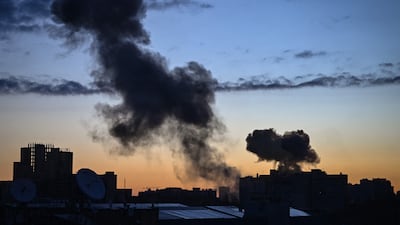
Smoke rising in Kyiv, which mayor Vitali Klitschko says faces a 'difficult and dangerous moment' as Russian forces step up strikes. AFP -

Pope Francis meets visitors holding the Ukrainian flag during his weekly general audience in the Vatican. AFP -

An anti-war protester demonstrates against Russia's invasion of Ukraine in front of the Nato headquarters in Brussels. AFP -
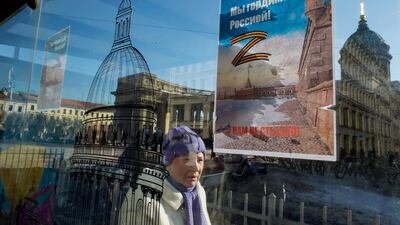
A poster in Saint Petersburg carries the letter Z, a symbol of support for the invasion, and reads: "We are proud of Russia! We are not ashamed!" AFP -

Amid the Ukraine war, there's time for a seaside stroll in Odesa. Reuters -
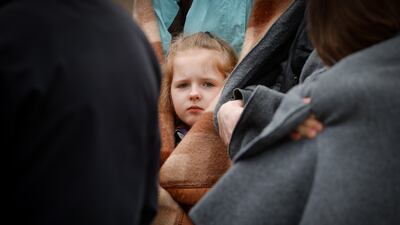
A child who fled from Ukraine to Belgium waits outside an immigration office in Brussels. EPA -
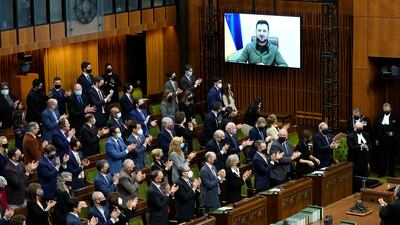
Ukrainian President Volodymyr Zelenskyy receives a standing ovation as he appears via videoconference to make an address to Canada's Parliament. AP -
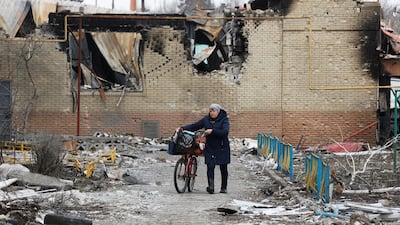
A woman walks with a bicycle next to a building damaged during the conflict in the separatist-controlled town of Volnovakha, Donetsk region. Reuters -
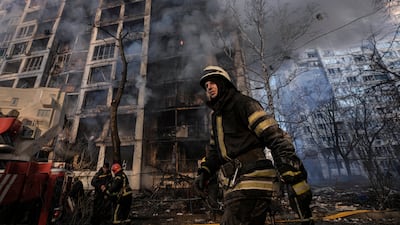
A firefighter outside a destroyed apartment building in a residential area of Kyiv. AP -

Ukrainian soldiers pay tribute to Col Valeriy Gudz, who was killed in battle against Russian troops, at a cemetery in the town of Boryspil. AP -
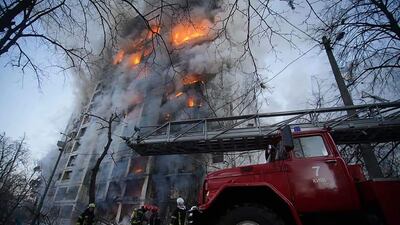
Firefighters work to extinguish a fire in a housing block hit by shelling in the Sviatoshynsky district, in western Kyiv. AFP -
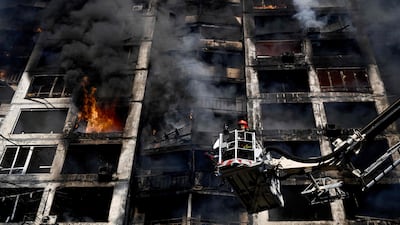
Two people were killed as a series of powerful explosions rocked residential districts in Kyiv just hours before talks between Ukraine and Russia were set to resume. AFP -

The Met Opera and Chorus performs during 'A Concert For Ukraine' in New York City. AFP -
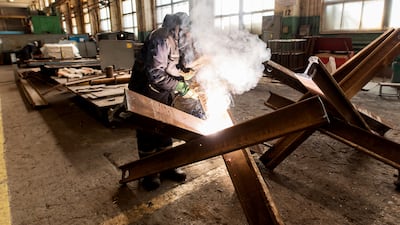
A worker welds metal at the Interpipe Steel plant in Dnipro, Ukraine. Hundreds of Interpipe’s 10,000 employees have joined the fight against Russia. AP -
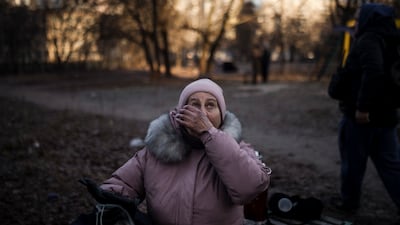
A woman is rescued by firefighters from her apartment in a burning building that was hit by artillery shells in Kyiv. AP -

Rescuers work at a building damaged by an air strike, in central Kharkiv, Ukraine. Reuters -

A woman who fled Ukraine to Belgium waits outside an immigration office, in Brussels. EPA -
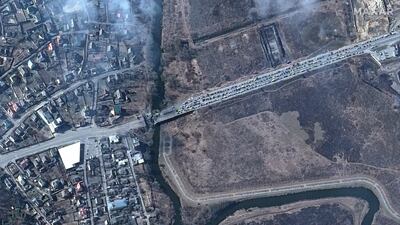
Cars stuck at the Irpin River bridge, as Russia unleashes a barrage of air strikes on cities across Ukraine. AFP -
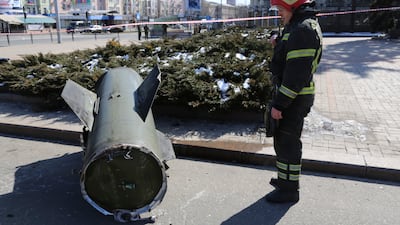
A firefighter looks at a section of a Ukrainian Tochka-U missile on a street in the separatist Donetsk region. The Russian military said 20 civilians were killed by a ballistic missile launched by the Ukrainian forces. AP -
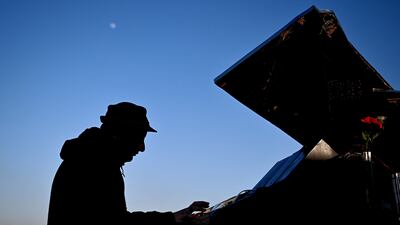
Musician Davide Martello plays a piano near the Ukrainian border in Medyka, Poland. More than 1.76 million people have crossed the Polish-Ukrainian border into Poland, the Polish Border Guard reported on March 14. EPA -
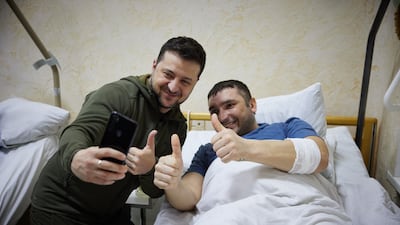
Ukrainian President Volodymyr Zelenskyy, left, snaps a selfie with a wounded man during a visit at a military hospital after fighting in the Kyiv region.AFP -
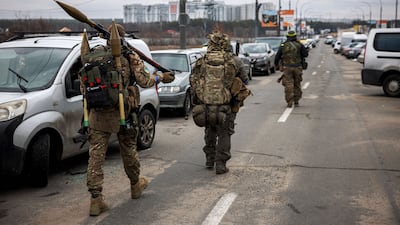
Ukrainian soldiers carry rocket-propelled grenades and sniper rifles as they walk towards the city of Irpin, north-west of Kyiv. AFP -

Troops carry an elderly woman on a stretcher across a makeshift bridge as Ukrainians flee Irpin. AFP -
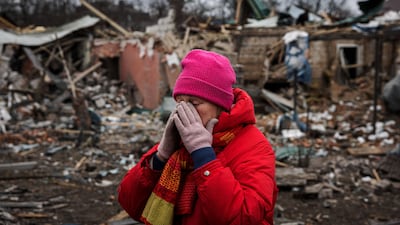
Irina Moprezova, 54, stands in front of a house that was damaged by an air strike in Irpin. AFP -
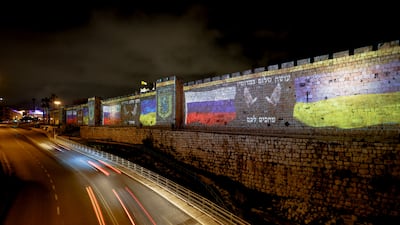
The flags of Russia and Ukraine are projected on the walls of Jerusalem's Old City, which a representative from the Jerusalem Municipality said is a show of support for diplomatic dialogue between the countries. Reuters -

A person holds a Ukrainian flag during an anti-war demonstration at the Brandenburg Gate in Berlin, Germany. Reuters -
A Ukrainian soldier takes cover as people flee Irpin. AFP -

Ukrainians shelter in an underground train station during the day in Kyiv. EPA -
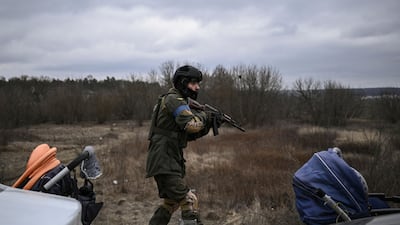
A Ukrainian serviceman walks carefully with his weapon in the city of Irpin, near Kyiv. AFP -
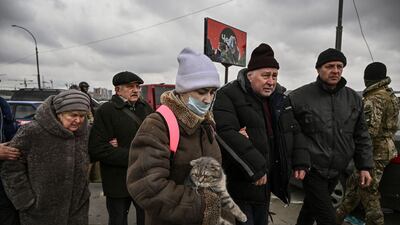
Ukrainian people flee the city of Irpin, north-west of Kyiv. AFP -
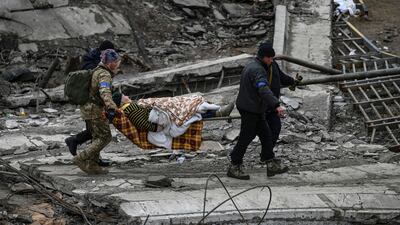
Ukrainian servicemen carry an elderly woman on a stretcher from the city of Irpin. AFP -

A girl plays games on her tablet inside a subway carriage being used as a bomb shelter in Kyiv. AFP -
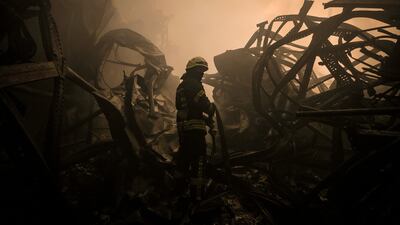
A Ukrainian firefighter drags a hose inside a large food products storage facility which was destroyed by an air strike on the outskirts of Kyiv. AP -

Ukrainian troops with a Javelin anti-tank missile on the front line in the northern Kyiv region. Reuters -
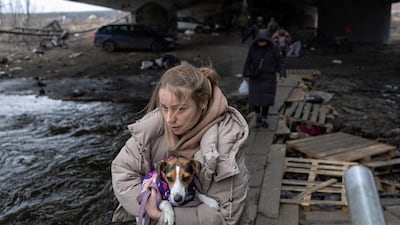
A woman carries her dog during an evacuation in Irpin. Reuters -
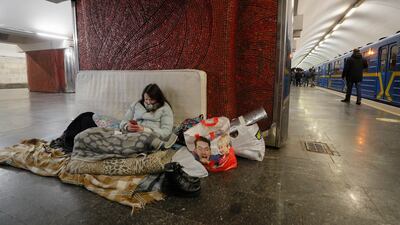
A Ukrainian woman takes shelter in a metro station during the day in Kyiv. EPA -
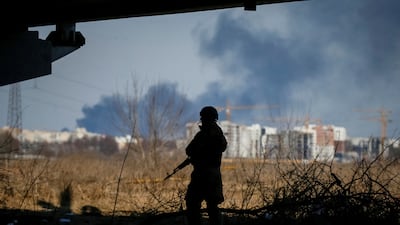
A member of the Ukrainian armed forces on patrol in Irpin. Reuters -

A Ukrainian fighter takes cover behind a car in the city of Irpin. AFP -
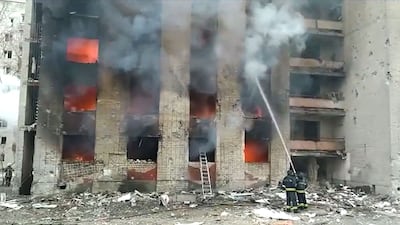
Firefighters at work after air strikes hit residential buildings in Chernihiv, northern Ukraine. AFP -
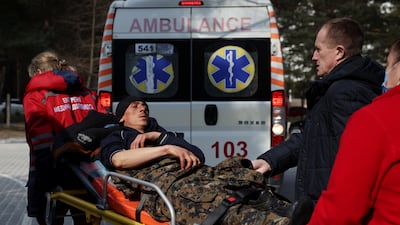
A man wounded in an air strike is helped by medical staff in Novoiavorivsk, western Ukraine. Getty -
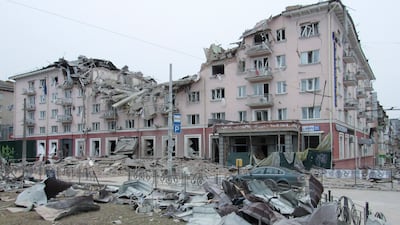
The ruins of the Ukraine Hotel after recent shelling in Chernihiv. EPA


According to the White House, the new $800 million US assistance package includes:
- 800 Stinger anti-aircraft systems
- 2,000 Javelin, 1,000 light anti-armour weapons, and 6,000 AT-4 anti-armour systems
- 100 tactical drones
- 100 grenade launchers, 5,000 rifles, 1,000 pistols, 400 machine guns, and 400 shotguns
- Over 20 million rounds of small arms ammunition and grenade launcher and mortar rounds
- 25,000 sets of body armour and helmets
Mr Biden also pledged to help Ukraine find and procure longer range anti-aircraft systems, at Mr Zelenskyy's request.
The executive order announcing the additional assistance comes after Mr Biden signed a government funding bill into law last week that includes $13.6 billion in additional military and economic aid for Ukraine.
Cognisant of US reluctance to allow a no-fly zone, Mr Zelenskyy suggested that the transfer of fighter jets to Ukraine and additional aerial defence systems could serve as an alternative.
“You know what kind of defence systems we need — S-300 and other similar systems,” he said, referring to the Soviet-designed surface-to-air missile system.
“You know how much depends on the battlefield, on the ability to use aircraft — powerful, strong aviation to protect our people, our freedom, our land.”
The Ukrainian military is largely accustomed to using Soviet and Russian-designed equipment, rendering transfers of US-made materiel that its armed forces are not trained to use largely unfeasible.
But Ukraine has sought advanced fighter jets from Nato allies such as Poland that use Soviet-designed systems.
Poland last week proposed to indirectly transfer its fleet of 28 MiG-29 fighter jets to Ukraine by first placing them in US custody at a Nato base in Germany. Warsaw did not consult with Washington before making the surprise announcement and the Biden administration ultimately rejected the proposal.
A Pentagon official told Congress last week that additional fighter jets would not result in “significant effectiveness” for the Ukrainian military and that the US remains largely focused on providing Ukraine with additional air defence and anti-armour capabilities — drawing bipartisan pushback from several members of Congress.
To make his case for increased assistance, Mr Zelenskyy invoked several motifs recognisable to an American audience, including the September 11 attacks and Martin Luther King Jr’s “I Have a Dream” speech.
-
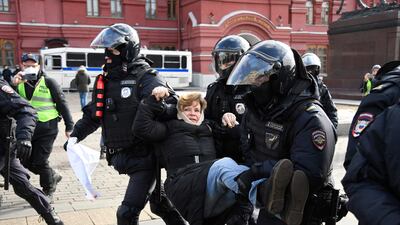
Police officers detain a woman in central Moscow, during a protest against Russian military action in Ukraine. AFP -
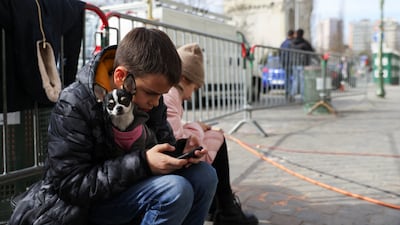
Children look at phones as people who fled the conflict in Ukraine wait outside an immigration office in Brussels, Belgium. Reuters -
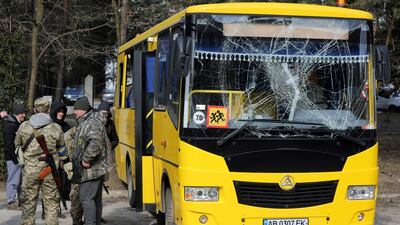
Soldiers stand next to a bus with a damaged windscreen, after an attack on the Yavoriv military base, in Novoyavorivsk, Ukraine. Reuters -

A soldier waits at a hospital after the attack on the Yavoriv military base. Reuters -
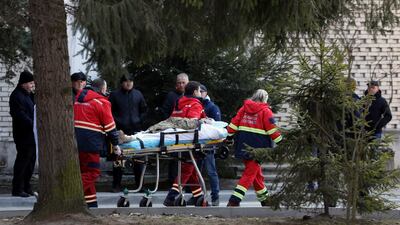
A wounded soldier is transported by medical workers, at a hospital in Novoyavorivsk, after the attack on the Yavoriv military base. Reuters -
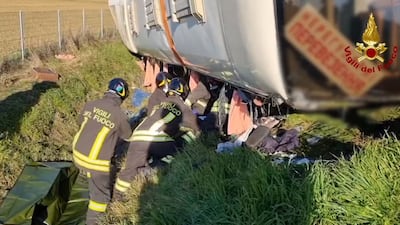
Rescuers work at the site of an accident after a bus that was carrying about 50 Ukrainian refugees overturned near Forli, central Italy. One person died in the crash. AFP -
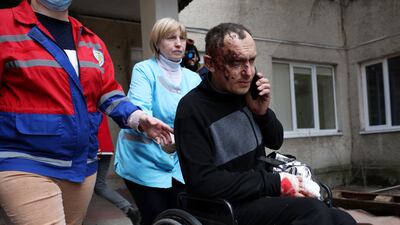
A man wounded in the air strikes at a nearby military complex is assisted by medical staff outside Novoiavorivsk District Hospital. Getty Images -
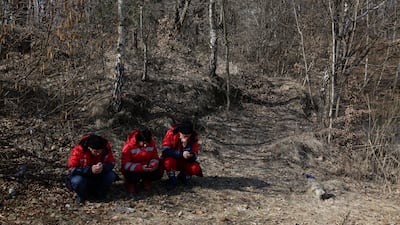
Paramedics find low ground after an air-raid siren sounds on the outskirts of Novoiavorivsk. Getty Images -
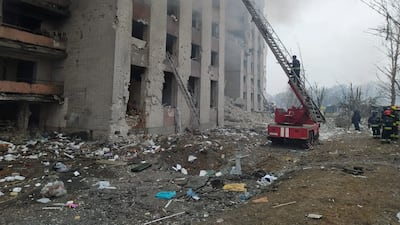
A view of a residential building damaged during an air strike, as Russia's invasion of Ukraine continues, in Chernihiv, Ukraine. Reuters -
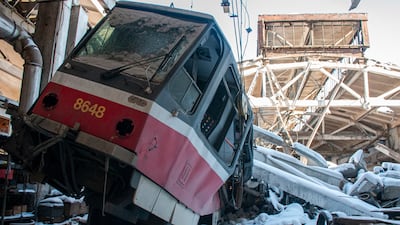
A tram damaged by shelling sits at a depot, in Kharkiv. AP -
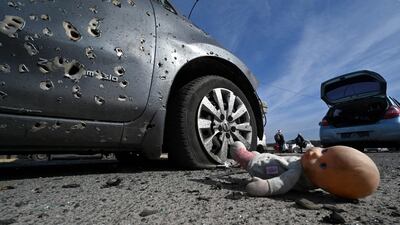
An abandoned doll next to a car riddled with bullets in Irpin, north of Kyiv. AFP -
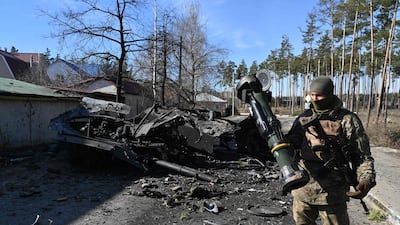
A Ukrainian soldier holds a Next Generation Light Anti-tank Weapon that was used to destroy a Russian armoured personal carrier in Irpin. AFP -
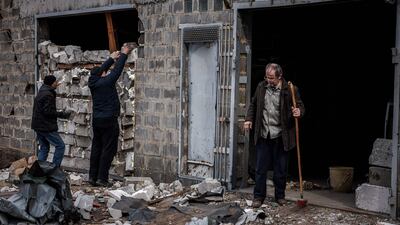
Residents try to strengthen the wall of a house damaged by recent shelling, on the outskirts Kyiv. AFP -
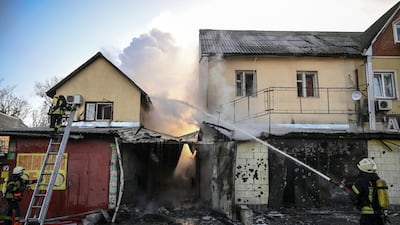
Firefighters extinguish a blaze at a house after shelling in Kyiv. AFP -
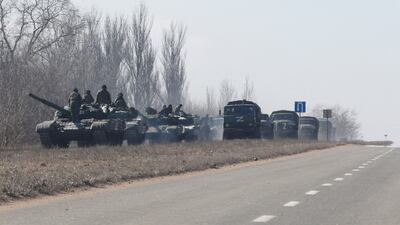
A convoy of pro-Russian troops outside the separatist-controlled town of Volnovakha in the Donetsk region, Ukraine. Reuters -
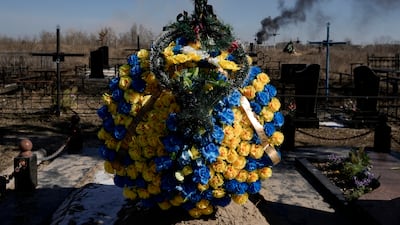
Smoke from shelling rises behind a wreath at a cemetery in Vasylkiv, south-west of Kyiv. AP -
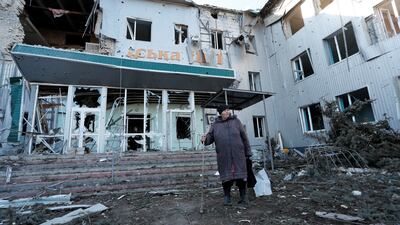
A woman stands outside a local hospital, damaged during fighting in Volnovakha. Reuters -
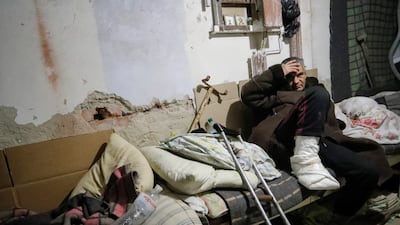
People gather in the basement of a local hospital, which was damaged during clashes in Volnovakha. Reuters -
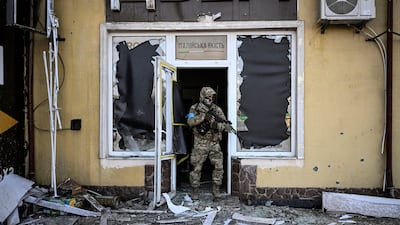
A Ukrainian soldier leaves a damaged building after shelling in Kyiv. AFP -
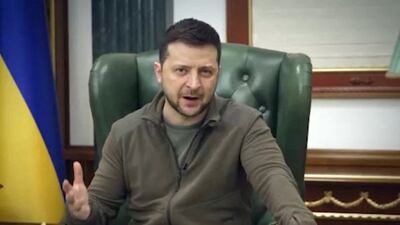
Ukrainian President Volodymyr Zelensky. AFP -

A finance police officer boards Russian billionaire Andrey Igorevich Melnichenko's superyacht, which has been sequestered at the northern port of Trieste, Italy. Reuters -

A Russian KA-52 gunship strikes a Ukrainian military object. AFP -
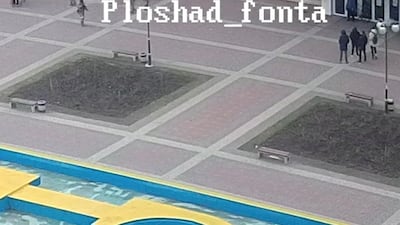
Bystanders watch what appears to be Russian forces arresting Ivan Fedorov, mayor of Melitopol, a city in south-eastern Ukraine. Reuters -
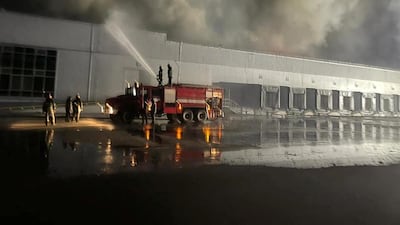
Firefighters battle a blaze at a warehouse storing frozen products hit by shelling in Kvitneve, Kyiv region. Reuters -
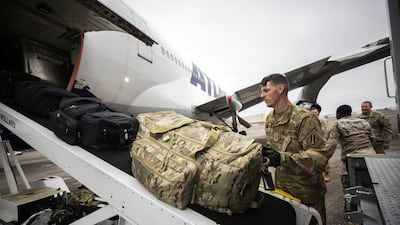
A soldier loads the cargo hold of a chartered Boeing 747 airplane with duffle bags belonging to US soldiers, during their deployment to Europe, at Hunter Army Airfield in Savannah, Georgia. AP -

Two young girls pray for peace in Ukraine at Lisbon's 16th century Jeronimos Monastery. AP Photo -
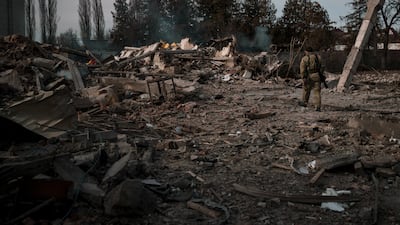
A volunteer of the Ukrainian Territorial Defence Forces walks on the debris of a car wash destroyed by Russian bombing in Baryshivka, east of Kyiv. AP Photo -
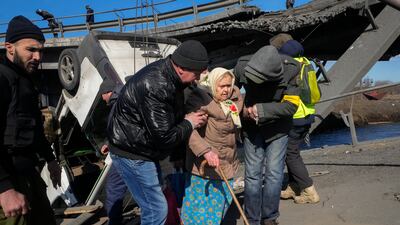
Volunteers pass an improvised path under a destroyed bridge as they help an elderly resident in Irpin, north-west Kyiv. AP Photo -

A woman who was evacuated from Irpin kisses a cat wrapped in a blanket at a triage point in Kyiv. AP Photo -
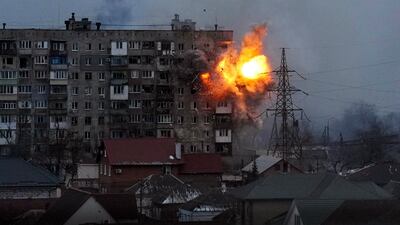
An explosion is seen in an apartment building after a Russian army tank fires in Mariupol. AP Photo -
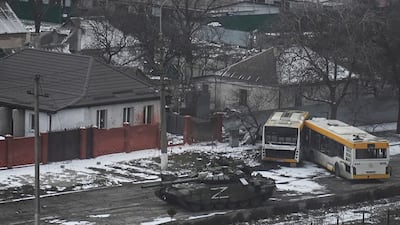
A Russian army tank moves through a street on the outskirts of Mariupol. AP Photo -
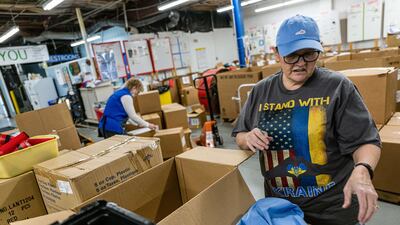
Tonya Steyn, office manager and volunteer co-ordinator, sorts through medical supplies at the non-governmental organisation, SOS International headquarters in Louisville, Kentucky. AFP -

An overview of damaged buildings and burning fuel storage tanks at Antonov Airport in Hostomel, north-west of Kyiv. Maxar Technologies / AFP -
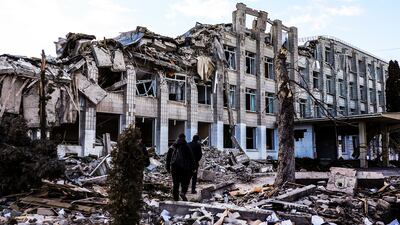
The destroyed main building of school number 25, after being bombed in Zhytomyr. EPA -
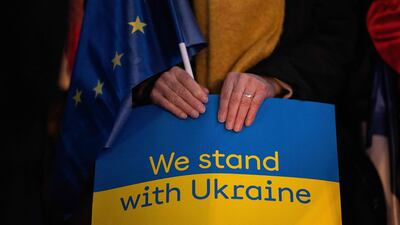
A supporter holds a sign to support Ukraine during Paris' mayor and 'Socialist party' (PS) presidential candidate's campaign meeting in Rennes, western France. AFP


He noted that Ukraine has experienced a September 11 attack “every night for three weeks now”, showing a video illustrating the devastation wrought by Russian air strikes on civilian targets.
“'I have a dream,'” said Mr Zelenskyy. “These words are known to each of you today. I can say, I have a need. I need to protect our sky.”
The Ukrainian president also told Congress that “new packages of sanctions are needed constantly every week until the Russian military machine stops".
“We propose that the United States sanction all politicians in the Russian Federation who remain in their offices and do not cut ties with those who are responsible for the aggression against Ukraine.”
For his part, Mr Biden vowed to keep up pressure on the Russian economy to make Mr Putin “pay the price” for the invasion and “weaken his position".
Mr Zelenskyy also asked members of Congress to exert their influence in their states and districts to pressure American companies to continue to divest from and pull out of the Russian market.
Several large American companies, including McDonalds, Starbucks, Pepsi and Netflix have already closed their businesses in Russia.
“All American companies must leave Russia,” he said. “I’m asking to make sure that the Russians do not receive a single penny that they use to destroy people in Ukraine.”

