

Despite attempts at diplomacy and pleas for de-escalation, tension continues to rise along the Ukrainian border, where Russia has amassed some 127,000 troops.
In December, Russian President Vladimir Putin sent a list of demands on Ukraine to western leaders. The West formally responded on Wednesday.
“The document we’ve delivered includes concerns of the United States and our allies and partners about Russia’s actions that undermine security, a principled and pragmatic evaluation of the concerns that Russia has raised, and our own proposals for areas where we may be able to find common ground,” US Secretary of State Antony Blinken said.
In an effort to make sense of what is going on, how we got here and what to expect, The National spoke to George Krol, a career diplomat who has served in various roles in India, Russia and Ukraine, and was the US ambassador to Uzbekistan (2011-2014), Belarus (2003—2006) and Kazakhstan (2015-2018).
What are the roots of the Ukraine conflict?
Formerly part of the Soviet Union, Ukraine borders Russia to the east and the north-east, with coastlines on the Sea of Azov and the Black Sea.
Ukraine declared independence from the Soviet Union in 1991, and after that time, about one third of its trade was conducted with Russia and another third with neighbouring European nations.
In 2008, Ukraine announced it would sign a “stabilisation agreement” with the EU, which led to many economic and cultural benefits, including tariff-free trade, access to the European Investment Bank, visa-free movement for its citizens and, longer term, the modernisation of the country's energy infrastructure.
-
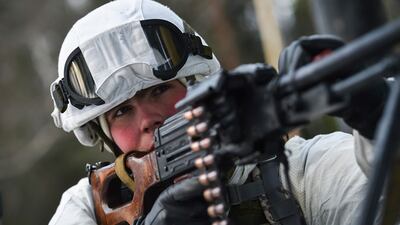
A Russian soldier attends a military exercise at the Golovenki training ground in the Moscow region, Russia. AP Photo -
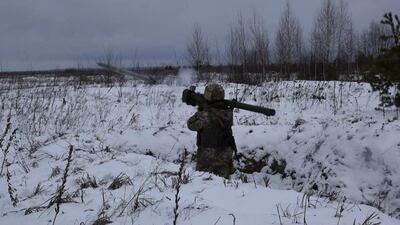
A member of the 14th Separate Mechanised Brigade of the Ukrainian Armed Forces takes part in anti-aircraft military drills in the Volyn region, Ukraine. Reuters -
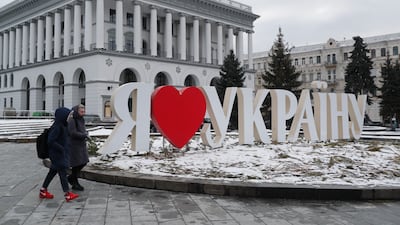
People walk past a sign reading 'I Love Ukraine' in the central square in Kiev. EPA -
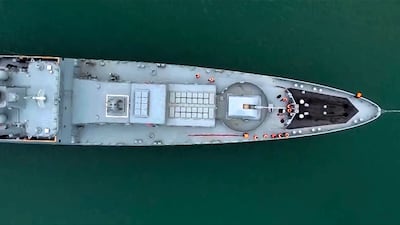
Russian naval frigate 'Admiral Essen' sails during an exercise in the Black Sea. AP -
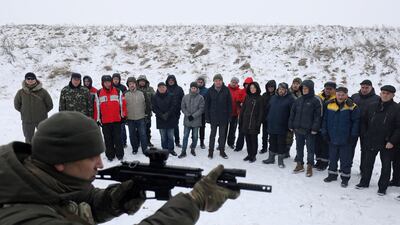
Employees of essential city industries and services attend a military training session outside Lviv, Ukraine. Reuters -
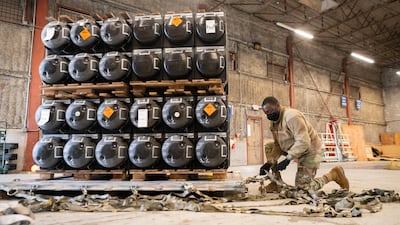
Airman 1st Class Olabode Igandan organises ammunition, weapons and other equipment bound for Ukraine during a foreign military sales mission at Dover Air Force Base, Delaware. AP -
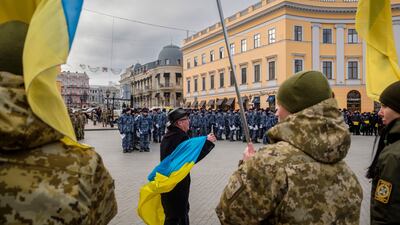
A member of the public waves a Ukrainian flag at a rally attended by soldiers and police in Odessa, Ukraine. Bloomberg -
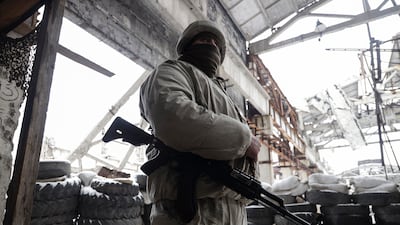
A Ukrainian serviceman patrols the front line near Avdiivka village, not far from the pro-Russian militant-controlled city of Donetsk, Ukraine. EPA -
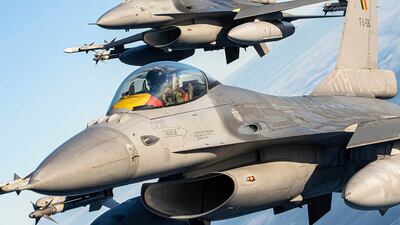
A Belgian Air Force F-16 fighter jet participates in Nato's Baltic Air Policing Mission in Lithuanian airspace. AP


The EU expected commitments in kind as well as political and human rights reform — something that proved a bit of a stumbling block for Kiev.
The trial and consequent seven-year imprisonment of former Ukrainian prime minister Yulia Tymoshenko for abuse of power in 2011 outraged European leaders and rights groups.
Ms Tymoshenko, an opponent of former Ukrainian president Viktor Yanukovych’s government, had been in favour of integration into the EU and membership in Nato while strongly opposing Ukraine’s membership in the Russia-led Eurasian Customs Union.
But Mr Yanukovych’s refusal to sign a free-trade agreement with the EU in 2014 resulted in an eruption of violent protests through the country.
Mr Yanukovych, who had maintained close ties with Moscow, was removed from office by a majority vote in Parliament and replaced by an interim government. Ms Tymoshenko was released and cleared of all charges a few months later.
Russia responded by annexing Ukraine’s Crimean Peninsula and backing a separatist rebellion in the eastern part of the country.
"Ukrainian politics is a very complicated group: there's control of oligarchs, nationalists and the like ... Yet the population as a large would like to see this thing resolved peacefully," Mr Krol said.
"But will their politicians make some kind of a deal that would allow some semblance of normalcy in their lives?"
Over the past several months, Russia has sent troops to its border with Ukraine, alarming Nato, as it sees the build-up as the precursor to an invasion.
Does Russia want to invade Ukraine?
“t's not that they want to invade Ukraine, and I don't think they even intend to invade Ukraine and I don't see really what they can gain from that other than a big problem on their hands because they're getting more out of it from bringing attention to it … rattling the cages, which they're doing,” Mr Krol said.
“There are some who say that they want to keep this pot boiling, because it keeps the Ukrainian government, its leverage on them and keeps them keeps them weak and keeps the tension on this situation, but they could turn it up and up and down, like a flame of gas.”
Mr Krol pointed to Russia's manoeuvres in Belarus, its fleet in the Black Sea and how its army has taken up positions in Moldova, all in addition to the thousands troops amassed on the Ukrainian border.
“They’ve got Ukraine surrounded and putting up the pressure to try to, if you will, force the Ukrainian government to come to terms — as well as the West — without going so far as to actually physically, seize the country and occupy it.”
The diplomat said the aim was to “keep everyone guessing” while maintaining a spotlight on the issue to bring the US to the table to discuss “serious matters that the Russians feel they have been raising again and again for many of these last 30 years".
-

An instructor trains members of Ukraine's Territorial Defence Forces, volunteer military units of the armed forces, in the capital Kiev. AP -

Dozens of civilians have been joining Ukraine's army reserves in recent weeks amid fears about a Russian invasion. AP -
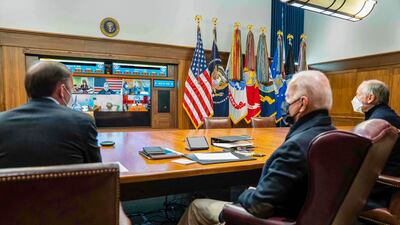
US President Joe Biden, centre, meets online with his national security team and senior officials to discuss Russia's actions towards Ukraine. AP -

A member of the US Air Force packs ammunition, weapons and other equipment bound for Ukraine, at Dover Air Force Base, Delaware. Reuters -
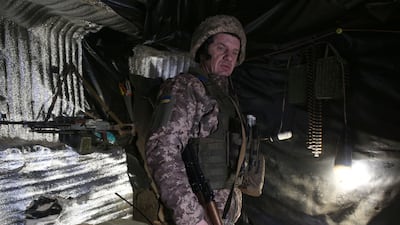
A Ukrainian soldier stationed in the trenches at the front line with Russia-backed separatists near Gorlivka, Donetsk. AFP -

Rising tension about Russia’s military build-up on the Ukraine border was not eased during talks on Friday between US Secretary of State Antony Blinken and Russian Foreign Minister Sergey Lavrov in Geneva. AFP -
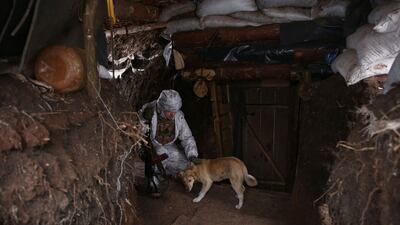
A Ukrainian soldier pets a dog in a trench at the front line. AFP -
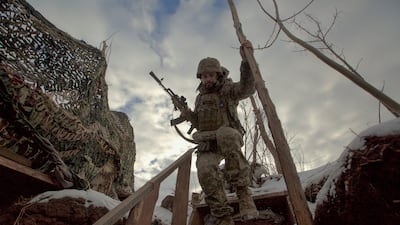
A Ukrainian soldier walks near the line of separation from Russian-backed rebels in the Donetsk region. Reuters -
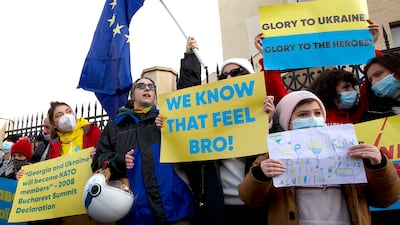
Activists hold an EU flag and posters as they gather in support of Ukraine at the Ukrainian embassy in Tbilisi, Georgia. AP -

The Russian embassy in London. Reuters -

Supporters of Ukrainian sovereignty arrive with a Ukrainian flag before holding a protest on the Peace Bridge in Calgary, Canada. Reuters -

People rallying in patriotic support of Ukraine hold a 500-metre ribbon in the colours of the Ukrainian flag outside St Michael's Golden-Domed Monastery on Unity Day, in Kiev. Getty Images -

A woman attends the patriotic rally in Kiev. There are now more than 120,000 Russian troops posted on the border along with significant numbers of tanks, artillery and missile batteries. Getty Images -
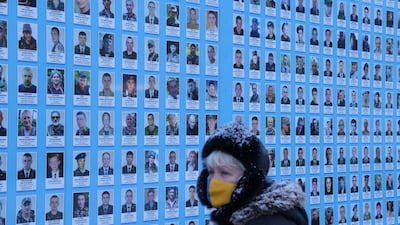
A woman wearing a face mask in the colours of the Ukrainian flag stands at the Wall of Remembrance in Kiev, which shows the photographs, names and birth and death dates of approximately 4,500 soldiers who have died fighting for Ukraine in the Donbas conflict. Approximately 13,000 people have died in the war. Getty Images


What does President Putin have against Nato?
Mr Krol said a slow boil began when Nato engaged in the bombing of Serbian positions in Yugoslavia in mid-1999 during the Kosovo War.
“There was no United Nations approval for this. No Nato member was being attacked by Serbia. There was no threat from Serbia to a Nato member and yet Nato decided — largely because of the United States' insistence on it — to conduct a military campaign against Serbia,” he said.
Kosovo declared independence from Serbia in 2008 and was recognised as independent by the US and other Nato members.
“I was director of Russian Affairs at the State Department and the Russians … they felt this could happen to them, because after all, they were fighting a separatists’ battle, very brutally, on both sides in Chechnya,” Mr Krol said.
“And when Nato was bombing Belgrade, and many Russians … immediately saw that this could be a threat and this is what Nato is really all about.”
The diplomat said the US has tried to “manage” Russia and its reactions to the expansion of Nato over the years by establishing the Nato-Russia Council, which aimed to give Russia a voice — but not a veto — in the alliance's actions.
But Mr Krol said the arrangement was frustrating for Russia, the largest country in Europe, not to have veto power while smaller countries did.
Mr Krol said, however, that several European countries protested granting Russia veto power, “saying, ‘You can't let Russia into Nato because they'll subvert it. It’s like having the wolf in your house'".
Nato suspended practical co-operation with Russia following the 2014 intervention in Crimea, but has held a number of meetings since, with the organisation saying it “remains open to a periodic, focused and meaningful political dialogue with Russia on the basis of reciprocity".
“In diplomacy, it's really tough, but the effort has to be made. What are all the different formulations that at the end of the day, everyone can finally agree on, even though they all dislike it so much?”

