


Ending America’s war in Afghanistan was President Joe Biden’s most important foreign policy decision of 2021, cementing a major shift in US military posture and Pentagon priorities for the years ahead.
America's pivot from “forever” wars in the Middle East and Afghanistan to one in which the US must contend with sophisticated “near-peer” competitors marks a sea change in its war-fighting doctrine, bringing a sharper focus on modernising major weapons systems and tackling emerging technologies such as autonomous weapons powered by artificial Intelligence.
Three months after the Pentagon's chaotic pullout from Kabul, it announced the completion of its Global Posture Review, mapping out the US military's global deployments and troop adjustments.
The full document remains classified but the Pentagon has listed the Indo-Pacific region as a priority and called for US military infrastructure changes in Australia and the Pacific Islands.
“In the Indo-Pacific, the review directs additional co-operation with allies and partners to advance initiatives that contribute to regional stability and deter potential Chinese military aggression and threats from North Korea,” the Pentagon said.
The review also signed off on a number of deployments including a helicopter squadron and artillery division headquarters in South Korea.
Two weeks after the withdrawal from Afghanistan, Mr Biden announced the creation of an enhanced trilateral security partnership with Australia and Britain, known as Aukus, that seeks to bolster the countries' military presence and co-ordination in the region.
It is “a shift away from counter-insurgency and counter-terrorism operations in the Middle East, towards a strategic competition with China, primarily in the Indo-Pacific,” Margarita Konaev, associate director of analysis and research fellow at Georgetown’s Centre for Security and Emerging Technology, told The National.
With a technologically sophisticated rival such as China, Dr Konaev predicted a greater focus from US military on modernising major weapons systems and building artificial intelligence capacity.
"The way that the US military organises, trains, equips, and generally prepares for the type of missions and engagements it has pursued during the last 20 years, including of course the operations in Iraq and Afghanistan, is fundamentally different from how it must prepare for the prospect of competition and conflict with a large scale, technologically sophisticated peer competitor like China," she said.
But Jason Campbell, a senior security researcher at the Rand Corporation, said the US pivot away from the war on terror should not come at the expense of countering violent extremism.
“From a conceptual standpoint, the biggest challenge for the US military in Afghanistan and the broader region is how to keep tabs on a rapidly evolving extremist threat environment without forces on the ground and very few options for maintaining access to the region,” Mr Campbell said.
He described the Pentagon as switching from smaller unit, counterinsurgency warfare to readying for conflict in a more conventional confrontation against adversaries like China and Russia.
In terms of continuing counterinsurgency efforts, the US military “will have to adjust operationally to areas where the access is limited, the terrain is more contested and other malign actors are more active”, Mr Campbell told The National.
One way to do this is by engaging more fully with partner nations who are confronting violent extremist organisations.
-
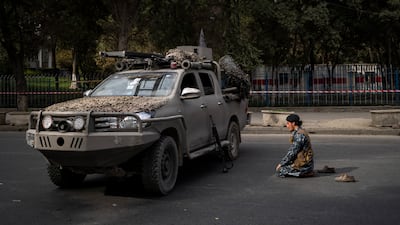
A Taliban fighter prays next to a demonstration organised by the Afghan Society of Muslim Youth, demanding the release of frozen international money in Kabul, Afghanistan. AP Photo -
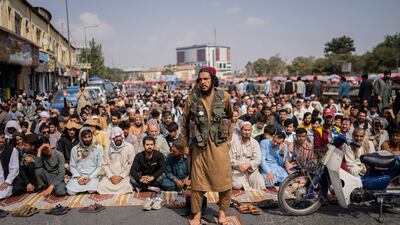
A Taliban fighter and a group of Afghan men attend Friday prayers in Kabul. AP Photo -
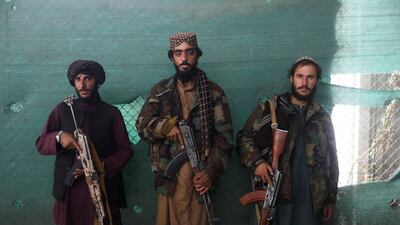
Taliban soldiers in Bagram Air Base in Parwan. Reuters -
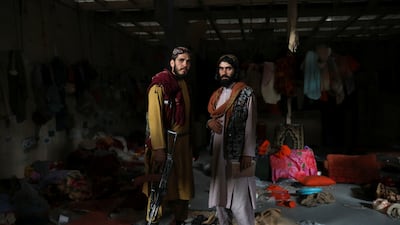
Taliban soldiers Seifatollah and Vasighollah stand in a prison in Bagram Air Base. Reuters -
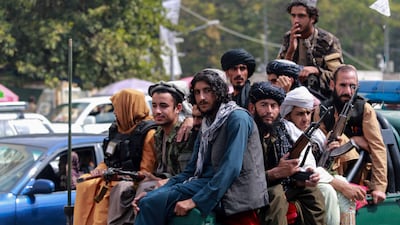
Taliban patrol Kabul. EPA -
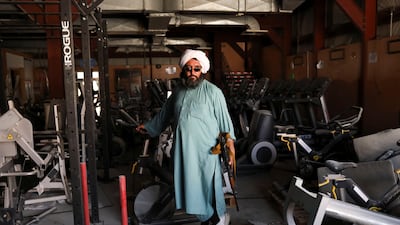
Vahdat, a Taliban soldier and former prisoner, stands next to exercise equipment in Bagram Air Base. Reuters -
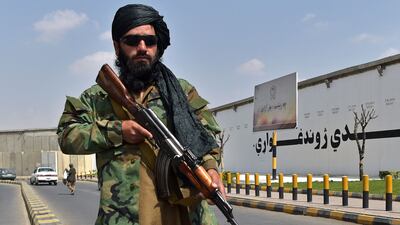
A Taliban fighter stands guard near Zanbaq Square in Kabul. AFP -
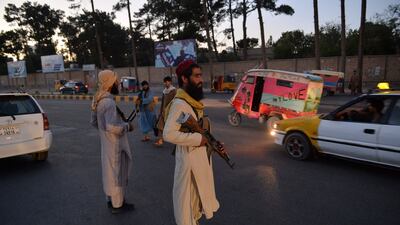
Taliban fighters police a road in Herat. AFP


The US formally ended its combat role in Iraq this month, but it is still partnering with Baghdad to fight extremists.
Some experts fear the Biden administration's military adjustments in the Middle East will fail to boost deterrence.
“The Biden administration's posture review does not reflect the strategic urgency required to meet the national security challenges the US faces now — much less in coming years,” said Jennifer Cafarella, a national security fellow at the Institute for the Study of War.
“Afghanistan and Syria remain primary examples of theatres in which an overly narrow definition of US interests led Washington to cede power vacuums that have driven instability and emboldened US adversaries.”
The US military in Syria came under increasing drone attacks from pro-Iranian groups this year. In the last two attacks in Al Tanf and Deir Zour, the US-led coalition limited its response to shooting drones down without risking escalation with Iran.
Like many observers, Ms Cafarella is questioning the US decision to leave Afghanistan.
“In both Afghanistan and Syria, small US commitments had significantly outsize strategic effects, making them smart investments amidst the changing landscape of geopolitical competition,” she said.
The Biden administration is in talks with Pakistan and other neighbouring countries to use their airspace to conduct “over-the-horizon” attacks on extremist groups inside Afghanistan.
US military commanders said this month that the threat of terrorism in Afghanistan has increased since the Taliban take over.
“Unfortunately, the Biden administration appears to be making force-posture decisions based on ideology rather than a well-calibrated defence strategy, which means additional withdrawals [including from the Middle East] are likely in the future,” Ms Cafarella noted.
John Spencer, a military scholar and the chairman of Urban Warfare Studies at the Modern War Institute, argued that ending the 20-year war in Afghanistan helps free up US military resources and institutional capacity to focus on those more strategic threats.
"The next war will be defined around the biggest threats to US interests and that clearly is going to be China and Russia," he said, dismissing the notion that future US military posture will shift to the high seas or cyber and drone wars instead of land battles.
The author of the forthcoming book Connected Soldiers: Life, Leadership and Social Connections in Modern War said current tension along Russia's border with Ukraine, where Moscow has amassed some 100,000 troops, makes it more critical that Mr Biden boosts the Nato alliance even as he pivots to Asia.
“You don't win wars and you don't achieve national interest without the full joint force, especially the land component,” Mr Spencer told The National, citing conflicts in Crimea and Nagorno-Karabakh as recent examples.
“History keeps reminding us that ground forces are still critical to achieving strategic objectives.”
-
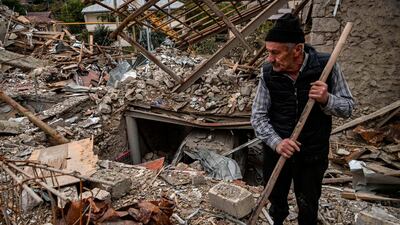
Retired police officer Guennadi Avanessian, 73, searches for belongings in the remains of his house, which he said was destroyed by Azeri shelling, in the city of Stepanakert. AFP -
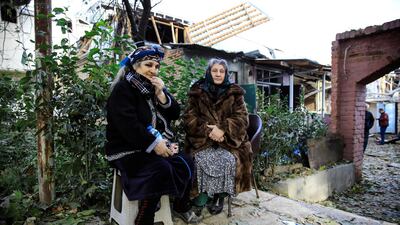
Women, whose houses are damaged, sit near the blast site hit by a rocket during the fighting over the breakaway region of Nagorno-Karabakh in the city of Ganja, Azerbaijan. Reuters -
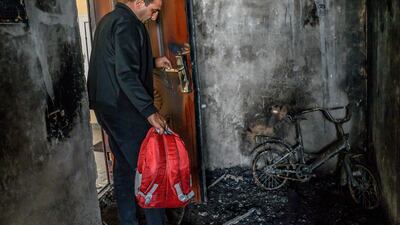
Razim Mehmedov, 40, holding his daughter's backpack stands in his flat that was damaged and burnt by shelling as residents return to their homes after a ceasefire in the military conflict between Armenia and Azerbaijan over the breakaway region of Nagorno-Karabakh, in the town of Terter, Azerbaijan. AFP -
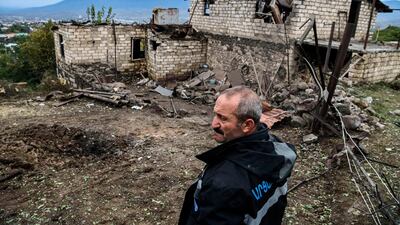
Ashot Aghajanian, 54, stands in the yard of his house destroyed by shelling in Stepanakert. AFP -
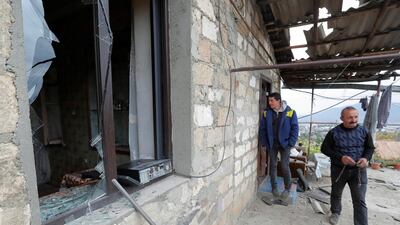
Men are seen next to a house damaged by recent shelling during the military conflict over the breakaway region of Nagorno-Karabakh, in Stepanakert. Reuters -
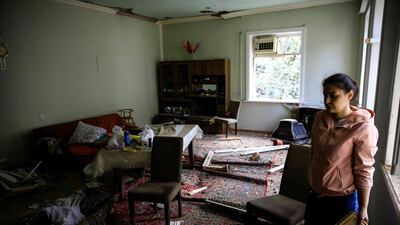
A woman searches for belongings in her damaged house hit by a rocket during the fighting over the breakaway region of Nagorno-Karabakh in the city of Ganja, Azerbaijan. Reuters -

Women are distraught after fighting broke out in the city of Ganja, Azerbaijan. AFP -
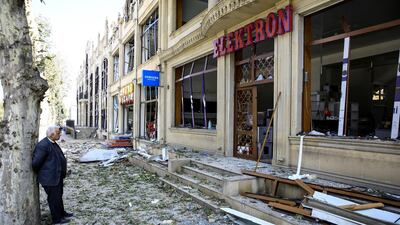
A shop owner stands in front of his destroyed premises in Ganja. Reuters -
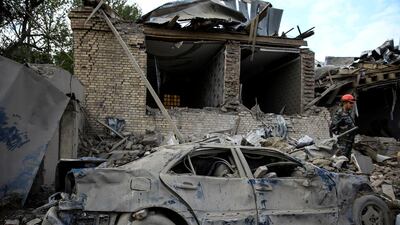
A damaged car in Ganja. Reuters -
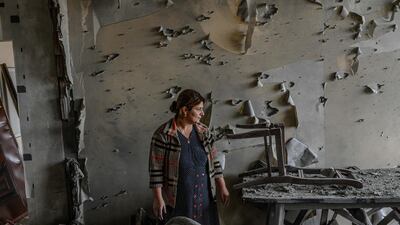
Xatire Celilova stands inside her destroyed flat after a ceasefire, in Terter, Azerbaijan. AFP -

Razim Mehmedov, 40, sits in a bedroom of his flat that was damaged and burnt by shelling as residents return to their homes in Terter. AFP -

Yasin Budakov, 40, holds a book, which his child forgot to take when they were running out of the family’s damaged flat in Terter. AFP -

A man watches rescuers searching for victims or survivors at a blast site in the city of Ganja. AFP



