

Four astronauts began their journey to the International Space Station on Thursday, blasting off from Nasa’s Kennedy Space Centre on board a SpaceX rocket.
The nine first-stage engines of the Falcon 9 roared into life just after 6am Gulf Standard Time, sending the Crew Dragon capsule and its occupants blazing through the darkened Florida skies.
Breaking through the sound barrier after only a minute, the rocket’s first stage then separated from the spacecraft and upper stage, landing autonomously on a SpaceX drone ship waiting in the Atlantic.
Shannon Walker, a Nasa astronaut who flew to space on the Crew-1 mission in November last year, said: "It was one of the most impressive launches I have seen."
Hours earlier, the astronauts smiled and waved as they headed for the launchpad in a convoy of Tesla cars before boarding the capsule.
A SpaceX tracker showed the Dragon capsule flying towards its rendezvous with the ISS.
-

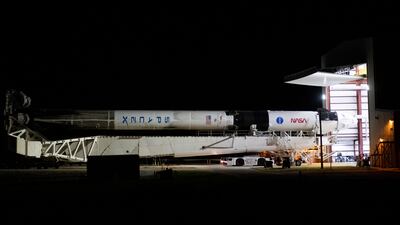
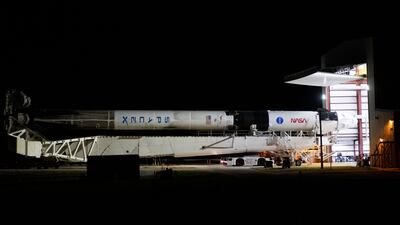
A SpaceX Falcon 9 rocket with the company's Crew Dragon spacecraft onboard on the launch pad during a static fire test before the Crew-3 mission, at Nasa's Kennedy Space Centre, Florida. EPA -

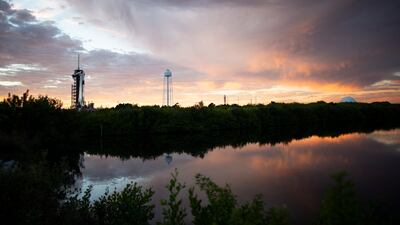
Sunset on the launch pad as preparations continue for the Crew-3 mission. EPA -
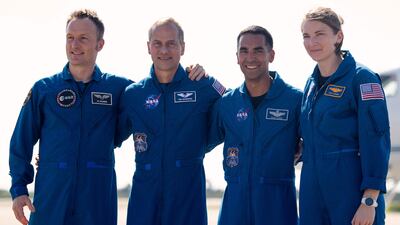
Nasa astronauts Raja Chari, Tom Marshburn, Kayla Barron and European Space Agency astronaut Matthias Maurer made up the crew. EPA -
They will spend six months researching material sciences, health and botany. EPA -

The team is expected to dock with the space station after a flight lasting several hours. EPA -

Raja Chari (2nd R) speaks to the media in Florida, with Tom Marshburn (2nd L), Kayla Barron (R) and Matthias Maurer. AFP -
The astronauts looked relaxed as they arrived at the Kennedy Space Centre. AFP -
The purpose of the mission is to help inform future deep space exploration. AP -
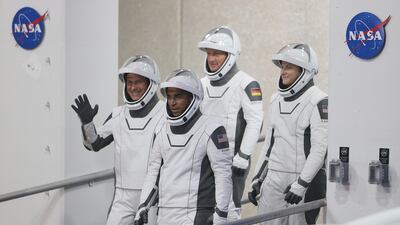
The Crew-3 astronauts begin their journey to the launch pad. AFP -

Matthias Maurer waves as he heads for the launch pad in a Tesla. AP -
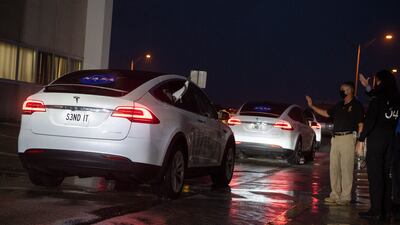
The Crew-3 astronauts head to the launch pad in a convoy of Tesla cars. EPA / Joel Kowsky / NASA / HANDOUT -
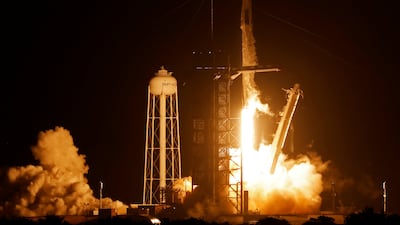
The Falcon 9 rocket carrying the astronauts lifts off. Reuters -
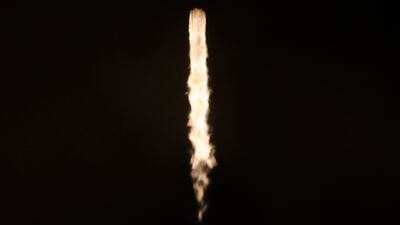
Flames from the rocket lit up the night sky over Florida during take off. Reuters


Thursday's flight was the fourth crewed mission to the ISS under Nasa's partnership with SpaceX, the rocket company founded in 2002 by Elon Musk, the billionaire chief executive of electric car maker Tesla.
The Crew-3 mission followed a flurry of high-profile space tourism flights this year, including the September launch of SpaceX Inspiration 4, the first all-civilian crew sent into orbit without a professional astronaut to accompany them.
Originally planned for October 31, Thursday's flight was delayed several times by bad weather over the launch site, and by what Nasa called a “minor medical issue” involving one of the four crew members.
Steve Stich, Nasa’s commercial crew programme manager, said on Tuesday that the astronauts were "all in good shape” ahead of the flight. The agency has not revealed which astronaut was affected by the medical issue.
The delays meant that the astronauts of the previous mission to the ISS, Crew-2, had to return to Earth before their replacements took off. A SpaceX Crew Dragon capsule carrying those astronauts splashed down in the Gulf of Mexico on Tuesday.
During that Crew-2 landing, one of the capsule’s four main parachutes was slow to open, fully deploying more than a minute after the other three and throwing up another potential problem for the Crew-3 launch schedule.
But Nasa and SpaceX said they had investigated the parachute issue and found nothing out of the ordinary.
“We don’t see anything that’s off-nominal that concerns us from a parachute standpoint,” said Bill Gerstenmaier, vice president of build and flight reliability at SpaceX.
“It performed essentially the way it was designed to perform,” he said, adding that SpaceX had observed parachutes deploying more slowly in tests.
Who are the astronauts of Crew-3?
The Crew-3 mission is made up of three Nasa astronauts, Lt Col Raja Chari, Tom Marshburn and Kayla Barron, and German Matthias Maurer of the European Space Agency.
Lt Col Chari, a US Air Force officer, is commanding the mission.
The astronauts are expected to dock with the ISS at 4.10am on Friday and will spend six months on board the orbital laboratory conducting experiments in botany, material science and health.

The Crew-3 mission is intended to help pave the way for future space exploration and benefit life on Earth.
Only one member of the crew has been to space before.
Mr Marshburn flew on a space shuttle mission in 2009 and then on a Russian Soyuz spacecraft from 2012-2013.
Ms Barron is the newest addition to Nasa’s astronaut corps, joining in 2017 after serving in the US Navy’s submarine fleet.
Mr Maurer, a materials science engineer, will become the 12th German to travel to space.
What science experiments will the crew conduct?
The mission’s main scientific aims include experiments to grow plants in space without soil and build optical fibres in microgravity, which research suggests would be better than those made on Earth.
Mr Maurer will help set up the European Robotic Arm on the Russian side of the ISS, and test out an artificial intelligence assistant called Cimon, which was developed by the German space agency DLR, Airbus and IBM.
“It’s an experiment which is really paving the way towards exploration,” he said.
One use envisioned for the AI assistant is to act as a geology expert that could help astronauts on a future mission to Mars, because of the time delay to communications with Earth, he said.
The Crew-3 astronauts will also go on spacewalks to finish upgrading the station’s solar panels.
The crew will also be on the ISS during two tourism missions, hosting Japanese tourists arriving aboard a Russian Soyuz spacecraft at the end of 2021 and the SpaceX Axiom crew, which is due to take off in February 2022.
Crew-2 splash down – in pictures
-
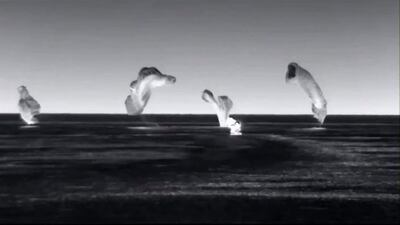
A screen grab from the SpaceX live webcast shows the Crew-2 SpaceX Dragon capsule 'Endeavour' parachuting to splashdown off the coast of Pensacola, Florida. AFP -
The SpaceX capsule with four astronauts aboard left the International Space Station for Earth after they spent six months in orbit. AFP -
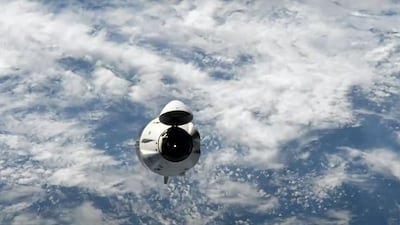
Since arriving on the ISS on April 24, the crew of two Americans, a Frenchman and one Japanese astronaut conducted hundreds of experiments and helped to upgrade the station's solar panel array. AFP -

The SpaceX Dragon capsule begins its return to Earth. AFP -
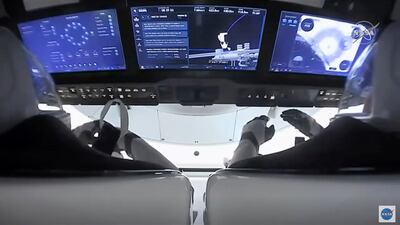
Astronauts in the SpaceX Dragon capsule prepare for undocking from the ISS. AP -
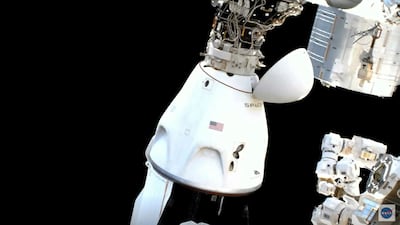
Astronauts collect data before returning to Earth. AP



