

The US Food and Drug Administration on Wednesday struck a decidedly neutral tone on whether to back booster shots of Pfizer's Covid-19 vaccine.
The agency's 23-page report comes before a crucial meeting on Friday, when its advisory panel will debate if there is enough proof to to show that Pfizer's Covid-19 booster shot is safe and effective.
If the panel determines Pfizer's booster shot is safe and effective and that it also raises immunity levels, the Centres for Disease Control and Protection will have decide which Americans should receive the additional dose.
Advisers to the CDC will hold a two-day meeting next week to discuss booster vaccines, Reuters reported.
President Joe Biden's administration plans to begin offering booster shots to eligible Americans beginning September 20, pending approval from the FDA, as part of its plan to combat the Covid-19 pandemic in the US. That plan could be delayed if the FDA's panel delivers a negative view of the proposal.
White House Press Secretary Jen Psaki on Wednesday expressed an optimistic view of the administration's planned roll-out.
“There was always going to be a process; that process is proceeding,” Ms Psaki said.
Mr Biden has already committed to receiving a booster dose.
To bolster its case for a booster shot, Pfizer pointed the FDA to data from Israel, which began offering boosters over the summer.
Pfizer noted its vaccine's strength wanes after six to eight months following the second dose, and virus-fighting antibodies offered from a third dose given to people during that time period appear strong enough to fend off the highly transmissible Delta variant.
Pfizer argued that the booster shot restored protection to “95 per cent effectiveness".
But the FDA remains sceptical, noting observational studies could include “known and unknown biases that can affect their reliability”.
-
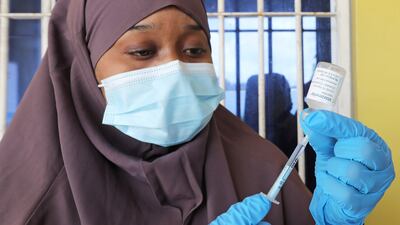
A healthcare worker prepares to administer a Covid-19 vaccine in Mogadishu, Somalia. Reuters -
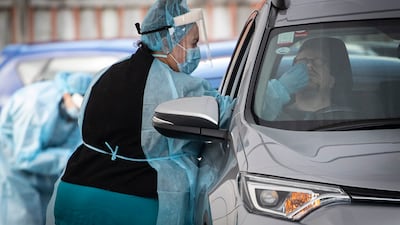
Workers take samples for Covid-19 tests at a drive-through clinic in Auckland, New Zealand. AP -

A monk uses his mobile phone in Ho Chi Minh City, Vietnam. Reuters -

A man reads a newspaper next to closed shops after the government announced an island-wide lockdown in Colombo, Sri Lanka. EPA -

A woman instructs her grandson to clean his hands at the State Fair in Louisville, Kentucky. Reuters -
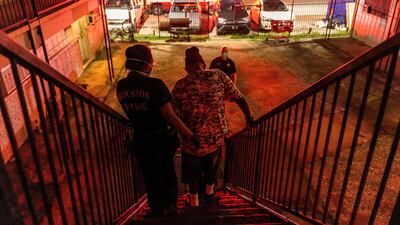
Medics transport a Covid-positive patient to a hospital in Houston, Texas. AFP -

Members of the security forces guard the Taj Mahal after sunset in Agra, India. EPA -

Vancouver Whitecaps goalkeeper Maxime Crepeau signs autographs before his team's match against Los Angeles FC in Vancouver, Canada. AP -
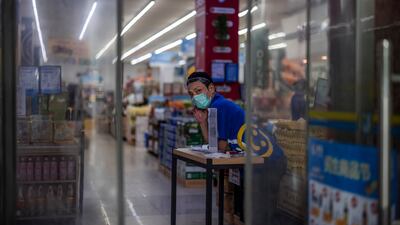
An employee stands at the entrance of a supermarket to check visitors' health app QR codes and body temperature in Shanghai, China. EPA -
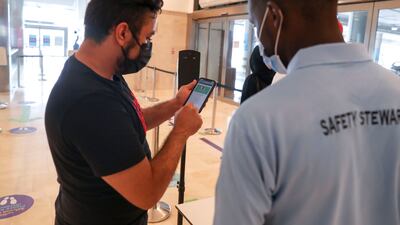
A man shows the green pass on his phone before entering a shopping mall in Abu Dhabi, UAE. Khushnum Bhandari / The National


The agency added that US-based studies are also likely to better represent vaccine effectiveness among Americans.
In its report, the FDA also indicated that overall data suggest Pfizer and other US-authorised Covid-19 vaccines “still afford protection against severe Covid-19 disease and death in the United States".
Moderna has also asked the FDA to allow a booster shot of its vaccine, but it remains unclear when the agency will discuss that or a booster for the single-dose Johnson & Johnson vaccine.
The US is already offering extra Pfizer or Moderna doses to those with severely weakened immune systems.
By pushing ahead with its booster roll-out, the US has rejected arguments from the World Health Organisation and other advocates that say rich countries should withhold offering boosters until more people worldwide have been vaccinated.
The Biden administration has recently taken a more hard-line stance on vaccine mandates amid the surging Delta variant, which has overwhelmed hospitals in states with low vaccination rates.
The US Department of Labour is currently developing a plan that would require businesses with at least 100 employees to require all workers be fully inoculated or subjected to weekly Covid-19 testing. Mr Biden also signed an executive order requiring the full vaccination of federal employees and contractors.
In all, up to 100 million vaccine-eligible Americans could be affected.
The disease has killed more than 667,000 people in the US, the highest death toll recorded for any country globally.

