


Myanmar’s UN ambassador Kyaw Moe Tun says he will not be cowed by an assassination plot against him and that he will continue resisting efforts by the military leadership back home to take his seat at UN headquarters in New York.
In an exclusive interview with The National, Kyaw Moe Tun, the UN envoy for Myanmar’s ousted civilian government, said he is “safe” thanks to round-the-clock security from US guards and that the fight for people power in Myanmar continues.
“We are resolute,” Kyaw Moe Tun said, adding he would fight until the military regime is brought down.
Since seizing power in a February 1 coup, the military has repeatedly tried to replace Kyaw Moe Tun with a loyalist. The envoy said he will not step down and urged the UN’s credentials committee to take his side when it meets next month.
“This seat is important for the people of Myanmar,” he said.
“Through this seat, I can convey the messages of the people of Myanmar and I can inform the desire of the people of Myanmar to the international community.”
Kyaw Moe Tun predicts a showdown in the coming weeks over whether he can remain as Myanmar's ambassador or whether the country's military leaders will be allowed to replace him with a hand-picked envoy.
Rival claims to UN representation are considered by a nine-member credentials committee that reports to the 193-nation General Assembly. The panel is set to meet in September before leaders travel to Manhattan for the UN’s annual high-level week.
Kyaw Moe Tun said he is “confident” that members will “listen to the voices of the people of Myanmar”.
-
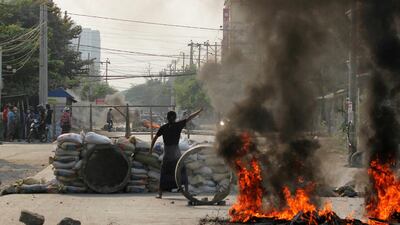
A demonstrator gestures near a barricade during a protest against the military coup in Mandalay, Myanmar. Reuters -
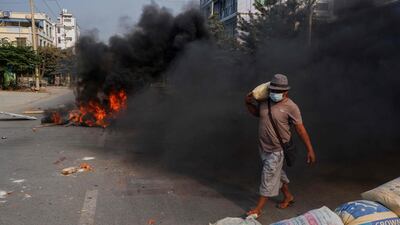
A man carries a sandbag to erect a makeshift barricade, as security forces stage a crackdown on demonstrations by protesters against the military coup, in Mandalay. AFP -

Demonstrators are seen behind barricades during a protest against the military coup in Mandalay. Reuters -
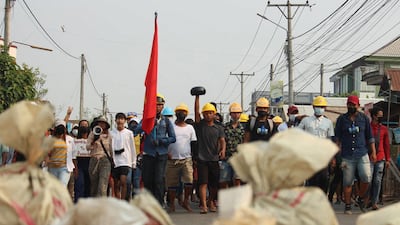
Protesters take part in a demonstration against the military coup in the coastal city of Dawei. AFP -
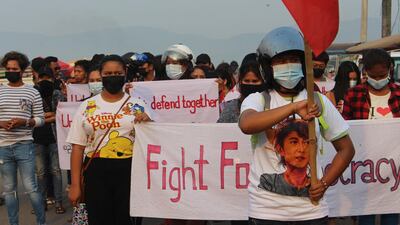
Protesters take part in a demonstration against the military coup in the coastal city of Dawei. AFP -
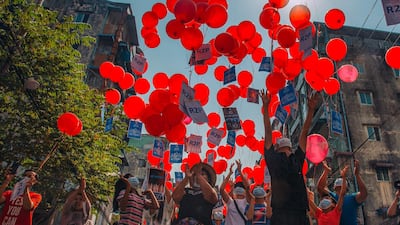
Residents release balloons with messages relating to "R2P", or the "Responsibility to Protect" principle that the international community is justified in taking action against a state that is deemed to have failed to protect its population from atrocities, in Yangon's Hlaing township. AFP -
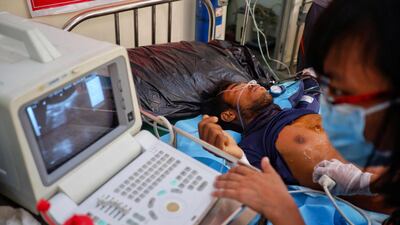
A resident receives medical attention after being injured during a crackdown by security forces on demonstrations by protesters against the military coup, in Mandalay. AFP -
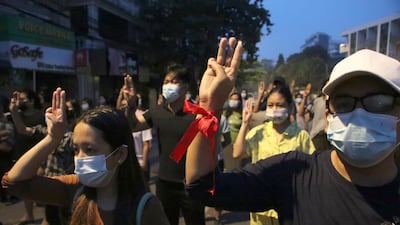
Anti-coup protesters flash three-fingered gesture, a symbol of resistance, during a rally outside their homes in downtown Yangon, Myanmar. AP Photo -

A demonstrator looks on along burning debris during a protest against the military coup in Mandalay. EPA -
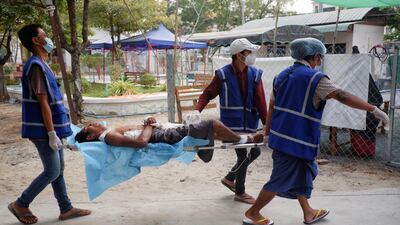
Medical volunteers carry an injured protester who was shot during a demonstration against the military coup in Mandalay. Reuters -
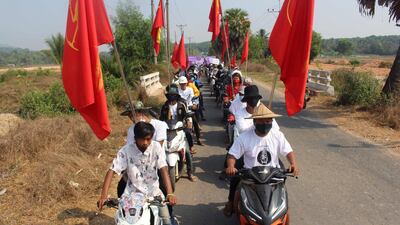
Protesters with flags take part in a demonstration against the military coup as they ride scooters through a rural part of Launglone township in Myanmar's Dawei district. AFP -
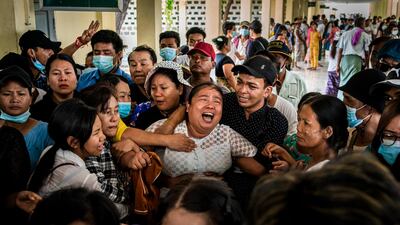
The mother of Aung Kaung Htet wails while mourning during a funeral for Aung, 15, who was killed when military junta forces opened fire on anti-coup protesters in Yangon. Getty Images -
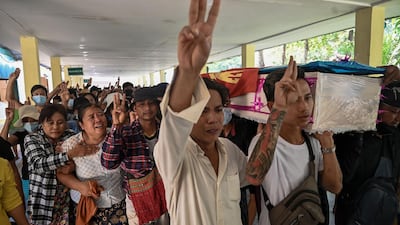
Mourners hold up the three-finger salute as they carry the coffin during the funeral of teenage protester Aung Kaung Htet in Yangon. AFP -
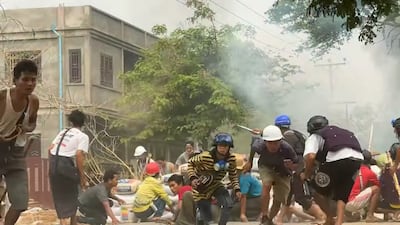
Protesters take cover during clashes with security forces in Monywa. Reuters -
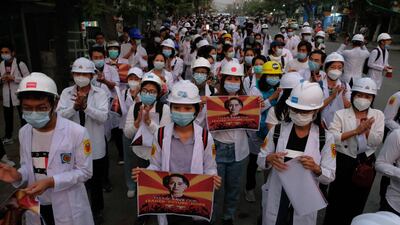
Medical staff and students take part in an early morning protest against the military coup and crackdown by security forces on demonstrations in Mandalay. AFP


He spoke with The National while under 24-hour US protection after investigators uncovered a plot involving at least two citizens of Myanmar to intimidate and even assassinate him if he refused to resign from his post.
Phyo Hein Htut, 28, and Ye Hein Zaw, 20, face up to five years in prison. Myanmar's military have denied any involvement in the conspiracy.
Prosecutors say Phyo Hein Htut had been in touch with an arms dealer in Thailand linked to Myanmar’s military. The plot reportedly involved hiring assailants and sabotaging the ambassador’s car to force it to crash.
Kyaw Moe Tun has cut back on his public activities, but was upbeat about his safety thanks to “very swift action” by US law enforcement. Members of his extended family back home were in a “safe place” he added, without elaborating.
Phyo Hein Htut had occasionally served as a volunteer security guard at Myanmar’s mission to the UN, he added.
The ambassador spoke with The National against a backdrop of chaos in Myanmar, which was upended when the military ousted an elected government led by Aung San Suu Kyi, with regular protests and fighting between the army and newly formed militias.
The US, Britain and others have slapped sanctions on Myanmar's military rulers over the coup and the repression of pro-democracy protests. More than 900 people have been killed and thousands arrested in the crackdown, a local monitoring group has reported.
The US on Tuesday said it would give Myanmar more than $50 million in aid to fight surging Covid-19 infections. After six months of turmoil, Myanmar's economy has collapsed and its health system has buckled against the fast-spreading pathogen.
For Kyaw Moe Tun, the South-East Asian nation has see-sawed between military and democratic civilian rule in recent turbulent decades, but the long-term trend is bending in favour of people power, he said.
Pro-democracy activists have thanked the West for its support to date, but want further action including the setting up no-fly zones to ground the military’s aircraft, enacting arms embargoes, as well as placing tougher sanctions on military chiefs.
“What we see is not enough,” Kyaw Moe Tun said.
“We need stronger and decisive action from the international community to stop the violence".

