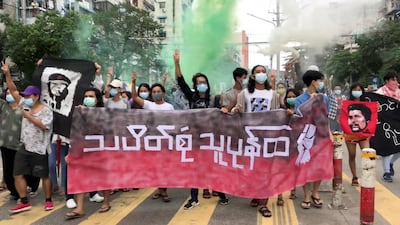
The UN General Assembly on Friday passed a resolution urging a halt to the flow of weapons into Myanmar after Secretary General Antonio Guterres called for “democracy to be reinstated” in the country following a military coup in February.
Speaking with reporters after taking the oath of office for a second term as UN secretary general, Mr Guterres asked for a "clear message" from the General Assembly.
He called for “democracy to be reinstated, those that were put in prison to be liberated and for the horrible violations of human rights and the killings that have taken place to stop”.
“I hope that the General Assembly will be able to send a very clear message in this direction, because we cannot live in a world where military coups become a norm,” he said.
The General Assembly adopted the resolution with the support of 119 countries. Belarus, which asked for the resolution to be put to a vote, was the only country to oppose it, while China and Russia were among 36 which abstained.
Myanmar has been in chaos since the junta seized power on February 1 and jailed elected leader Aung San Suu Kyi and other senior members of her party.
The coup has unleashed daily protests as well as fighting between the armed forces and ethnic minority forces.
The General Assembly resolution was weeks in the making and followed talks between western countries and the Asean regional bloc, which has been mediating a crisis that could push half of Myanmar’s population below the poverty line.
An earlier draft called for the “immediate suspension” of all weapons transfers to the country, but talks with Asean saw this diluted to a call “to prevent the flow of arms into Myanmar”.
General Assembly resolutions carry moral weight, but only the Security Council can impose legally binding sanctions. Such moves require nine votes in favour and no veto from the US, Russia, China, France or Britain, the five permanent council members.
Serious action on Myanmar by the Security Council has been opposed by China and some other Asian members.
Human Rights Watch and Amnesty International have pushed for a tough General Assembly resolution to prompt the Security Council to impose an enforceable arms embargo.
Britain’s UN ambassador Barbara Woodward said on Friday “urgent action” was needed to pressure Myanmar’s junta and that the General Assembly draft was an “opportunity to send a clear message”.
“The military has committed horrific acts of violence against ordinary civilians. They have burnt villages to the ground,” Ms Woodward told reporters.
“Thousands of people have been forced to flee over the borders to seek refuge in neighbouring countries.”
The UN envoy to Myanmar, Christine Schraner Burgener, briefed the council on the crisis behind closed doors on Friday after returning from a trip to the region, which did not include a stop in Myanmar, as the junta has barred her from entering.
Speaking with reporters afterwards, she said the junta had been “surprised about the resistance of the people”, with opponents to military rule holding anti-coup protests, creating a parallel government and forming armed resistance cells.
“That's a new situation, different from the past when they had the full power,” said Ms Schraner Burgener.
The council also heard from Erywan Pehin Yusof, Brunei's second minister for foreign affairs, who was one of two envoys from the Asean regional bloc to meet Myanmar's junta leader Min Aung Hlaing this month.
The junta says it overthrew Ms Suu Kyi’s government over its refusal to address reported fraud in the November election that she won in a landslide.
International observers have said the elections were fair.
The junta’s forces have killed more than 860 people since the February 1 coup, according to the Assistance Association for Political Prisoners, a campaign group. The junta has said the number is much lower.
The UN office in Myanmar this week said it was "alarmed" by the "sharp deterioration" in the country following a discovery of mass graves and the reported torching of some 150 homes by government security forces in the Magway region.
Ms Suu Kyi's trial began on Monday, hearing evidence that she broke coronavirus restrictions during last year’s election and illegally imported walkie-talkies, her lawyer told reporters.
The pro-democracy leader turned 76 on Saturday, with opponents of the coup wearing flowers in their hair in imitation of her trademark style to mark the occasion.

Rankings
ATP: 1. Novak Djokovic (SRB) 10,955 pts; 2. Rafael Nadal (ESP) 8,320; 3. Alexander Zverev (GER) 6,475 ( 1); 5. Juan Martin Del Potro (ARG) 5,060 ( 1); 6. Kevin Anderson (RSA) 4,845 ( 1); 6. Roger Federer (SUI) 4,600 (-3); 7. Kei Nishikori (JPN) 4,110 ( 2); 8. Dominic Thiem (AUT) 3,960; 9. John Isner (USA) 3,155 ( 1); 10. Marin Cilic (CRO) 3,140 (-3)
WTA: 1. Naomi Osaka (JPN) 7,030 pts ( 3); 2. Petra Kvitova (CZE) 6,290 ( 4); 3. Simona Halep (ROM) 5,582 (-2); 4. Sloane Stephens (USA) 5,307 ( 1); 5. Karolina Pliskova (CZE) 5,100 ( 3); 6. Angelique Kerber (GER) 4,965 (-4); 7. Elina Svitolina (UKR) 4,940; 8. Kiki Bertens (NED) 4,430 ( 1); 9. Caroline Wozniacki (DEN) 3,566 (-6); 10. Aryna Sabalenka (BLR) 3,485 ( 1)
Can NRIs vote in the election?
Indians residing overseas cannot cast their ballot abroad
Non-resident Indians or NRIs can vote only by going to a polling booth in their home constituency
There are about 3.1 million NRIs living overseas
Indians have urged political parties to extend the right to vote to citizens residing overseas
A committee of the Election Commission of India approved of proxy voting for non-resident Indians
Proxy voting means that a person can authorise someone residing in the same polling booth area to cast a vote on his behalf.
This option is currently available for the armed forces, police and government officials posted outside India
A bill was passed in the lower house of India’s parliament or the Lok Sabha to extend proxy voting to non-resident Indians
However, this did not come before the upper house or Rajya Sabha and has lapsed
The issue of NRI voting draws a huge amount of interest in India and overseas
Over the past few months, Indians have received messages on mobile phones and on social media claiming that NRIs can cast their votes online
The Election Commission of India then clarified that NRIs could not vote online
The Election Commission lodged a complaint with the Delhi Police asking it to clamp down on the people spreading misinformation
COMPANY%20PROFILE
%3Cp%3E%3Cstrong%3EName%3A%20%3C%2Fstrong%3ESmartCrowd%0D%3Cbr%3E%3Cstrong%3EStarted%3A%20%3C%2Fstrong%3E2018%0D%3Cbr%3E%3Cstrong%3EFounder%3A%20%3C%2Fstrong%3ESiddiq%20Farid%20and%20Musfique%20Ahmed%0D%3Cbr%3E%3Cstrong%3EBased%3A%20%3C%2Fstrong%3EDubai%0D%3Cbr%3E%3Cstrong%3ESector%3A%20%3C%2Fstrong%3EFinTech%20%2F%20PropTech%0D%3Cbr%3E%3Cstrong%3EInitial%20investment%3A%20%3C%2Fstrong%3E%24650%2C000%0D%3Cbr%3E%3Cstrong%3ECurrent%20number%20of%20staff%3A%3C%2Fstrong%3E%2035%0D%3Cbr%3E%3Cstrong%3EInvestment%20stage%3A%20%3C%2Fstrong%3ESeries%20A%0D%3Cbr%3E%3Cstrong%3EInvestors%3A%20%3C%2Fstrong%3EVarious%20institutional%20investors%20and%20notable%20angel%20investors%20(500%20MENA%2C%20Shurooq%2C%20Mada%2C%20Seedstar%2C%20Tricap)%3C%2Fp%3E%0A
MATCH INFO
Uefa Champions League quarter-final second leg:
Juventus 1 Ajax 2
Ajax advance 3-2 on aggregate
MATCH INFO
Manchester City 2 (Mahrez 04', Ake 84')
Leicester City 5 (Vardy 37' pen, 54', 58' pen, Maddison 77', Tielemans 88' pen)
Man of the match: Jamie Vardy (Leicester City)
The specs
Engine: 2-litre 4-cylinder and 3.6-litre 6-cylinder
Power: 220 and 280 horsepower
Torque: 350 and 360Nm
Transmission: eight-speed automatic
Price: from Dh136,521 VAT and Dh166,464 VAT
On sale: now
25%20Days%20to%20Aden
%3Cp%3EAuthor%3A%20Michael%20Knights%3C%2Fp%3E%0A%3Cp%3EPages%3A%20256%3C%2Fp%3E%0A%3Cp%3EAvailable%3A%20January%2026%3C%2Fp%3E%0A
Mercer, the investment consulting arm of US services company Marsh & McLennan, expects its wealth division to at least double its assets under management (AUM) in the Middle East as wealth in the region continues to grow despite economic headwinds, a company official said.
Mercer Wealth, which globally has $160 billion in AUM, plans to boost its AUM in the region to $2-$3bn in the next 2-3 years from the present $1bn, said Yasir AbuShaban, a Dubai-based principal with Mercer Wealth.
“Within the next two to three years, we are looking at reaching $2 to $3 billion as a conservative estimate and we do see an opportunity to do so,” said Mr AbuShaban.
Mercer does not directly make investments, but allocates clients’ money they have discretion to, to professional asset managers. They also provide advice to clients.
“We have buying power. We can negotiate on their (client’s) behalf with asset managers to provide them lower fees than they otherwise would have to get on their own,” he added.
Mercer Wealth’s clients include sovereign wealth funds, family offices, and insurance companies among others.
From its office in Dubai, Mercer also looks after Africa, India and Turkey, where they also see opportunity for growth.
Wealth creation in Middle East and Africa (MEA) grew 8.5 per cent to $8.1 trillion last year from $7.5tn in 2015, higher than last year’s global average of 6 per cent and the second-highest growth in a region after Asia-Pacific which grew 9.9 per cent, according to consultancy Boston Consulting Group (BCG). In the region, where wealth grew just 1.9 per cent in 2015 compared with 2014, a pickup in oil prices has helped in wealth generation.
BCG is forecasting MEA wealth will rise to $12tn by 2021, growing at an annual average of 8 per cent.
Drivers of wealth generation in the region will be split evenly between new wealth creation and growth of performance of existing assets, according to BCG.
Another general trend in the region is clients’ looking for a comprehensive approach to investing, according to Mr AbuShaban.
“Institutional investors or some of the families are seeing a slowdown in the available capital they have to invest and in that sense they are looking at optimizing the way they manage their portfolios and making sure they are not investing haphazardly and different parts of their investment are working together,” said Mr AbuShaban.
Some clients also have a higher appetite for risk, given the low interest-rate environment that does not provide enough yield for some institutional investors. These clients are keen to invest in illiquid assets, such as private equity and infrastructure.
“What we have seen is a desire for higher returns in what has been a low-return environment specifically in various fixed income or bonds,” he said.
“In this environment, we have seen a de facto increase in the risk that clients are taking in things like illiquid investments, private equity investments, infrastructure and private debt, those kind of investments were higher illiquidity results in incrementally higher returns.”
The Abu Dhabi Investment Authority, one of the largest sovereign wealth funds, said in its 2016 report that has gradually increased its exposure in direct private equity and private credit transactions, mainly in Asian markets and especially in China and India. The authority’s private equity department focused on structured equities owing to “their defensive characteristics.”
