


Live updates: Follow the latest news on Israel-Gaza
History teacher Samira has struggled to get her GCSE pupils at a boys’ school on the outskirts of London interested in the Tudors.
Instead, they have more pressing questions about the history of the Palestinian-Israeli conflict.
“None of my boys care one bit about Henry VIII’s wives,” Samira told The National.
“All of them do want to know how come land was taken away from people.
“Who are the Ottomans? How did Britain just get involved and hand it over to Israel? Why did European Jews end up in the Middle East?”
Samira, who teaches at a Muslim-majority school, is one of the few teachers addressing the conflict’s history, despite growing demand.
“The boys really wanted us to teach it,” she said. “It is part the world they’re living in. Right now, it’s a central part of the news they consume.”
Only 44 schools in the UK taught the Palestinian-Israeli conflict as part of the GCSE curriculum in 2023, despite the UK's historical involvement in Mandatory Palestine and the foundation of Israel.
The history of the conflict from the British withdrawal and creation of Israel in 1948 to the Oslo Accords of 1995 is taught in a GCSE History module by Edexcel, a UK exam body, and is the only one of its kind in the UK.

Yet in 2023, only 1,812 GCSE students registered at exams for the module across 44 schools, Edexcel told The National.
This accounts for 0.5 per cent of GCSE history entries for that year, which were 331,146 according to figures from the Nuffield Foundation.
It also represents less than 2 per cent of state secondary schools (3,061) in the UK excluding Scotland, according to data from the Department of Education.
OCR, another exam board, dropped its GCSE module covering the subject in 2019. It offers it for A-level, to an even smaller pool of history students.
The figures predate the October 7 Hamas attacks, which started the most recent Israel-Gaza war.
But earlier rounds of violence in Gaza, Jerusalem and the West Bank in recent years have led to growing questions from pupils about the conflict and its origins.
Extra-curricular initiatives addressing the conflict and its history have gained traction since October 7, and as the war has raised tension among communities in the UK.
UK educational charity Parallel Histories, which supplies teachers with resources on the conflict that tell the story from the Israeli and Palestinian perspectives, said demand for its material had tripled since that date.
Samira’s school has not taken up the Edexcel GCSE, but it has allowed her to teach the history of the conflict.

Other teachers told The National they had also set up history societies to teach about the hostilities.
Samira feared that not doing so would make children more vulnerable to misinformation on social media. She sensed pupils were giving up on their teachers.
“I had a kid in my class who asked what was happening in Israel and Palestine at the beginning of the conflict,” she said, referring to a different school.
“I told her we’re not talking about this. She said, 'It's OK, I’ll go home and watch it on TikTok.'
“She made me feel so redundant. I was like: my goodness, did you just replace me with TikTok?”
Teaching the conflict in schools is needed to create a safe environment for children to debate, and have any misconceptions or false information corrected, Samira said.
Physics teacher-turned-UK politician Layla Moran said it was difficult for teachers to do so without better resources and support.
“As a former teacher I can understand why this topic could be seen as being trickier to teach than other modules,” Ms Moran told The National.

Ms Moran, an MP with Palestinian heritage, has been campaigning for better understanding between UK communities as tensions have raised during the Israel-Gaza war.
“We have seen increasingly divisive rhetoric around the ongoing conflict in Gaza, with political leaders using events to stoke division amongst our communities at home,” she said.
“But the lack of any knowledge of the history of the Israel-Palestine conflict makes having reasoned conversations more difficult.
“It’s more important than ever that teachers are given sufficient support and training to equip them with the confidence they need to choose the GCSE history module and teach the material.”
Samira's pupils were inclined to empathise with the Palestinian story for family or spiritual reasons. She did not see this as a problem.
“You need to articulate the narrative to make a persuasive case,” she said.
“If they do believe in the Palestinian side rather than the Israeli side, they now have proper arguments, instead of sloganeering, which is so easy to do.”
Edexcel’s textbook on the Middle East has not been without controversy. In 2019, publisher Pearson pulled it off the shelves after complaints of bias from British-Jewish organisations.
Then in 2021, a British organisation supporting Palestinian universities said the revised edition had ignored crucial elements of the Palestinian story.
Parallel Histories' founder Michael Davies was commissioned by Edexcel to conduct independent reviews of its material after the complaints.
Latest from the Israel-Gaza war – in pictures
-
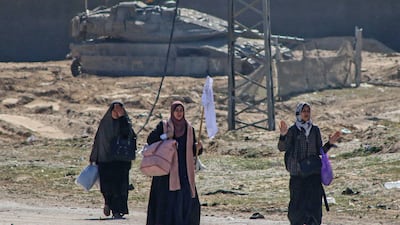
Displaced Palestinians hold a white flag as they pass an Israeli tank position while fleeing the Hamad Town district of Khan Younis. Bloomberg -
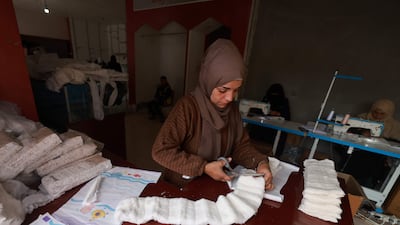
A Palestinian woman cuts material to be used for sewing nappies at a workshop in Rafah. AFP -
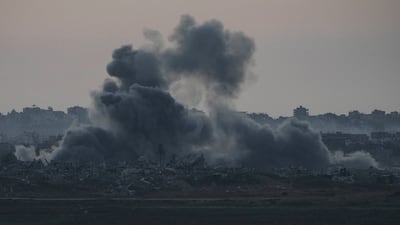
Smoke rises following an explosion in Gaza, as seen from southern Israel. AP -
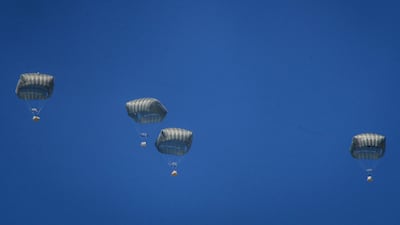
Parachutes carrying relief for Palestinians drop from an Egyptian Air Force cargo plane over central Gaza. Bloomberg -
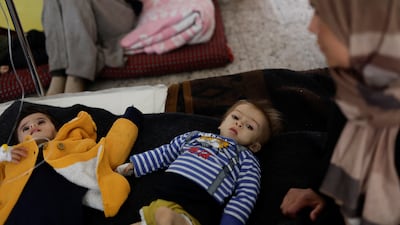
A Palestinian boy who is suffering from malnutrition is treated at a healthcare centre amid widespread hunger. Reuters -
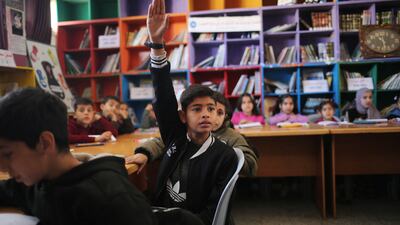
Palestinian children attend an English class in the library of the school housing displaced people in Rafah, the southern Gaza Strip. AFP -
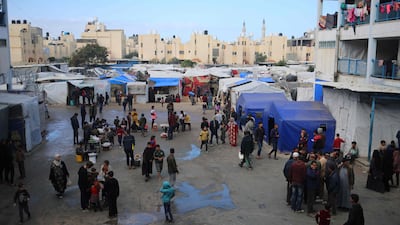
An UNRWA-run school housing displaced Palestinians in Rafah. AFP -
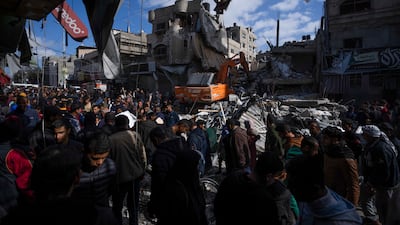
Palestinians search for bodies and survivors in the rubble of a residential building destroyed in an Israeli air strike in Rafah. AP -
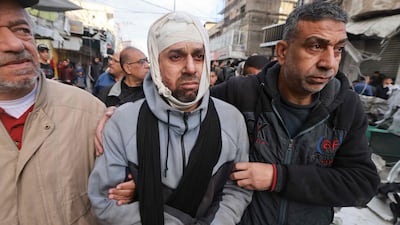
A wounded Palestinian man who lost his wife and daughter walks past a neighbours' house destroyed by Israeli bombing in Rafah. AFP -
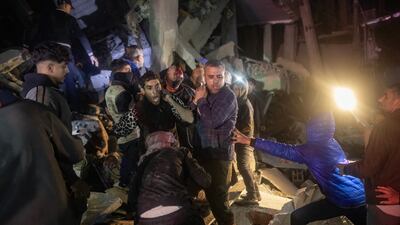
An injured man is rescued from the rubble after an Israeli air strike on the Rafah camp in Gaza. EPA -
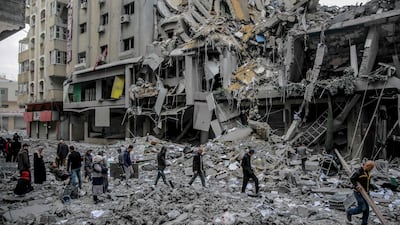
Palestinians walk amid the rubble of houses destroyed by the Israeli bombardment of Gaza city. AFP -

Aid is dropped into Gaza from US military aircraft. Reuters -
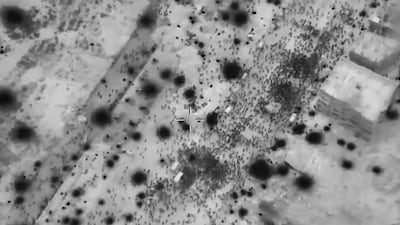
Palestinians gather at air lorries in Gaza. More than 100 were killed when Israeli troops opened fire. AP -
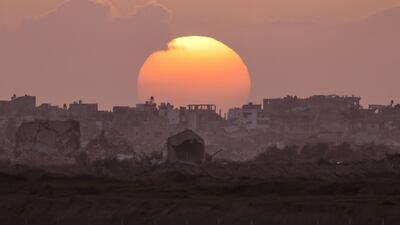
The sun sets behind destroyed buildings in Gaza. AFP -

A Palestinian man enters a heavily damaged house following an Israeli strike in Rafah, in the southern Gaza Strip. AFP -
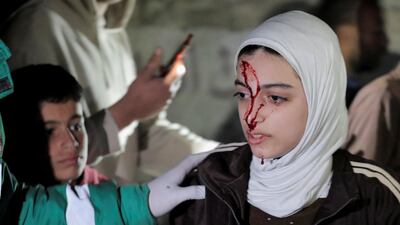
A wounded Palestinian is assisted at the site of an Israeli strike in Deir Al Balah, in the central Gaza Strip. Reuters -
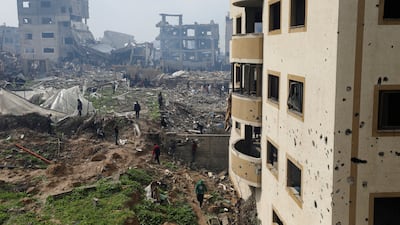
Palestinians gather in the hope of getting bags of flour carried by air lorries near an Israeli checkpoint in Gaza city, as the enclave's residents face crisis levels of hunger. Reuters -

Palestinian children wait to receive food cooked by a charity kitchen as the conflict between Israel and Hamas continues in Gaza. Reuters -
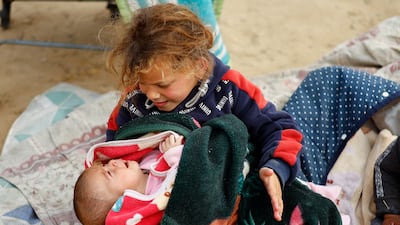
A displaced Palestinian child holds a crying baby in a camp in Rafah, in the southern Gaza Strip. Reuters


Another obstacle is the government’s counter-terrorism programme, Prevent, which requires head teachers to report any early signs of radicalisation among pupils.
Comments from pupils might be misconstrued and reported, with critics of the programme saying that Muslim children could unfairly become targets.
“That’s puts teachers in a very difficult position with the community of parents that they’re serving,” said Mr Davies.
“There was enough distrust, particularly from the Muslim community in the UK, that you can see why head teachers would be worried about being put in that position.”
Some Muslim teachers had been warning Muslim children that they risked being reported if they spoke about the conflict, Samira said. This furthered the distrust between pupils and their teachers.
“I can see where the teachers are coming from, but what happens is they [are] enforcing a silence that’s so uncomfortable,” she said.
“Children then know that schools and classrooms are not a safe place for them to express solidarity with Palestine, because they might be reported.”

Ghanem Nuseibeh, chairman of the UK charity Muslims Against Anti-Semitism, said teachers need better training to deal with topics such as the Palestinian-Israeli conflict.
“A teacher who wants to take a subject on would need to be extremely sensitive to the students’ responses,” Mr Nuseibeh said.
“I don’t think majority of teachers are trained to deal with such an active conflict, that brings up such high emotions.”
Concerns for a teachers' safety were plausible, he said.
“I fully understand the position of teachers. Particularly now, with social media, there will be an element of concern for their own safety and security from either side.”
But the UK had a “responsibility” to teach about the conflict because of its historical involvement and to prevent misinformation from spreading.
“The UK more than any other nation is morally and historically responsible for what is going on,” Mr Nuseibeh said.
“A lot of disinformation is spreading across communities. If you don’t teach it at schools, people will get their information from other sources. It’s important for facts to be established.”
A representative of the Department for Education said: “It is important that children are taught about global events and schools offer this opportunity in a safe and controlled environment.
“We know navigating the conflict can be challenging for teachers, and this is why the Education Secretary wrote to schools to provide advice on how to discuss the Israel-Hamas conflict in the classroom.
“We have also published resources and lesson plans on our Educate Against Hate website to complement existing guidance on impartiality.”
Protest outside UK Parliament calls for Gaza ceasefire – in pictures
-
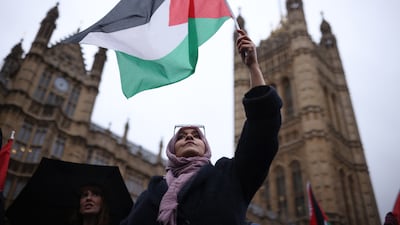
A protester waves a Palestinian flag during a rally outside the UK Parliament in London calling for a ceasefire, as MPs consider a motion on Gaza on February 21. Getty Images -
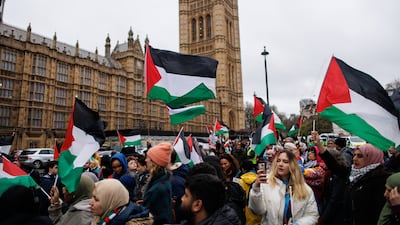
Pro-Palestinian protesters queue for the House of Commons public gallery as British MPs debate a motion in Parliament on calling a ceasefire in Gaza. EPA -
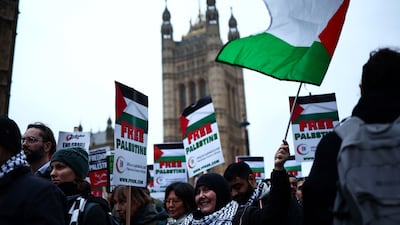
Demonstrators wave Palestinian flags in Parliament Square, London. AFP -
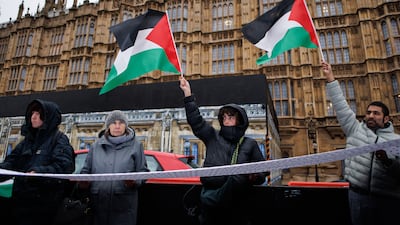
Protesters queue for the House of Commons public gallery. EPA -
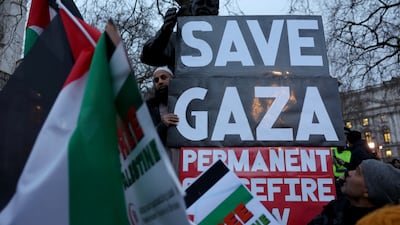
The protest outside the House of Commons. Reuters -
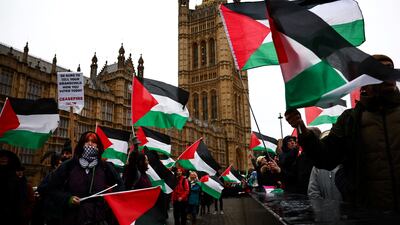
The protest in Parliament Square. AFP -
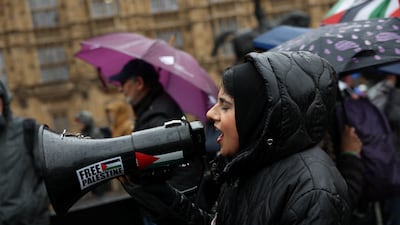
Campaigners queue to lobby MPs in Parliament before the Gaza ceasefire vote. Reuters -
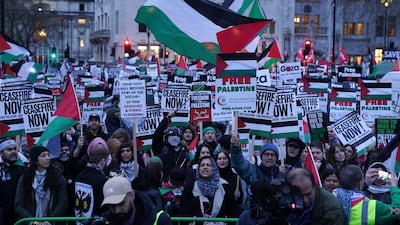
People gather for the Palestine Solidarity Campaign outside the Houses of Parliament. PA -
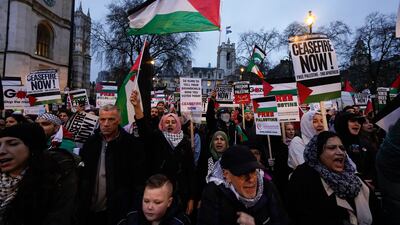
People take part in a Palestine Solidarity Campaign rally outside the Houses of Parliament, London. PA -
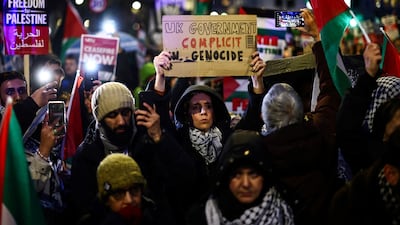
Demonstrators wave Palestinian flags and hold placards in Parliament Square. AFP -
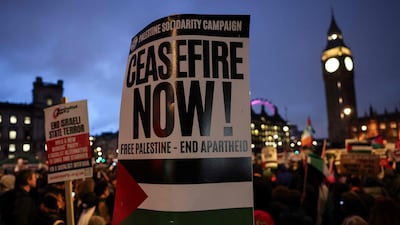
The protest in Parliament Square as the House of Commons voted on a call for an immediate ceasefire in Gaza. AFP



