



Britain's Chancellor Jeremy Hunt on Wednesday set out a budget that aimed to save the Conservatives’ election hopes, including giveaways to investors, an end to the non-dom tax regime and increased rates for business-class travellers.
There was also a well-trailed 2 per cent reduction to National Insurance. He announced a "one-off adjustment" to the level of air passenger duty for those with non-economy tickets, such as premium economy, business class and first class.
Mr Hunt helped UK property investors with an unexpected cut in taxes on property sales, reducing the higher rate of property capital gains tax from 28 per cent to 24 per cent.
However, holiday homeowners face losing out on profits as he ended mortgage relief on AirBnB properties. The Treasury estimates that the changes will raise £600 million over the next four years. With about 70,000 second homes registered as holiday lettings in the UK, that means each owner will lose an average of £2,142 a year.
He also announced plans to fund new housing developments and said the government was on track to build a million new homes by the end of this parliament
The chancellor confirmed he would scrap the current non-dom tax regime for wealthy foreigners with overseas earnings, replacing it with a “modern, simpler and fairer residency-based system”.
He said abolishing the non-dom status would raise £2.7 billion a year – which Labour, a supporter of the policy, had pledged to put into NHS funding but which Mr Hunt put towards tax cuts.
From April 2025, new arrivals to the UK will not be required to pay any tax on foreign income and gains for their first four years of UK residency, a more generous regime than at present and one of the most attractive offers in Europe.
“But after four years, those who continue to live in the UK will pay the same tax as other UK residents.”
Growth expected
The UK economy is expected to grow more than expected over the next two years as it rebounds from recession, according to the UK fiscal watchdog.
But it predicted that growth would ease back earlier than previously forecast in the longer term.
New economic predictions by the Office for Budget Responsibility (OBR) also showed that UK inflation is poised to drop below the government’s 2 per cent target rate within a “few months” after interest rate increases by the Bank of England.
It also warned that the slowdown in inflation could be knocked off course by disruption in the Middle East and surge by as much as 7 per cent in a worst-case scenario.
Mr Hunt told the House of Commons he would offer "much-needed help in challenging times" and stimulate economic growth.
Regarding inflation, he said: "When the Prime Minister and I came into office, it was 11 per cent. But the latest figures show it is now 4 per cent, more than meeting our pledge to halve it last year.
"And today's forecasts from the OBR show it falling below the 2 per cent target in just a few months' time, nearly a whole year earlier than forecast in the autumn statement.
"That did not happen by accident. Whatever the pressures and whatever the politics, a Conservative government, working with the Bank of England, will always put sound money first."
Mr Hunt told the house the economy is expected to grow 0.8 per cent this year and 1.9 per cent next year, 0.5 per cent higher than the OBR's autumn forecast.
Mr Hunt added: "Because we have turned the corner on inflation, we will soon turn the corner on growth."
He said Labour MPs "don't have a growth plan". "Our plan is for economic growth not sustained through migration but one that raises wages and living standards for families," he added.
The new plans come weeks after it was revealed the UK economy slipped into a technical recession at the end of 2023.
The Tories are about 20 points behind in opinion polls, meaning Mr Hunt is under pressure to revive growth and the Conservatives' election prospects.
Responding to the budget, opposition Labour leader Keir Starmer said “record levels of migration” have prevented an “even deeper decline”, telling MPs: “While on these benches we do not demean for a second the contribution that migrants make to a thriving economy, it is high time the party opposite was honest with the British public about the role migration plays in their economic policy.
“Because right now in terms of growth that is all they have. There is nothing else.”
As expected, there was no change to the 'tourist tax', despite a campaign to reintroduce VAT-free shopping for foreigners.
Dee Corsi of New West End Company, which represents 600 shops in London, said: "Whilst our EU counterparts actively leverage tax-free shopping as a means to supercharge growth, we are unable to see the policy’s potential – not just for retail, but for hospitality, leisure and cultural attractions across the nation.
"Put simply, the Chancellor has missed yet another opportunity to inject some growth into the UK at a time when we need it most and it is British businesses, and their employees, who will feel the impact most."
There was also little mention of defence. Spending on armed forces will rise to 2.5 per cent "as soon as economic conditions allow", Mr Hunt said.
The budget at a glance:
National Insurance
Mr Hunt announced a 2 per cent cut to National Insurance, from 10 per cent to 8 per cent, with self-employed National Insurance cut from 8 per cent to 6 per cent.
He said: "It means an additional £450 a year for the average employee or £350 for someone who is self-employed. When combined with the autumn reduction it means 27 million employees will get an average tax cut of £900."
Capital gains tax
Mr Hunt announced a reduction in the higher rate of property capital gains tax from 28 per cent to 24 per cent in the hope it would encourage landlords and second home-owners to sell their properties, making more available for a variety of buyers including those looking to get on the housing ladder for the first time.
The unexpected move to reduce the tax, paid on profits when you sell something that has increased in value, could prove a win-win for homeowners and the Treasury, said Victoria Price, managing director at Alvarez & Marsal Tax.
She said: “Mr Hunt made an unexpected move to reduce the CGT rate on residential properties sales from 28 per cent to 24 per cent with the Chancellor banking on the fact that a lower rate will stimulate more movement in the property market and ultimately increase taxes.
"A win-win for homeowners and the Treasury alike if this thesis plays out.”
Holiday lets
Mr Hunt abolished the furnished holiday lettings regime, removing favourable conditions afforded to furnished holiday lettings which is believed to cause a shortage of affordable housing in certain areas, such as Cornwall and the Lake District.
Travel
Mr Hunt also announced a tax increase for airline passengers travelling in premium cabins, with a “one-off adjustment” to the level of air passenger duty (APD) for those with non-economy tickets, such as premium economy, business class and first class.
He said the measure will “account for high inflation in recent years”. APD for passengers in premium cabins on departures from UK airports currently ranges from £13 to £200 based on the distance of the flight.
Clive Wratten, chief executive of the Business Travel Association industry body, called the hike "disastrous for the economic welfare and wellbeing of British businesses and their employees".
He added: “Contrary to common misconceptions, business travel is not just for the wealthy. This tax will hinder growth for small and medium enterprises through limiting international collaboration opportunities. This is therefore just another tax on British businesses.”
British ISA
Mr Hunt also announced a new British ISA to encourage investment in UK companies and boost the City.
It will give people an additional £5,000 tax-free allowance to invest in UK assets, on top of the existing £20,000 limit.
"This will be on top of the existing ISA allowances and ensure that British savers can benefit from the growth of the most promising UK businesses as well as supporting them with the capital to help them expand," Mr Hunt said.
Mr Hunt said he had received calls from more than 200 City representatives to reform the ISA system and encourage more people to invest in UK assets.
Oil and gas
Mr Hunt extended the windfall tax on North Sea oil and gas companies, saying the scheme will be extended by an additional year to 2029, raising £1.5 billion.
He said the government will legislate in the Finance Bill to abolish the Energy Profits Levy “should market prices fall to their historic norm for a sustained period of time”.
“But because the increase in energy prices caused by the Ukraine war is expected to last longer, so too will the sector’s windfall profits. So I will extend the sunset on the Energy Profits Levy for an additional year to 2029 raising £1.5 billion.”
Douglas Ross, the Scottish Conservative leader, criticised the plan.
He said: "There are many positive measures in the Chancellor’s budget which I strongly support.
"However, while I accept the Chancellor had some tough decisions to make, I’m deeply disappointed by his decision to extend the windfall tax for a further year."
Non-dom scheme replaced with residency scheme
Mr Hunt said the government will introduce a system which is both "fairer and remains competitive" and will abolish the current tax system for non-doms status.
"As of April 25, new arrivals to the UK will not be required to pay any tax on foreign income and gains for their first four years of UK residency, a more generous regime than at present and one of the most attractive offers in Europe," he said.
"But after four years, those who continue to live in the UK will pay the same tax as other UK residents."
Memorial to Muslims who fought for UK
The Chancellor announced £1 million to build a memorial honouring an estimated 750,000 Muslims who have fought for British armed forces.
"I start by today remembering the Muslims who died in two world wars in the service of freedom and democracy. We need a memorial to honour them," he told the house.
"Whatever your faith, or colour or class, this country will never forget the sacrifices made for our future."
Freeze in fuel duty
Mr Hunt said he would maintain the 5p cut and freeze fuel duty for a further 12 months.
"This will save the average car driver £50 next year and bring total savings since the 5p cut was introduced to around £250," he said.
"Taken together with the alcohol duty freeze, this decision also reduces headline inflation by 0.2 percentage points in 2024-25 allowing us to make faster progress towards the Bank of England's 2 per cent target."
Increase in VAT threshold
Mr Hunt increased the VAT registration threshold from £85,000 to £90,000 from April 1 – the first increase in seven years.
He said: "This will bring tens of thousands of businesses out of paying VAT altogether and encourage many more to invest and grow."
Film studio scheme
The chancellor announced a 40 per cent relief on gross business rates for eligible film studios in England.
He said: "Having worked closely with the Culture Secretary and listened carefully to representations from companies like Pinewood, Warner Bros and Sky Studios will provide eligible film studios in England with a 40 per cent relief on their gross business rates until 2034."
He also introduced a new tax credit for UK independent films with a budget of less than £15 million.
Tax relief for performing arts
Mr Hunt said in the pandemic the government introduced higher 45 per cent and 50 per cent level of tax relief, which was due to end in March 2025.
He said: "It has been a lifeline for performing arts across the country.
"Today in recognition of their vital importance to our national life I can announce I am making those tax reliefs permanent at 45 per cent for touring and orchestral productions and 40 per cent for non-touring productions.
"Lord Lloyd-Webber says this will be a once-in-a-generation transformational change that will ensure Britain remains the global capital of creativity."
Life Sciences Centre
Mr Hunt announced plans to support research by medical charities into diseases such as cancer, dementia and epilepsy with £45 million more funding, including £3 million for Cancer Research UK.
He also announced plans by AstraZeneca to invest £650 million in the UK to expand their footprint on the Cambridge Biomedical Campus and fund the building of a vaccine manufacturing hub in Speke in Liverpool.
Armed forces
Spending on armed forces will rise to 2.5 per cent "as soon as economic conditions allow", he said.
"We are providing more military support to Ukraine than nearly any other country and our spending will rise to 2.5 per cent as soon as economic conditions allow."
NHS productivity plan
On the NHS, Mr Hunt said the systems that support its staff are "often antiquated". On the long-term workforce plan, he added: "I wanted better care for patients, better value for taxpayers and more rewarding work for its staff.
"Making changes on the scale we need is not cheap. The investment needed to modernise NHS IT systems so they are as good as the best in the world costs £3.4 billion.
"But it helps unlock £35 billion of savings, 10 times that amount. So in today's Budget for long-term growth, I have decided to fund the NHS productivity plan in full."
Child care
Mr Hunt said the government will guarantee pay rates to childcare providers for the next two years, in order to deliver on its care offer for children over nine months old.
The package is aimed at getting more working-age parents back into work while they juggle caring responsibilities.
The Budget through the years – in pictures
-
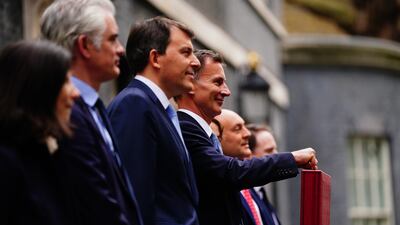
Chancellor Jeremy Hunt holds his ministerial red box outside 11 Downing Street before delivering his 2023 Budget. All photos: Getty Images -

Rishi Sunak departs Downing Street to deliver the Budget in 2020 with the first UK lockdown less than two weeks away -
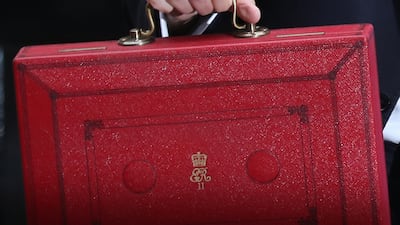
Philip Hammond holds the red case as he departs 11 Downing Street in 2017 -
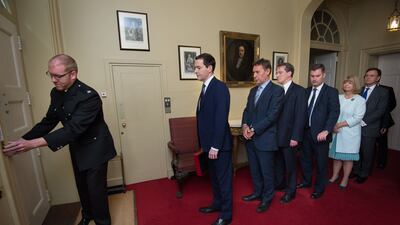
George Osborne leads his Treasury team out of 11 Downing Street to deliver the first Budget of the new Conservative government in 2015 -
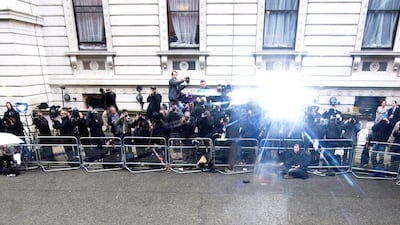
Alistair Darling stands with his wife Margaret as he prepares to deliver his final Budget before the 2010 general election -
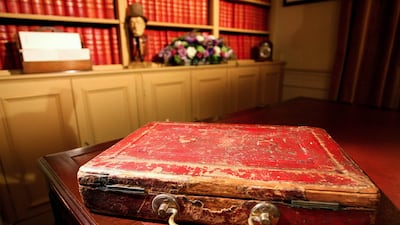
The Budget box – or "Gladstone box" – sits in Alistair Darling's study before the 2008 Budget -
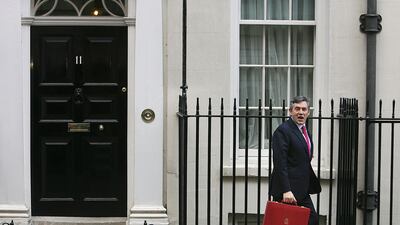
Gordon Brown leaves for Parliament to present his 11th Budget statement in 2007, his last before becoming prime minister -
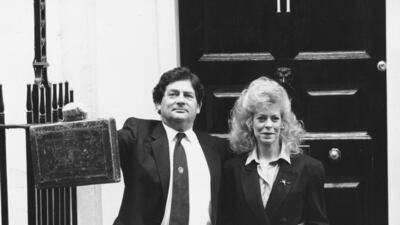
Nigel Lawson and his wife Therese leaving 11 Downing Street prior to the 1988 Budget statement -
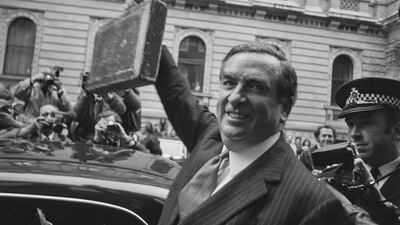
Labour chancellor Denis Healey leaves Downing Street for the House of Commons with his budget box in 1974 -
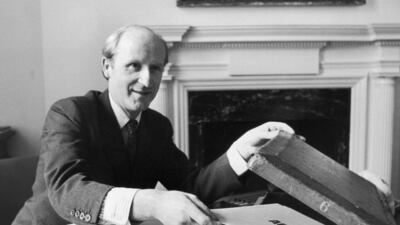
Conservative chancellor Anthony Barber prepares for the 1971 Budget in his office at the Treasury -
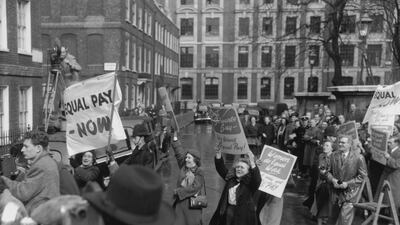
Equal Pay for Women activists demonstrate as chancellor Rab Butler leaves Conservative Party headquarters to present his Budget in 1954 -
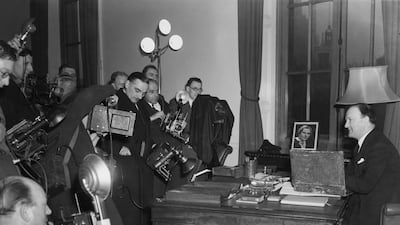
Rab Butler faces the cameras at the Treasury before his presentation of the Budget in 1953 -
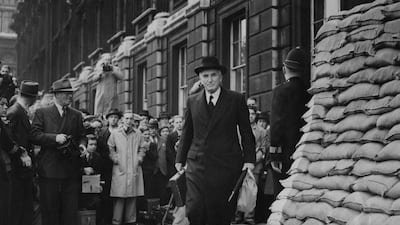
John Simon leaves the Treasury to present his first war Budget in 1939 -

Neville Chamberlain prepares his Budget in 1937 -
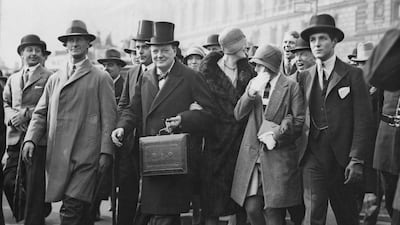
Winston Churchill makes his way to the House of Commons to present his Budget in 1929, accompanied by his daughter, Diana



