


Rishi Sunak is to summon university vice-chancellors to Downing Street to discuss how Jewish students can be protected on campus amid “unacceptable” behaviour.
The UK Prime Minister also warned “mob rule is replacing democratic rule” in Britain, telling police chiefs there needs to be a tougher stance on “intimidation” stemming from protest marches against the war in Gaza.
The moves come after concerns were raised about the policing of marches where demonstrators have used anti-Semitic placards and chants, as well as the targeting of politicians.
A rise in racist attacks meant that “the whole fabric of our nation is under threat”, Mr Sunak said in a speech at the annual dinner of the Community Security Trust (CST) – a charity protecting Jewish communities in Britain – on Wednesday evening.
He said he intended to tackle anti-Muslim hatred as well as anti-Semitism.
He warned that the situation at UK universities is “not acceptable”, giving examples including “Iranian generals giving anti-Semitic speeches”.
People were abusing the right to freedom of speech “as a cover for hate speech”, he warned.

He said Jewish students were being “targeted, threatened, and assaulted simply for being Jewish” and said a chaplain at the University of Leeds had to take his family into hiding after death threats because he is an Israeli military reservist.
“Where people break the law on our campuses they will be met with the full consequences,” Mr Sunak said.
“And where they create a culture of intimidation we will hold the university leadership to account. University leaders must take personal responsibility for protecting Jewish students in their institutions.”
Vice Chancellors of the country’s leading universities would be called in to meet in Downing Street to discuss exactly how that could be achieved, he said.
In a bid to tackle the “utterly sickening” rise in anti-Semitism seen in recent months, the Prime Minister announced funding to provide security guards, CCTV and alarm systems at Jewish community sites.
The Home Office has said the announcement of £54 million ($68.2 million) consists of new funding for the CST to provide the security measures until 2028, in addition to £18 million previously allocated to the charity for 2024-2025. Extra funding has also been provided to increase protection of MPs.
Mr Sunak said “hateful narratives” would be called out and greater investment made in interfaith work to build greater community cohesion and understanding.
He hit out at protest marches held in UK cities since October 7 that left “Jewish families feeling unable to enter the centre of our capital city at the weekend”.
He said he would not allow a pattern of increasingly violent and intimidating behaviour to shout down elected representatives.
Marching and protesting “with passion” to demand the protection of civilian life was allowed but not calling for violent acts or beaming “anti-Semitic tropes on to Big Ben”, referring to an incident in Westminster last week while MPs were debating a motion calling for a ceasefire in Gaza.
There was no cause to justify the support of proscribed terrorist groups, including Hamas, Mr Sunak said.
“Yes, you can freely criticise the actions of this government, the Israeli government or indeed any government," he added. “But no, you cannot use that as an excuse to call for the eradication of a state – or any kind of hatred or anti-Semitism.”
Hamas’s attack on Israel in October raised community tensions in the UK, where pro-Palestinian protests as well as counter rallies have been held regularly in cities across the country.
Protests have also been staged outside MPs' homes.
House of Commons Speaker Lindsay Hoyle changed parliamentary rules last week to allow a vote on a Labour amendment on a ceasefire in Gaza, which he said was based on concern over MPs’ safety – sparking chaos in the chamber. This led to a warning from Mr Sunak that Parliament should never be intimidated by “extremists”.
The Prime Minister has discussed a new “democratic policing protocol” with police chiefs, which would see more patrols and “provides clarity that protests at elected representatives' homes should be treated as intimidatory”.
He spoke with senior officers at a meeting in Downing Street on Wednesday afternoon alongside Home Secretary James Cleverly.
Mr Sunak said: “There is a growing consensus that mob rule is replacing democratic rule. And we've got to collectively, all of us, change that urgently.”
He continued: “But we also need to demonstrate more broadly to the public that you will use the powers you already have, the laws that you have. I am going to do whatever it requires to protect our democracy and our values that we all hold dear.”
Protest outside UK Parliament calls for Gaza ceasefire – in pictures
-
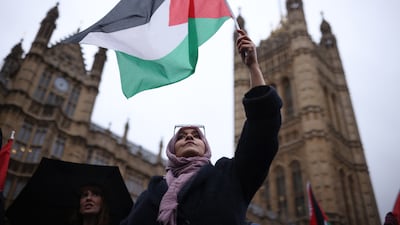
A protester waves a Palestinian flag during a rally outside the UK Parliament in London calling for a ceasefire, as MPs consider a motion on Gaza on February 21. Getty Images -
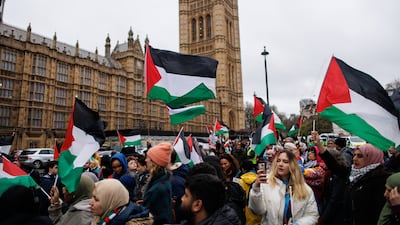
Pro-Palestinian protesters queue for the House of Commons public gallery as British MPs debate a motion in Parliament on calling a ceasefire in Gaza. EPA -
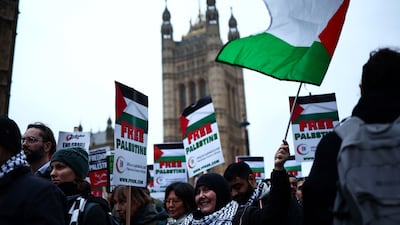
Demonstrators wave Palestinian flags in Parliament Square, London. AFP -
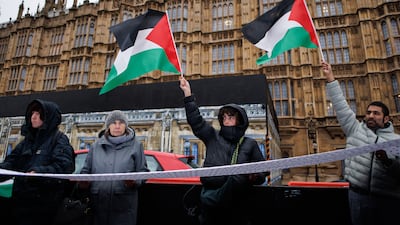
Protesters queue for the House of Commons public gallery. EPA -
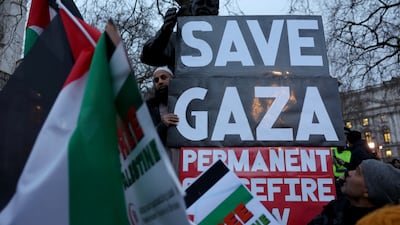
The protest outside the House of Commons. Reuters -
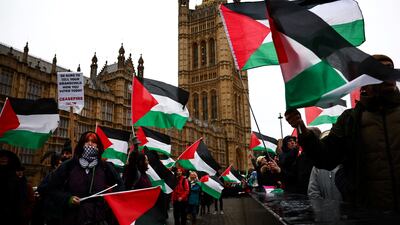
The protest in Parliament Square. AFP -
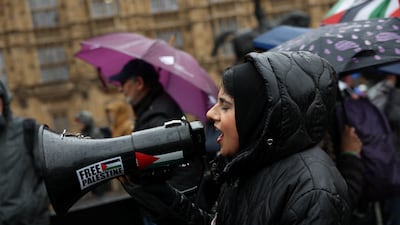
Campaigners queue to lobby MPs in Parliament before the Gaza ceasefire vote. Reuters -
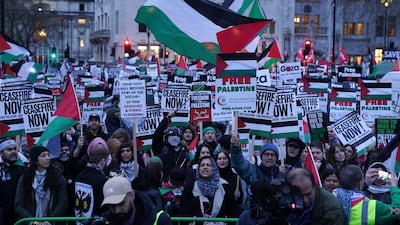
People gather for the Palestine Solidarity Campaign outside the Houses of Parliament. PA -
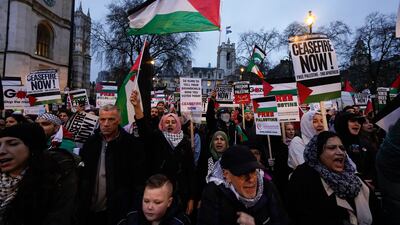
People take part in a Palestine Solidarity Campaign rally outside the Houses of Parliament, London. PA -
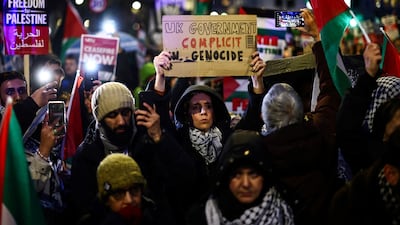
Demonstrators wave Palestinian flags and hold placards in Parliament Square. AFP -
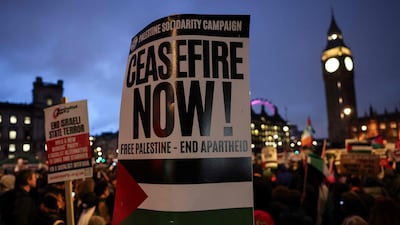
The protest in Parliament Square as the House of Commons voted on a call for an immediate ceasefire in Gaza. AFP


The new rules, known as the Democratic Policing Protocol, provide “clarity that protests at elected representatives’ homes should be treated as intimidatory”, Mr Sunak said. Police have “adequate powers” to direct protesters away, the protocol states.
The new security package will enhance police protection as well as helping to fund private security guards for those facing a higher risk.
It will ensure all elected representatives and candidates have a dedicated named police contact to liaise with on security matters.
The Home Secretary this week questioned whether holding regular pro-Palestinian marches “adds value” to protesters' calls for an immediate ceasefire, saying they “made their point”.
Mr Cleverly questioned what future demonstrations in support of ending the violence in Gaza hoped to achieve, given the Conservative government was in “disagreement” with their position.
“They have made their position clear, we recognise that there are many people in the UK that hold that position. We respect that, but the UK government’s position is a disagreement with that for very practical, well thought-out reasons,” he said.
The government says it supports an immediate humanitarian pause in the fighting, but says a permanent ceasefire can only happen if Hamas frees all Israeli hostages and relinquishes control of Gaza.
Ben Jamal, director of the Palestine Solidarity Campaign, which has organised many protests, said Mr Cleverly’s comments showed the government did not understand the role of protest “as an important part of the democratic process”.
“They regard it as a hindrance, something that should be suppressed,” Mr Jamal said.

