



Objects stolen from the British Museum that were sold to dealers throughout the world are being shown in a new exhibition at the London institution.
About 2,000 artefacts were reported as missing, stolen or damaged by the museum in August last year, which led to the sacking of one member of staff.
The new Rediscovering Gems exhibition shows 10 of the stolen items, along with other classical Greek and Roman artefacts of the same type that were used for sealing documents and for decoration.
Getting back 357 stolen artefacts, so far, from six collectors has been “very, very painstaking” work, said Tom Harrison, keeper of the British Museum’s department of Greece and Rome.
But Mr Harrison said the help from dealers, who bought the items from various places, has been “supportive” in providing information to find them.
He said the artefacts were “very widely scattered” all over the world, so the recovery has been “very slow business” and “much more complicated than we possibly could have imagined”.
Mr Harrison estimated that among the affected artefacts, about 500 items have been “irreparably” or minimally damaged.
“(If) we could manage to get every object back, there still will be a net loss because we’ve got objects that had gold mounts that don’t have gold mounts, objects that were fractured by taking the gold mount off them and that’s just a horrible factor," he said.
"Some of them can be conserved or improved but there are limits to what we can achieve in that way."
Mr Harrison said there was optimism among museum staff five months since the thefts were revealed, but he did not want to minimise the effects, which included British Museum director Hartwig Fischer's resignation.
“I don’t want to talk in relation to this [exhibit], for example, in terms of silver linings," he said.
"I think it’s kind of inappropriate … the damage is just terrible, the impact in terms of reputation obviously isn’t something that’s quick to repair.
“But actually, there are positive things that have come out of it, very straightforwardly. This material is getting a look in, curatorial expertise in relation to these things is kind of hugely appreciated.
“There are lots of things that are going well. At least objects will be better documented.
"My collection generally will be better documented than it’s ever been, I think, as a result of this in the end, because we’re looking into every single object and the archival material in relation to it and we’re learning things from that constantly.”
British Museum artefacts - in pictures
-
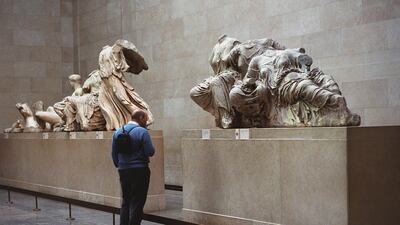
These sculptures form part of the Elgin Marbles, which were taken from the Parthenon in Athens, Greece, more than 200 years ago. Reuters -
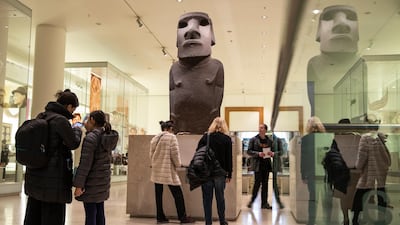
This Easter Island figure, known as Hoa Hakananai'a, has been the subject of a repatriation request. Getty Images -
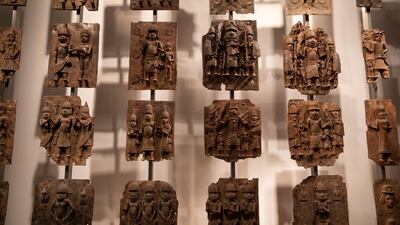
Plaques that form part of the Benin Bronzes, which were taken from Africa by British troops in 1897. Getty Images -
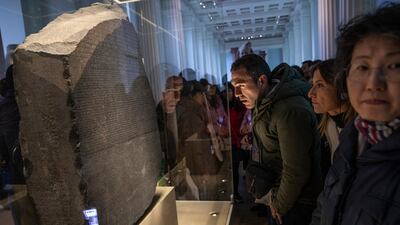
The Rosetta Stone, which was used to decipher Egyptian hieroglyphs, has been requested to be returned. Getty Images -

These Gandharan objects were returned to Afghanistan this year with the British Museum's help. Courtesy Trustees of the British Museum -
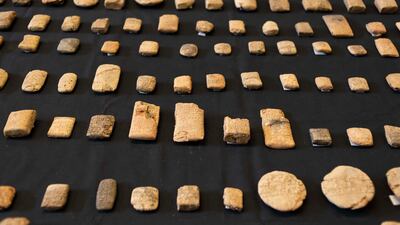
Another important haul to be returned to Iraq wsd 154 Mesopotamian texts written on clay in cuneiform script. Courtesy Trustees of the British Museum


Mr Harrison called recovery “a big project” that needs some staff, across the museum, trying to find and verify the items and working with colleagues to transport them and get export licences to bring them back to the UK.
Claudia Wagner, a senior research associate in gems at the British Museum, said how different engraved gems have been part of an “enormous scandal” once before.
Gems had been popular, reaching their height in the 18th century, until Polish prince Stanislaw Poniatowski’s collection was sold at Christie’s in London in the 19th century, and was discovered to be fake.
Ms Wagner said distinguishing false and real gems is becoming easier, with improved ways of dating, but the study requires a lot of expertise.
She said the summer disclosure of thefts has revived interest.
“Very much so, so now there’s definitely quite a revival in the art and possibly it had started slightly earlier, because now with digital photography, we really can capture the beauty and the details of it,” Ms Wagner said.
The gem expert, who is also a lecturer and researcher at the University of Oxford, also spoke about how engraving gems took more than half a year in the ancient past.
Ms Wagner said they could have been worn by “very, very rich Romans” and have been found at the ancient Roman sites of Pompeii and Herculaneum.
She also said the gems, including one of the stolen ones featuring the head of Augustus, who is credited as the first Roman emperor, were tools of propaganda.
Ms Wagner compared the engraved gems to the Make America Great Again hats, showing support for former US president Donald Trump.
“We know this is Augustus, as the same head appears on his coinage and very often they were symbols of power,” she said.
Rediscovering Gems will run until June 15 in room three at the British Museum.

