


Russia is heading towards victory in Ukraine with the initiative unequivocally transferring to Moscow, one of Britain’s most senior former officers has told The National.
In a wide-ranging interview, Gen Sir Richard Barrons argued that Ukraine’s military “has got nothing left in the locker right now” after its gruelling summer counter-offensive.
Unless the West improves its military aid, the momentum is likely to remain with President Vladimir Putin, fuelled by significant assistance from Iran which has sent not only kamikaze drones but ballistic missiles that are being used to soak up Ukraine’s air defence weapons.
If Europe and America fail to provide Kyiv with the weapons and money it needs then it would be “an absolute failure of politics” that will see a resurgent Russia on its doorstep with a far more powerful army than before the invasion, argued the former head of Britain’s Joint Force Command.
As the war approaches its third year, both sides are locked in an attritional stalemate along a 1,000km front line with little likelihood of a decisive breakthrough until 2025.
Putin ascendant
“The initiative in this war is unequivocally transferring to Russia and that is not the situation we expected at the start of this year but it’s an honest appraisal of where we are,” said Gen Barrons.
2023 has not been without its challenges for Mr Putin, with the Wagner mutiny in June proving the gravest challenge to his authority. But with mercenary chief Yevgeny Prigozhin probably assassinated in an air crash, the Russian President now appears more secure and confident than at any time since the February 2022 invasion.
“That's a combination of the failure of the Ukrainian counter-offensive to deliver even its minimum objectives,” said Gen Barrons. “Then the major wobble in US politics and now EU politics on financial support to Ukraine. The reason he's much more confident is because he's not losing this war. And Russia wins by not losing.”

Artillery barrage
A key ingredient to victory for either side will be building enough shells to break through the front lines, said Gen Barrons, a former Royal Artillery officer.
It is estimated that Russia fired between 10 and 12 million rounds in the first year of the war – on occasion using an astonishing 60,000 shells a day.
While its stocks have depleted, one million shells from North Korea will help tide Moscow over until its manufacturing base ramps up production to two million a year by the end of 2024.
By contrast, the US should be able to produce about 600,000 155mm rounds next year and the EU might get to 300,000 with Britain’s BAE Systems up to another 100,000.
But Russia, whose industry is on a war footing, will still be outproducing the West by two-to-one.
Without massed artillery fire, and lacking a sizeable air force, Ukraine is unlikely to succeed and could itself be subject to a Russian offensive opened with a huge bombardment.
The Israel-Gaza war has seen a further depletion of western stocks, with munitions sent to Israel that may otherwise have gone to Kyiv.
“Putin will be rubbing his hands with glee at the distraction of Gaza particularly with artillery ammunition that was going to go to Ukraine now being fired at Palestinians,” said the veteran of the Iraq and Afghanistan wars.

Empty locker
After a bruising 2023, both sides are now in a period of consolidation, using 2024 to train and re-equip their armies.
“Ukraine has got nothing left in the locker right now, so decisive action is not possible by either side before 2025,” said Gen Barrons, 64. “But the trend is firmly, but only marginally, in Russia's favour right now. So Putin is in a pretty good place.”
Russia has lost nine out of 10 of the 360,000 soldiers from its initial invasion force with an estimated 120,000 dead and 200,000 wounded, according to a US intelligence estimate.
But Mr Putin is willing to absorb the huge losses as he has a much greater pool of manpower to draw from, with Russia’s population of 146 million outnumbering Ukraine’s 40 million.
Mr Putin, and most Russians, remain unfazed by the exceptionally high casualties, as many are from Asiatic Russia or are convicts.
So long as they can continue recruiting without the politically toxic policy of mass mobilisation of Moscow’s and St Petersburg’s middle classes, manpower should not be a problem.
Nato training
For more than four months from June, the Nato-equipped and trained new Ukrainian army attempted to batter a breakthrough in Russian lines.
Faced with a well-planned deep defence, including millions of mines, Kyiv’s generals made few inroads on the front line failing to achieve a breakout to the Sea of Azov and cut off occupied Crimea.
The average age of Ukrainian troops in some units is 45, because the country has decided against mobilising its youth to preserve its economy.

“So they've mobilised their dads essentially,” said Gen Barrons. “But the only way they can break the deadlock is by mobilising civil society. They've got to mobilise their youth and find more people willing to fight.”
With a lack of specialists in the summer offensive, each brigade of about 4,000 people could only produce about two company’s worth of actual assault troops, around 200 men.
When they attacked in armoured vehicles they got bogged down in the minefields, then the Russians fired “scatter-able” mines behind the attackers to isolate them and then pick them off.
Soon the assault companies were decimated leaving the Ukrainians only able to assault in small numbers which “was never going to them to the Sea of Azov”.

Can Ukraine win?
Blanket drone use by both sides has meant that the battlefield has become remarkably transparent, making mass armoured manoeuvres impossible. But counter-drone technology could soon assist the Ukrainians.
To succeed Ukraine will need to fight the “deep battle” targeting Russia’s Black Sea fleet, airbases and command centres with long-range missiles.
“To make it really hard behind the front line, so that the Russians can't build up their own capability, everyone has to have a tough winter,” said Gen Barrons.
“Don't allow people to stay warm and snug in a bunker, they need to wear them out.”
Then they will need to concentrate their forces at a five-to-one advantage, at the right point on the Russian front line, breach the deep defences and have the resources to exploit the breakthrough.
But that will require industrial and logistic power, especially the need to fire 10,000 shells a day for several weeks.
Ukraine also needs the F-16 fighters to keep the Russian Air Force at bay and to shoot down the highly effective attack helicopters.
All of the above will take until 2025 and only if the West continues to fund it, said Gen Barrons.

Arms from Iran
Kyiv is also having to use a large number of its Patriot air defence missiles to shoot down Iran-supplied missiles and drones.
“The drones don't have a high penetration rate, but they do consume anti-aircraft missiles,” said the former officer.
Tehran is also likely to supply Moscow with long-range missiles which will give it the volume to hammer at Ukraine’s infrastructure, in particular its electricity supply.

Freaking Europe out
Gen Barrons lamented the inability of western capitals to use their financial might to greater effect. With the US economy worth about $23 trillion a year and Europe $15 trillion, it was “a massive failure of deterrence” that Russia’s $2.2 trillion economy was succeeding, he said.
“It's an absolute failure of politics and we will deserve to be the victims of the 21st century if we can't sort this out,” he said.
“It's our fault because we did not mobilise industry in 2022 and 2023 to ride the wave of popular support when Ukraine was seen to be in the ascendant.”
If Mr Putin was to prove successful then he could end up with an army twice as powerful and more experienced than the one he started with, he said.
“And that ought to really freak Europe out,” concluded Gen Barrons.
Ukraine-Russia conflict latest – in pictures
-

Firefighters attend a blaze after a Russian attack in Kyiv. AP -
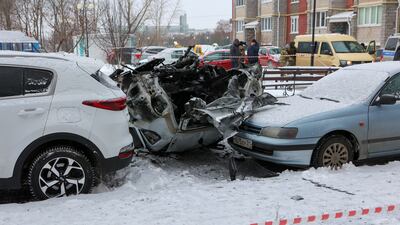
A destroyed car in a courtyard of a multi-storey apartment building after what local authorities say was a Ukrainian military strike in the city of Belgorod, Russia. Reuters -
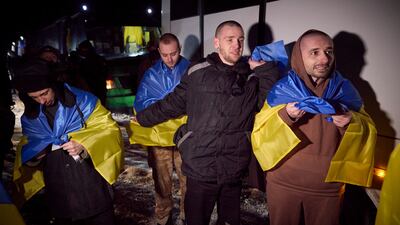
Ukrainian prisoners of war after a prisoner exchange near Sumy, Ukraine. AP -
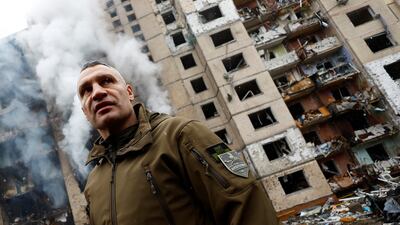
Kyiv Mayor Vitali Klitschko visits a residential building damaged during a Russian missile attack in Kyiv. Reuters -
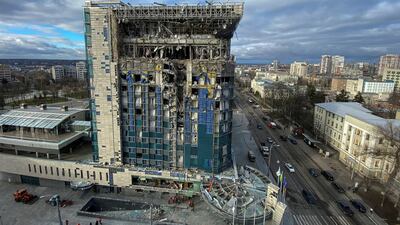
The Kharkiv Palace Hotel after a Russian missile strike. Reuters -

Ukrainian rescuers after a Russian drone attack on an office building in downtown Kharkiv. EPA -
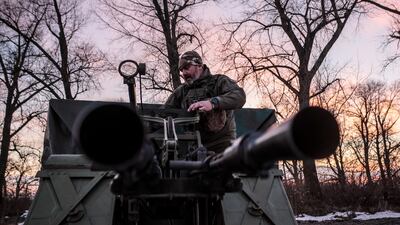
A Ukrainian serviceman operates an anti-aircraft machine gun after an air raid alarm in the Kyiv region. EPA -
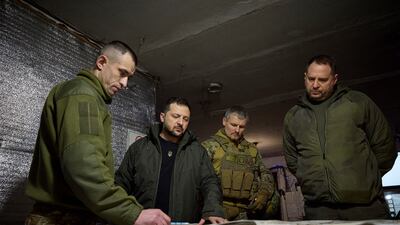
Ukrainian President Volodymyr Zelenskyy speaking with commanders during his trip to the Donetsk region. EPA -
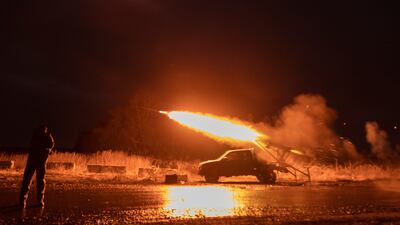
Ukrainian servicemen fire a self-made rocket launcher on a front line in the Donetsk area. EPA -
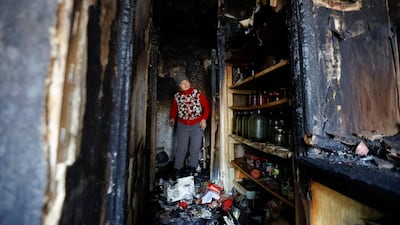
A woman searches for household items in her burnt-out apartment, recently hit by shelling in Donetsk. Reuters -
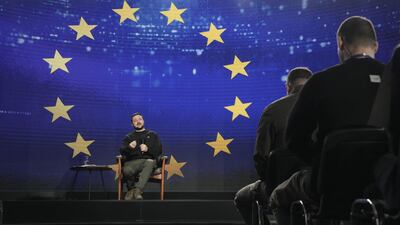
Ukrainian President Volodymyr Zelenskyy during a news conference in Kyiv. Bloomberg -
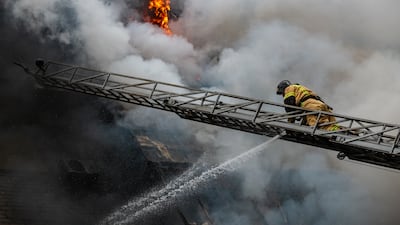
A firefighter at the site of a damaged building after shelling in Donetsk. EPA -

A worker carries out repairs to the Cathedral of the Transfiguration that was damaged as a result of a Russian missile in Odesa. AFP -
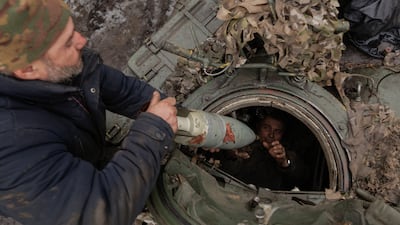
Ukrainian troops prepare anti-aircraft artillery from their position on a front line near Zaporizhzhia. EPA -
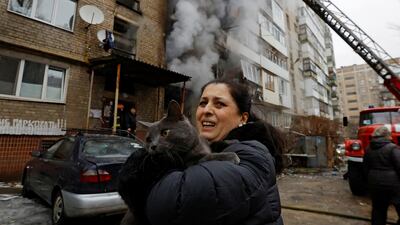
A woman with her cat, which was saved from an apartment building damaged by recent shelling in Donetsk. Reuters -

A howitzer is fired at Russian positions in Donetsk. Reuters -

Civilians take shelter in a gym after their apartments were damaged in a drone attack in Odesa. AFP -
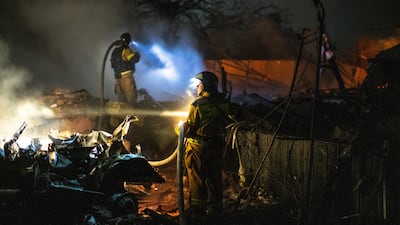
Firefighters work at destroyed houses following shelling in Donetsk. EPA -

A Ukrainian soldier looks out for danger near Bakhmut. AFP -
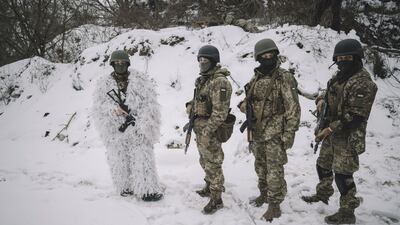
Members of the Siberian Battalion carrying out military exercises with the International Legion of the Armed Forces of Ukraine at an undisclosed location in Ukraine. Bloomberg



