


Live updates: Follow the latest news on Israel-Gaza
A delegation of ministers from Arab and Islamic countries urged the UK to play a “balanced role” in the Israel-Gaza conflict during a meeting with British Foreign Secretary David Cameron on Wednesday.
The delegation was formed at the Islamic-Arab Summit in Riyadh to meet the five permanent members of the UN Security Council in efforts to end the Israel-Gaza war.
The committee of nine ministers and diplomats was led by Saudi Foreign Minister Prince Faisal bin Farhan. It welcomed the four-day humanitarian truce between Israel and Hamas, according to a statement from the kingdom after the meeting.
After holding talks with Mr Cameron, the delegation said it was urging the international community to build on this to reach a “complete and sustainable ceasefire as soon as possible”.
It also addressed the need to revive the peace process in the hope of establishing a “sovereign, independent” Palestinian state in line with 1967 borders and with East Jerusalem as its capital, and discussed the securing of safe passages for humanitarian aid into Gaza.
UK Prime Minister Rishi Sunak has expressed unwavering support for Israel's "right" to defend itself from Hamas, but stressed it must do so within international law. Lord Cameron reaffirmed the UK's support for a two-state solution after his surprise appointment last week and said he would work for a political solution to the crisis.
“The agreement reached last night is an important opportunity to get the hostages out and more aid into Gaza to help the Palestinian people," he said on Wednesday. “We discussed how to use this step forward to think about the future and how we can build a peaceful future which provides security for Israel but also peace and stability for the Palestinian people.”
The visiting committee called on the UK to “reject all forms of selectivity” by holding Israel accountable for its actions according to international law, and not to “overlook the ugly crimes” committed by “occupation forces and settler militias” in the Palestinian territories.
Upon leaving Westminster, the delegation went straight to Paris to meet French President Emmanuel Macron at the Elysée Palace.
This will conclude three days of intense diplomatic efforts, involving meetings with Russian Foreign Minister Sergey Lavrov in Moscow and Chinese Vice President Han Zheng earlier this week.
'Momentum for diplomacy'
The meeting with Lord Cameron is part of a “momentum for diplomacy” that experts speaking at foreign affairs think tank Chatham House see as driven by Arab states.
But it is fraught with challenges – not least because of Israel’s internal confusion over the future of Gaza. “When thinking of a diplomatic path forward, we do need to look at the appetite for that in Israel,” said Dr Elham Fakhro, associate fellow at Chatham House.
Though the Arab world’s message is “clear”, the challenges are varied and touch on existing normalisation agreements with Israel, experts on the panel said.

Foremost among these is Egypt, which has had “extremely solid” relations with Israel since the Camp David Accords, according to Mirette Mabrouk, senior fellow and founding director of the Egypt programme at the Middle East Institute. The 40-year agreement has been an “essential” security guarantor for Israel.
Yet the relationship has soured as the risk of Israel pushing Palestinians out of Gaza and into Egypt's Sinai Peninsula grows. Israeli officials have expressed intent to do so.
Egypt considers an influx of Palestinian refugees to be a security risk and a red line. Ignoring Egyptian concerns, US and European diplomats have urged Cairo to take in Palestinian refugees in exchange for debt relief from its economic crisis.
The move by western countries on behalf of Israel has threatened to “push Egypt beyond its limits", Ms Mabrouk said. “When a country that has had the worst economic crisis in 50 years is promised debt relief and consistently says no, you should pay attention,” she said.
Among the Gulf states, Saudi Arabia has “gone the furthest” in its willingness to put pressure on Israel, said Dr Fakhro.
Latest from Israel-Gaza conflict - in pictures
-
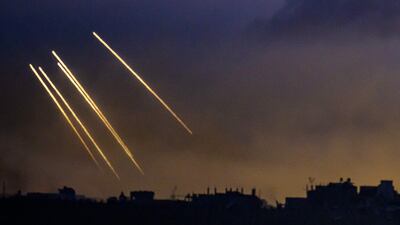
Smoke ammunition fired by Israeli troops near the border with the Gaza Strip, in southern Israel. AFP -

Israeli soldiers react during the funeral of Capt Liron Snir at the Mount Herzl military cemetery, Jerusalem. Reuters -
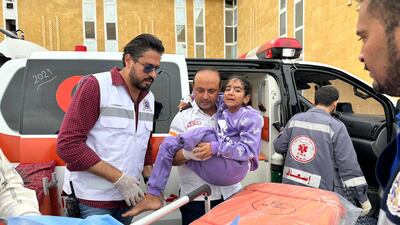
Egyptian paramedics transport a Palestinian child arriving from Gaza to an ambulance at the Rafah border crossing. AFP -

An Israeli tank appears through a soldier's night vision scope near the Gaza Strip in southern Israel. Getty Images -
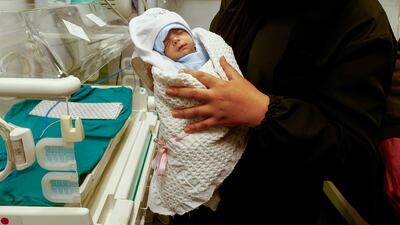
A Palestinian mother holds her newborn in a maternity hospital in Rafah, after he was evacuated from Al Shifa Hospital in Gaza city. Reuters -

Israeli artillery train its guns towards the Gaza Strip in Southern Israel. Getty Images -

A family watch news updates on the Israeli hostages and Palestinian prisoners swap deal, near Hebron in the Israeli-occupied West Bank. Reuters -
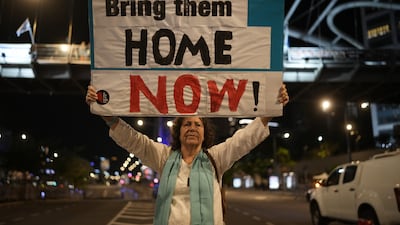
People demonstrate outside the Kyria defence complex as the political cabinet hold a meeting in Tel Aviv, Israel. Getty Images -
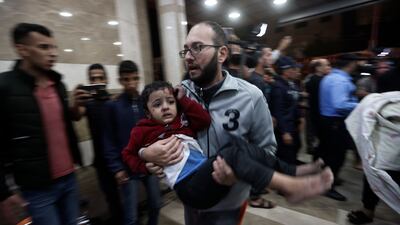
A wounded Palestinian child is carried into Nasser Hospital following an Israeli bombardment on Khan Younis refugee camp, southern Gaza Strip. AP -
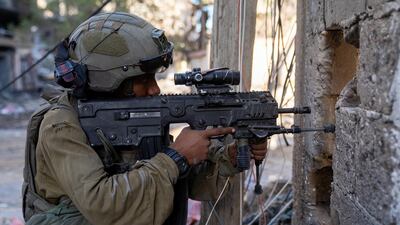
An Israeli soldier takes position behind a wall in Gaza, as Israel's war against Hamas continues. Reuters -
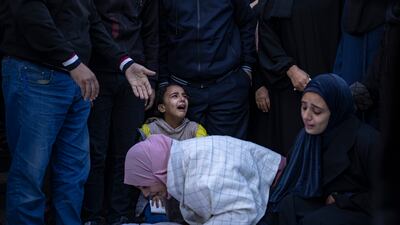
Palestinians mourn their relatives killed in the Israeli bombardment of the Gaza Strip, at a hospital in Khan Younis. AP -
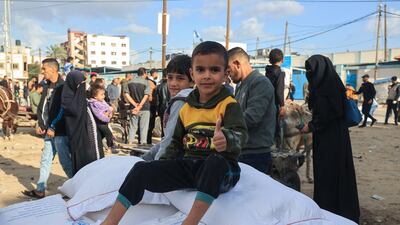
People receive bags of flour at a distribution centre of the UN agency for Palestinian refugees (UNRWA), in the Rafah refugee camp. AFP -
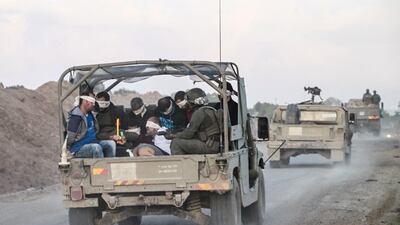
Israel's military transports Palestinian detainees from the Gaza Strip, near Israel's border with Gaza, in southern Israel. Reuters -
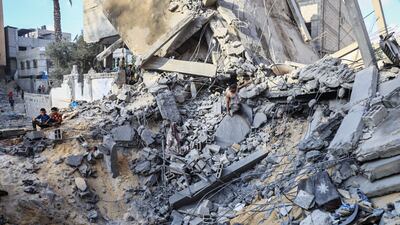
Palestinians amongst the rubble of a building destroyed by an Israeli air strike in Khan Younis, Gaza. Bloomberg -

Thomas Hand, father of Emily Hand, during a press conference by family members of hostages in Gaza, at the Israeli embassy, London. Getty Images -
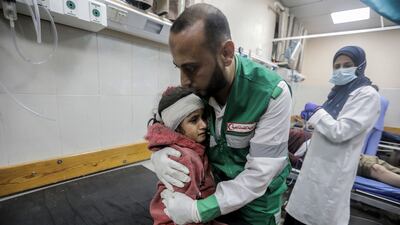
A man consoles a young Palestinian girl at Nasser Medical Hospital, Khan Yunis, Gaza. Getty Images -

A mother covers her daughter as a siren signals incoming rockets launched from the Gaza Strip towards Israel, in Tel Aviv. Reuters -
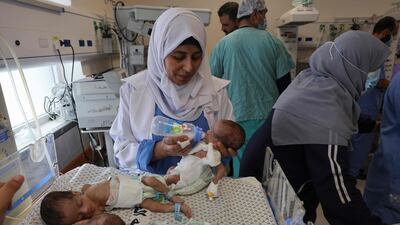
Palestinian medics care for babies evacuated from Al Shifa Hospital to the Emirates Hospital in Rafah in the southern Gaza Strip. AFP -
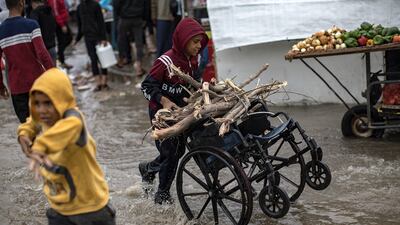
A child collects firewood in a camp provided by the UN for displaced Palestinians who lost their homes in Israeli raids, in Khan Yunis. EPA -
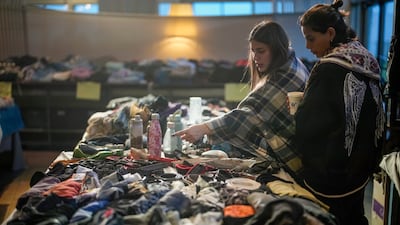
Personal items recovered from the Supernova music festival on display for family and relatives to collect in Caesarea, Israel. Getty Images -

Palestinians flee the Zeitoun district, southern Gaza Strip, as battles between Israel and Hamas continue. AFP -

Thousands gathered at the State Library for the weekly protest in support of Palestinians in Melbourne, Australia. Paul Stafford / The National -
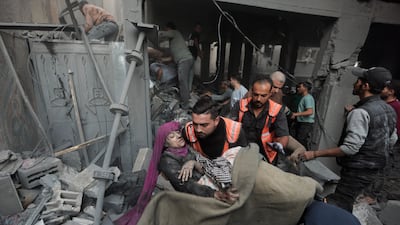
Palestinian rescuers evacuate an injured woman following an Israeli air strike in Khan Younis refugee camp. AP -

A rally to call for a ceasefire held at Dorchester Square in Montreal, Quebec, Canada. AFP -

Palestinians flee to the southern Gaza Strip along Salah al-Din Street, during the ongoing Israeli bombardment. AP -
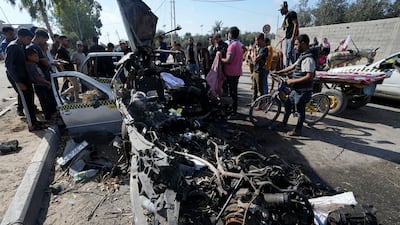
Palestinians check taxis that were hit by the Israeli military along Salah al-Din Street, on the outskirts of Gaza city. AP -
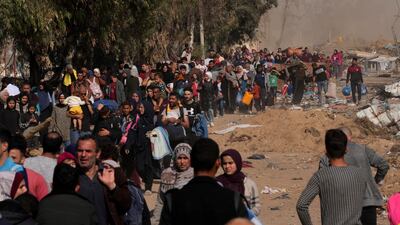
Thousands of Palestinians flee to the southern Gaza Strip along Salah al-Din Street. AP -
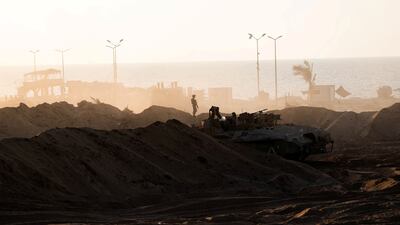
Israeli soldiers in the Gaza Strip amid the continuing ground operation against Hamas. Reuters -
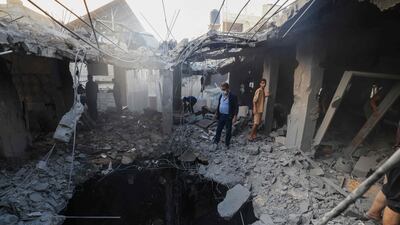
Palestinians search for survivors in the rubble of a building following Israeli bombardment in Khan Yunis. AFP -

Palestinians injured in air strikes arrive at Nasser Medical Hospital in Khan Younis, Gaza. Getty Images -
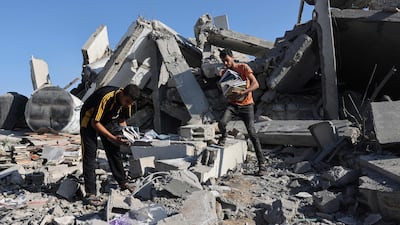
Palestinians collect books from the rubble of a cultural centre following an Israeli strike in Rafah. AFP -

Notices dropped by the Israeli military over Rafah in the southern Gaza Strip calling for those remaining to leave the area. AFP -

A man walks among debris at the site of an Israeli strike in Khan Younis, amid the ongoing conflict between Israel and Hamas. Reuters -
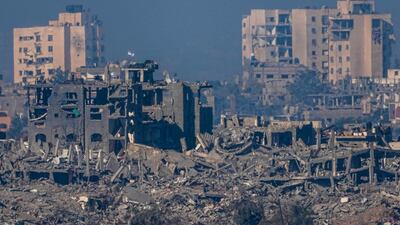
Israeli flags on the top of destroyed buildings in the Gaza Strip. AP -
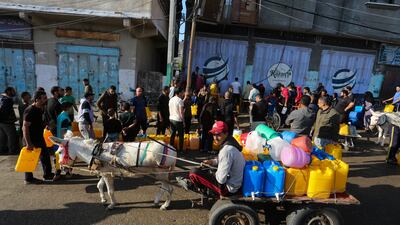
Palestinians line to collect water in Rafah on Saturday, November 18. AP


Understanding what Israel wants from the war is another obstacle in the path to peace, she said. “There are some unknowns. What is Israel trying to accomplish beyond its general goal of eliminating Hamas? What is Israel willing to do when there is a ceasefire eventually?” Dr Fakhro said.
An emboldened far right in Israel has called for the establishment of a wide buffer zone that would push Palestinians to southern Gaza. Talk of bringing the Palestinian Authority back to Gaza has been met with direct opposition from Israeli officials.
The US has opposed an Israel occupation of Gaza after the war. But Arab states will be reluctant to "clean up the mess" after an Israeli withdrawal.
Egypt or other Arab states' involvement in post-conflict Gaza could place them in the role of “occupier”.
“The agreement on this subject is fairly homogeneous and is the same as most of the Arab states,” Ms Mabrouk said of Egypt.
Nonetheless, ideas and proposals for how Arab states, the US and Israel can work together to contribute to peace and reconstruction are circulating in Washington, Dr Fakhro said.
“The hope is that yes, in the day after [the war], you have a momentum for diplomacy and there is a way forward,” she said.

