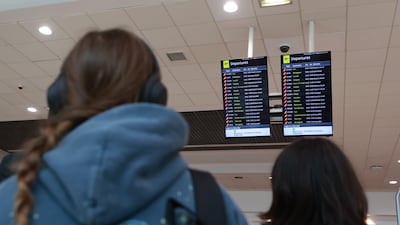
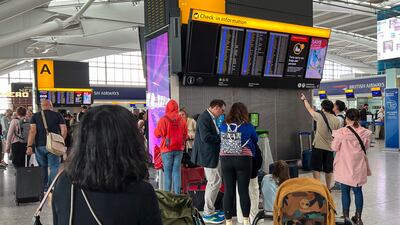
Passengers queuing at Gatwick Airport after a glitch in the air traffic control system caused mass cancellations. Getty Images.

Cancelled flights leave hundreds of passengers stranded at UK airports


Laura O'Callaghan
  • English
  • Arabic

Travellers were stranded at UK airports on Tuesday morning after dozens more flights were cancelled following a day of chaos caused by an air-traffic control glitch.

Transport Secretary Mark Harper said issues of this magnitude “haven’t happened for a decade” as he ruled out a cyber attack.

“Our technical experts have looked at it and are clear that it wasn’t a cyber security incident,” he told Sky News.

The Civil Aviation Authority has launched an “independent review” into the incident and is due to deliver a report to Mr Harper “in days”. The government will examine whether lessons can be learnt.

A technical fault was detected in the UK’s air-traffic control system on Monday morning and resolved by early afternoon. Airports had to resort to a backup system, meaning fewer flights could be processed.

Hundreds of flights were cancelled, leaving thousands stranded at airports in Britain and overseas.

About 790 departures and 785 arrivals across all UK airports were scrapped on Monday, aviation analytics company Cirium said. This equated to around 27 per cent of planned journeys.

On Tuesday, data from Flightradar24 showed 78 flights at Heathrow were delayed, while at least 32 departures and 31 arrivals were cancelled. That compares to more than 170 axed flights on Monday.

At Gatwick Airport, the second major hub in London, 23 departures were cancelled on Tuesday while 51 arrivals were called off, according to the data.

Manchester Airport reported delays and cancellations and urged people to check their flight status with their airline.

Mr Harper tried to reassure travellers, stressing that airlines had a legal responsibility to provide accommodation and food to passengers who had their journeys cancelled.

It remains unclear when travel will return to normal but passengers reported cancellations at UK airports on Tuesday morning.

British Airways, which operates the most flights to and from Heathrow, was the worst affected airline.

A man travelling to Dubai shared a video showing a crammed terminal at the West London airport on X, formerly known as Twitter.

“This is awful,” he wrote. “I can’t move in Heathrow Airport, there is no room. I have been here for 27 hours now. I want to get back to Dubai and nobody from customer service is helping. They’re ignoring everyone.”

On Monday evening, Heathrow said “schedules remain significantly disrupted” following the technical issues. It advised passengers to check with their airlines before travelling to the airport on Tuesday.

National Air Traffic Services, the country's leading air traffic control provider, said at 3.15pm on Monday it had “identified and remedied” the technical issue affecting its systems and it was working with airlines and airports to support affected flights.

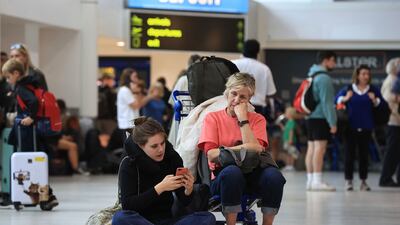
  • Passengers wait at Heathrow Airport. The UK's air traffic control systems have grounded thousands of flights on one of the busiest travel days of the year. PA
    Passengers wait at Heathrow Airport. The UK's air traffic control systems have grounded thousands of flights on one of the busiest travel days of the year. PA
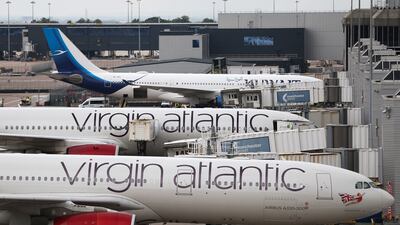
  • Planes line up at Manchester Airport. EPA
    Planes line up at Manchester Airport. EPA
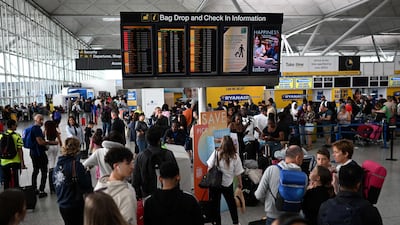
  • Passengers check the boards at Stansted Airport, north of London. AFP
    Passengers check the boards at Stansted Airport, north of London. AFP
  • Passengers wait at Belfast International Airport, Ireland. AP
    Passengers wait at Belfast International Airport, Ireland. AP
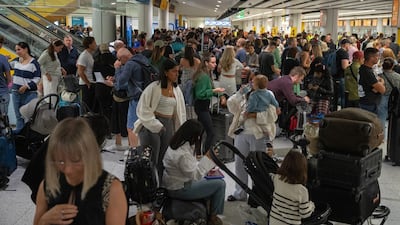
  • People wait near packed check-in desks at Gatwick Airport. Getty Images
    People wait near packed check-in desks at Gatwick Airport. Getty Images
  • Passengers queue in a departure lounge at Heathrow Airport in London. EPA
    Passengers queue in a departure lounge at Heathrow Airport in London. EPA
  • People wait near check-in desks at Gatwick Airport. Getty Images
    People wait near check-in desks at Gatwick Airport. Getty Images
  • Passengers look at departure boards at Belfast International Airport. PA
    Passengers look at departure boards at Belfast International Airport. PA
  • Passengers check the departures board at Heathrow Airport. AP
    Passengers check the departures board at Heathrow Airport. AP
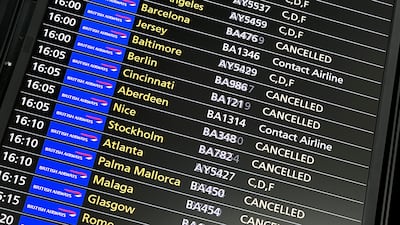
  • Cancelled flights are displayed on the departures board at Heathrow Airport. AP
    Cancelled flights are displayed on the departures board at Heathrow Airport. AP

Mr Harper on Tuesday told GB News: “It's nearly a decade since there was a significant issue like this.

“We want to make sure it doesn't happen again because of all the disruption that's been caused to passengers across the country.”

Juliet Kennedy, operations director at the air traffic services, said the issue meant the automatic system that provides controllers with details of every aircraft and its route stopped working.

“To manage safety, we had to limit the number of flights we could manage,” she added.

Ten tax points to be aware of in 2026

1. Domestic VAT refund amendments: request your refund within five years

If a business does not apply for the refund on time, they lose their credit.

2. E-invoicing in the UAE

Businesses should continue preparing for the implementation of e-invoicing in the UAE, with 2026 a preparation and transition period ahead of phased mandatory adoption. 

3. More tax audits

Tax authorities are increasingly using data already available across multiple filings to identify audit risks. 

4. More beneficial VAT and excise tax penalty regime

Tax disputes are expected to become more frequent and more structured, with clearer administrative objection and appeal processes. The UAE has adopted a new penalty regime for VAT and excise disputes, which now mirrors the penalty regime for corporate tax.

5. Greater emphasis on statutory audit

There is a greater need for the accuracy of financial statements. The International Financial Reporting Standards standards need to be strictly adhered to and, as a result, the quality of the audits will need to increase.

6. Further transfer pricing enforcement

Transfer pricing enforcement, which refers to the practice of establishing prices for internal transactions between related entities, is expected to broaden in scope. The UAE will shortly open the possibility to negotiate advance pricing agreements, or essentially rulings for transfer pricing purposes. 

7. Limited time periods for audits

Recent amendments also introduce a default five-year limitation period for tax audits and assessments, subject to specific statutory exceptions. While the standard audit and assessment period is five years, this may be extended to up to 15 years in cases involving fraud or tax evasion. 

8. Pillar 2 implementation 

Many multinational groups will begin to feel the practical effect of the Domestic Minimum Top-Up Tax (DMTT), the UAE's implementation of the OECD’s global minimum tax under Pillar 2. While the rules apply for financial years starting on or after January 1, 2025, it is 2026 that marks the transition to an operational phase.

9. Reduced compliance obligations for imported goods and services

Businesses that apply the reverse-charge mechanism for VAT purposes in the UAE may benefit from reduced compliance obligations. 

10. Substance and CbC reporting focus

Tax authorities are expected to continue strengthening the enforcement of economic substance and Country-by-Country (CbC) reporting frameworks. In the UAE, these regimes are increasingly being used as risk-assessment tools, providing tax authorities with a comprehensive view of multinational groups’ global footprints and enabling them to assess whether profits are aligned with real economic activity. 

Contributed by Thomas Vanhee and Hend Rashwan, Aurifer

UAE currency: the story behind the money in your pockets
Scores

New Zealand 266 for 9 in 50 overs
Pakistan 219 all out in 47.2 overs 

New Zealand win by 47 runs

The%20specs
%3Cp%3E%3Cstrong%3EPowertrain%3A%20%3C%2Fstrong%3ESingle%20electric%20motor%0D%3Cbr%3E%3Cstrong%3EPower%3A%20%3C%2Fstrong%3E201hp%0D%3Cbr%3E%3Cstrong%3ETorque%3A%20%3C%2Fstrong%3E310Nm%0D%3Cbr%3E%3Cstrong%3ETransmission%3A%20%3C%2Fstrong%3ESingle-speed%20auto%0D%3Cbr%3E%3Cstrong%3EBattery%3A%20%3C%2Fstrong%3E53kWh%20lithium-ion%20battery%20pack%20(GS%20base%20model)%3B%2070kWh%20battery%20pack%20(GF)%0D%3Cbr%3E%3Cstrong%3ETouring%20range%3A%20%3C%2Fstrong%3E350km%20(GS)%3B%20480km%20(GF)%0D%3Cbr%3E%3Cstrong%3EPrice%3A%20%3C%2Fstrong%3EFrom%20Dh129%2C900%20(GS)%3B%20Dh149%2C000%20(GF)%0D%3Cbr%3E%3Cstrong%3EOn%20sale%3A%3C%2Fstrong%3E%20Now%3C%2Fp%3E%0A
Key figures in the life of the fort

Sheikh Dhiyab bin Isa (ruled 1761-1793) Built Qasr Al Hosn as a watchtower to guard over the only freshwater well on Abu Dhabi island.

Sheikh Shakhbut bin Dhiyab (ruled 1793-1816) Expanded the tower into a small fort and transferred his ruling place of residence from Liwa Oasis to the fort on the island.

Sheikh Tahnoon bin Shakhbut (ruled 1818-1833) Expanded Qasr Al Hosn further as Abu Dhabi grew from a small village of palm huts to a town of more than 5,000 inhabitants.

Sheikh Khalifa bin Shakhbut (ruled 1833-1845) Repaired and fortified the fort.

Sheikh Saeed bin Tahnoon (ruled 1845-1855) Turned Qasr Al Hosn into a strong two-storied structure.

Sheikh Zayed bin Khalifa (ruled 1855-1909) Expanded Qasr Al Hosn further to reflect the emirate's increasing prominence.

Sheikh Shakhbut bin Sultan (ruled 1928-1966) Renovated and enlarged Qasr Al Hosn, adding a decorative arch and two new villas.

Sheikh Zayed bin Sultan (ruled 1966-2004) Moved the royal residence to Al Manhal palace and kept his diwan at Qasr Al Hosn.

Sources: Jayanti Maitra, www.adach.ae

COMPANY%20PROFILE
%3Cp%3E%3Cstrong%3ECompany%3A%3C%2Fstrong%3E%20Vault%3Cbr%3E%3Cstrong%3EStarted%3A%20%3C%2Fstrong%3EJune%202023%3Cbr%3E%3Cstrong%3ECo-founders%3A%20%3C%2Fstrong%3EBilal%20Abou-Diab%20and%20Sami%20Abdul%20Hadi%3Cbr%3E%3Cstrong%3EBased%3A%20%3C%2Fstrong%3EAbu%20Dhabi%3Cbr%3E%3Cstrong%3ELicensed%20by%3A%3C%2Fstrong%3E%20Abu%20Dhabi%20Global%20Market%3Cbr%3E%3Cstrong%3EIndustry%3A%20%3C%2Fstrong%3EInvestment%20and%20wealth%20advisory%3Cbr%3E%3Cstrong%3EFunding%3A%20%3C%2Fstrong%3E%241%20million%3Cbr%3E%3Cstrong%3EInvestors%3A%20%3C%2Fstrong%3EOutliers%20VC%20and%20angel%20investors%3Cbr%3E%3Cstrong%3ENumber%20of%20employees%3A%20%3C%2Fstrong%3E14%3Cbr%3E%3C%2Fp%3E%0A
Updated: August 29, 2023, 2:17 PM