


Israeli Prime Minister Benjamin Netanyahu held his first meeting with his British counterpart Rishi Sunak in London on Friday, after arriving at Downing Street to throngs of protesters.
The UK Prime Minister greeted his guest at the steps of No 10 with a handshake.
Hundreds of critics of Mr Netanyahu's coalition government's sweeping proposals to overhaul the judiciary descended on Whitehall on Friday morning ahead of his arrival.
Some held banners referring to him as a “dictator” while shouts of “traitor” could be heard from protesters holding Israeli flags.
A separate group of demonstrators waving Palestinian flags staged a protest outside the gates of Downing Street.
As Mr Sunak shook his guest's hand, loud shouts of “shame” in Hebrew could be heard coming from the crowds.
Sunak 'stresses importance of democracy'
Downing Street confirmed Mr Sunak had broached the subject of judicial reforms in Israel with Mr Netanyahu.
“The Prime Minister stressed the importance of upholding the democratic values that underpin our relationship, including in the proposed judicial reforms in Israel,” Mr Sunak's office said.
Britain's leader also “expressed his solidarity with Israel in the face of terrorist attacks in recent months” and stressed the UK’s support for its ally’s right to defend itself.
“At the same time, the PM outlined international concern at growing tensions in the West Bank and the risk of undermining efforts towards the two state solution,” Mr Sunak's office said.
“He encouraged all efforts to de-escalate, particularly ahead of the coming religious holidays.”
-

Britain's Prime Minister Rishi Sunak, left, receives Israel's Prime Minister Benjamin Netanyahu at No 10 Downing Street, in London. AFP -

Mr Netanyahu arrives for his first bilateral meeting with Mr Sunak. AFP -
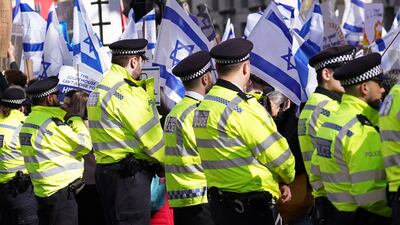
Demonstrators protest on Whitehall in London following Mr Netanyahu's visit. PA -
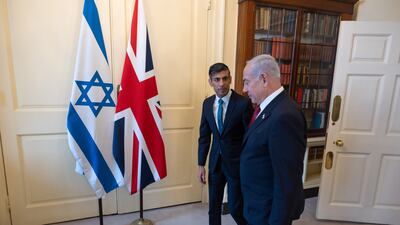
Mr Sunak welcomes Mr Netanyahu inside 10 Downing Street. Photo: No 10 Downing Street -

Mr Sunak and Mr Netanyahu hold a meeting inside 10 Downing Street. Photo: No 10 Downing Street -

Demonstrators dressed as characters from The Handmaid's Tale protest on Whitehall. AFP -

Mr Sunak and Mr Netanyahu hold a discussion inside 10 Downing Street. Photo: No 10 Downing Street -
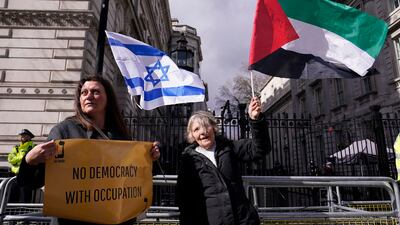
Protestors outside 10 Downing Street. AP -
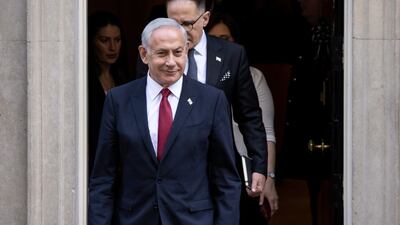
Mr Netanyahu leaves 10 Downing Street. EPA -
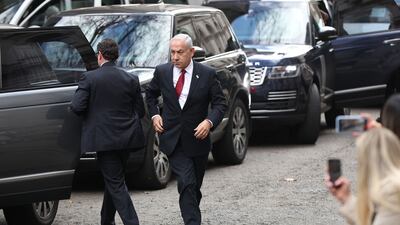
Mr Netanyahu’s office said he is expected to focus on 'the Iranian issue' with the UK Prime Minister. AFP -
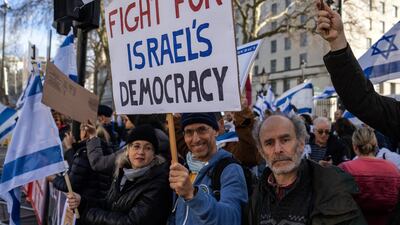
Demonstrators hold up a sign as they gather near Downing Street before the arrival of Mr Netanyahu. Getty -
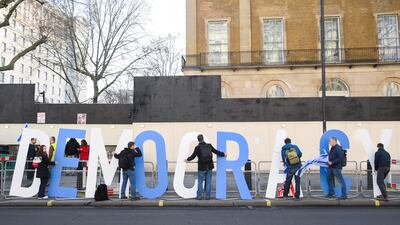
Demonstrators spell out the word "Democracy" as they protest in London. Reuters


During their meeting, which lasted about an hour, they discussed shared security and defence challenges including the Iran nuclear threat and Russia’s invasion of Ukraine.
“On Iran, they discussed the UK and Israel’s significant concern about Iran’s destabilising activity, and agreed that our governments would continue to work closely together to push back against aggression and manage the risk of nuclear proliferation.”
Mr Sunak and Mr Netanyahu expressed an interest in striking a “modern free-trade agreement with cutting-edge service provisions” and pledged to direct their teams to work “at pace” to achieve this.
Earlier, Mr Netanyahu’s office said he expected to focus on “the Iranian issue” with the UK Prime Minister, seeking to form “a united international front against Iran to stop its nuclear programme”.
“The two are also expected to discuss strengthening the strategic ties between Israel and the United Kingdom, and increasing security and intelligence co-operation,” the Israeli Prime Minister's office said.
Mr Netanyahu was afterwards expected to meet Home Secretary Suella Braverman to discuss measures to deal with “global terrorism”, it said.
In Israel, protesters have blocked major roads and scuffled with police in recent weeks as demonstrations sweep across the nation.
After a series of scandals involving wealthy associates, Mr Netanyahu is on trial for fraud, breach of trust and accepting bribes. He denies wrongdoing.
Critics say his government, the most right-wing in Israel’s history, is dragging the nation towards authoritarianism by upending its system of checks and balances.
British Jews voice concerns
Gideon Delayahu stood outside Downing Street holding a banner that read: “Democracy”.
He said he had fears about the direction Mr Netanyahu appears to be taking Israel in.
Originally from Tel Aviv, Mr Delayahu has lived in London for 23 years but still owns assets in Israel and wants his children to be able to live there if they wish when they are older.
He views Mr Netanyahu’s proposals as a “betrayal of the democratic contract” he has with the electorate.
“They’re bringing in undemocratic rule,” he told The National. “I am extremely worried about it. It’s on a knife-edge.”
“I want my children to have a place they can be proud of. I have liberal democratic views and I am gobsmacked by what is happening. I want Israel to be a liberal democracy otherwise no one will want to go there or [do business] there.”

His fellow Londoner Michael Feiner, also originally from Tel Aviv, shared his fears, particularly for the technology industry.
Mr Feiner was among protesters holding banners depicting Mr Netanyahu as a “dictator”. He said that while he believed the Israeli leader was “a democrat in his heart”, he had been “showing signs of dictatorship”.
'Two-state solution is dead'
Chaim Blier was one of several members of the Neturei Karta sect of Haredi Jews who joined pro-Palestinian protesters.
The group do not recognise the state of Israel as legitimate and believe that human attempts to establish Jewish sovereignty over the land are sinful.
Mr Blier, from London’s Stamford Hill community, held a sign condemning the existence of the state of Israel.
One of his comrades held up a banner reading: “Benjamin Netanyahu and the state of Israel do not represent world Jewry.”
“We support the right of the Palestinian people and stand against crimes against humanity,” he told The National.

Jan, a British woman who recently travelled to the West Bank, held a sign that read “Free Palestine” as she huddled among the crowds.
Speaking to The National, the Londoner said while she had always empathised with the Palestinian cause, it became more real for her following her trip.
“I saw what the apartheid system looks like and how Palestinians are living every day,” she explained.
“Some people have to get up at 3am to go through a checkpoint in order to cross to Israel to work.
“I feel like I have to speak out about it. I have written an article about it and I have come here to protest. I don’t support Netanyahu because he is undermining democracy.
“The two-state solution is dead because of the [Israeli] settlements and theft of land. I would like to see a one-state solution with equal rights for Israelis and Palestinians.”
Mr Netanyahu landed in London early on Friday amid political turmoil in his own country. There is a huge amount of discontent among Israeli voters over his government's proposals to shake up the judiciary.
He and his allies argue that changes are necessary to diminish the powers of the Supreme Court, which they say has become politicised and is blocking good governance.
But many Israelis see the plan as an attempt to weaken democracy in the country.
UK-Israel road map
Israel's longest-serving prime minister's visit to the UK capital came days after Israeli Foreign Minister Eli Cohen met his British counterpart in the city for talks.
Mr Cohen and British Foreign Secretary James Cleverly signed an agreement to boost trade, defence and security ties between the two nations.
The 2030 Road Map for UK-Israeli relations focuses heavily on technology and includes “shared commitments to tackle the scourge of anti-Semitism”, the UK Foreign Office said.
The Palestinian Mission to the UK, as well as the opposition Labour Party, raised concerns about the deal in the run-up to Mr Netanyahu's visit.
Husam Zomlot, the Palestinian ambassador to Britain, said the UK-Israeli treaty “represents an abdication of the UK’s responsibilities under international law and the UK’s unique historic responsibility for the Palestinian issue”.


