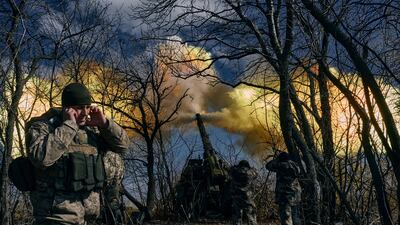
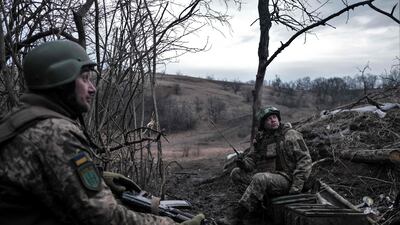
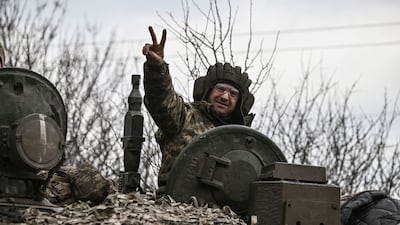
Soldiers of the Ukrainian Volunteer Army hold their positions at the front line near Bakhmut, Donetsk region, on March 11, 2023, amid the Russian invasion of Ukraine. (Photo by Sergey SHESTAK / AFP)

Russia running out of artillery ammunition, claims UK intelligence


Gillian Duncan
  • English
  • Arabic

Russian artillery ammunition shortages have probably worsened to the extent that “punitive shell-rationing” is taking place in many areas of Ukraine's front line, according to British military intelligence.

The Ministry of Defence said this explains is why Russian forces have failed to advance recently, despite focusing their efforts in the beleaguered town of Bakhmut.

The update comes as both sides, particularly Russia, continue to suffer high casualties in the ruined mining town, with the months-long fight for it becoming Europe's bloodiest infantry battle since the Second World War.

“It is very tough in the east — very painful,” Ukrainian President Volodymyr Zelenskyy said in a Monday video address that he has held nightly since Russia launched its invasion more than a year ago.

“We have to destroy the enemy's military power. And we shall destroy it,” he said.

The ministry said: “In recent weeks, Russian artillery ammunition shortages have likely worsened to the extent that extremely punitive shell-rationing is in force on many parts of the front.

“This has almost certainly been a key reason why no Russian formation has recently been able to generate operationally significant offensive action.

“Russia has almost certainly already resorted to issuing old munitions stock which were previously categorised as unfit for use.”

Separately, in what would be the first international war crimes cases arising from the invasion, the International Criminal Court (ICC) is expected to seek the arrest of Russian officials for forcibly deporting children from Ukraine and targeting civilian infrastructure, a source told Reuters.

Russia would be certain to reject arrest warrants against its officials, but an international war crimes prosecution could deepen its diplomatic isolation over a campaign that has killed thousands of civilians and driven millions from their homes.

Speaking on Tuesday, Kremlin spokesman Dmitry Peskov said Russia does not recognise the jurisdiction of the ICC after being asked about the reports the ICC was expected to seek its first arrest warrants against Russian individuals in relation to the conflict in Ukraine shortly.

"We do not recognise this court, we do not recognise its jurisdiction," Mr Peskov told Tass, the Russian news agency.

Ukraine and Russia conflict latest - in pictures

  • Ukrainian soldiers fire a howitzer towards Russian positions, near Bakhmut in Ukraine. AP
    Ukrainian soldiers fire a howitzer towards Russian positions, near Bakhmut in Ukraine. AP
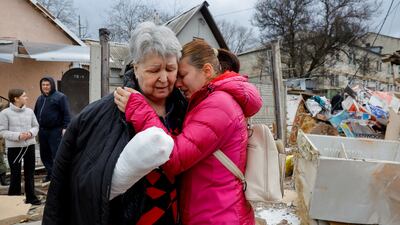
  • Resident Svetlana Boiko, 66, who was wounded in recent shelling, is comforted near her destroyed house in Donetsk. Reuters
    Resident Svetlana Boiko, 66, who was wounded in recent shelling, is comforted near her destroyed house in Donetsk. Reuters
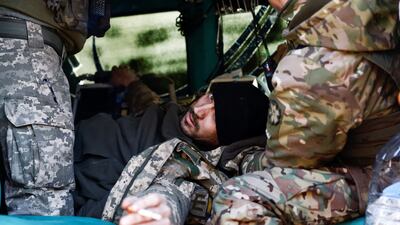
  • A wounded Ukrainian soldier is treated in a front-line stabilisation ambulance, near Kreminna. Reuters
    A wounded Ukrainian soldier is treated in a front-line stabilisation ambulance, near Kreminna. Reuters
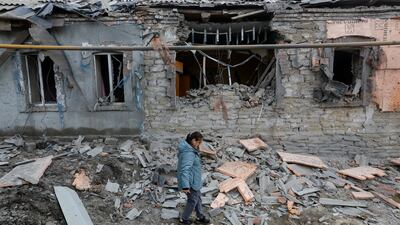
  • A house in Donetsk destroyed in recent shelling. Reuters
    A house in Donetsk destroyed in recent shelling. Reuters
  • Ukrainian volunteer soldiers hold their positions at the front line near Bakhmut. AFP
    Ukrainian volunteer soldiers hold their positions at the front line near Bakhmut. AFP
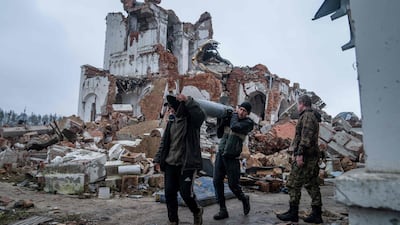
  • Volunteers carry the remains of a Uragan rocket as they clear the area around the Sviatohirsk Cave Monastery in Dolyna. AFP
    Volunteers carry the remains of a Uragan rocket as they clear the area around the Sviatohirsk Cave Monastery in Dolyna. AFP
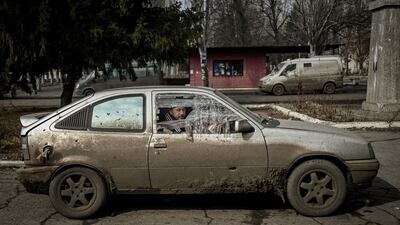
  • A man sits inside a damaged car in the village of Chasiv Yar. AFP
    A man sits inside a damaged car in the village of Chasiv Yar. AFP
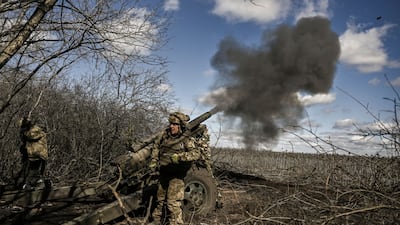
  • Ukrainian servicemen fire at Russian positions in the region of Donbas. AFP
    Ukrainian servicemen fire at Russian positions in the region of Donbas. AFP
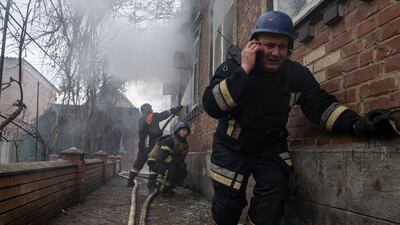
  • Rescue workers put out a fire in a house shelled by Russian forces in Kostiantynivka. AP
    Rescue workers put out a fire in a house shelled by Russian forces in Kostiantynivka. AP
  • A Ukrainian serviceman moves towards the frontline city of Bakhmut. AFP
    A Ukrainian serviceman moves towards the frontline city of Bakhmut. AFP
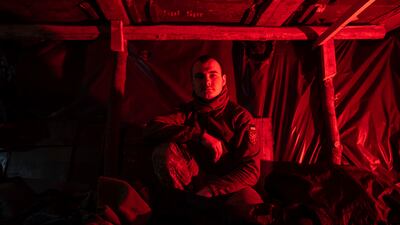
  • Vladyslav, a Ukrainian paratrooper of the 80 Air Assault brigade, rests in a dugout at the front line near Bakhmut. AP
    Vladyslav, a Ukrainian paratrooper of the 80 Air Assault brigade, rests in a dugout at the front line near Bakhmut. AP
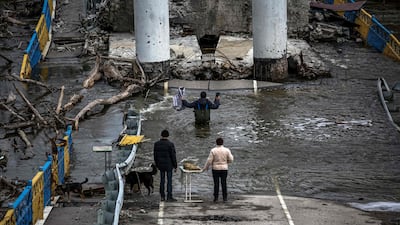
  • Residents of the village of Bohorodychne cross the Seversky Donets river to retrieve bread from the other bank. AFP
    Residents of the village of Bohorodychne cross the Seversky Donets river to retrieve bread from the other bank. AFP

The prosecutor of the ICC is expected to ask a pre-trial judge to approve issuing warrants against several Russians for the abduction of children from Ukraine to Russia and the targeting of civilian infrastructure in Ukraine, a source with knowledge of the matter told Reuters on Monday.

Russia, however, appeared on the cusp of one long-sought diplomatic breakthrough with sources telling that Chinese President Xi Jinping could visit Russia as soon as next week.

The Chinese Foreign Ministry did not respond to requests for comment. The Kremlin said it had nothing to announce yet.

Bakhmut

On the battlefront, Ukrainian soldiers said on Monday they were repelling attacks near Kreminna, north of Bakhmut.

In a forest, some 8km from the front, cannons boomed and explosions rumbled constantly in the distance.

Agency reporters on the ground saw a soldier being brought from the front with a wounded leg. He was stabilised in a van with a splint and painkillers before being taken to a medical centre.

“Two or three weeks ago the fighting was at its peak but it has calmed down a bit,” said Mykhailo Anest, a 35-year-old medic.

“There is a lot of artillery and mortar fire.”

Soldiers of the Ukrainian Volunteer Army hold their positions at the front line near Bakhmut. AFP

Trench warfare, described by both sides as a meat grinder, has claimed a huge toll in Bakhmut, in Donetsk, with both sides reporting hundreds of enemy troops killed.

Russia launched five missile attacks, 35 air strikes and 76 heavy rocket salvo systems during the past day, including on civilian infrastructure in the Sumy and Donetsk regions, Ukraine's military said on Wednesday.

Ukrainian forces repelled attacks on seven settlements in the Bakhmut front, it said.

Russia says taking Bakhmut would open a path to capture all of Donetsk, a central war aim.

Ukraine, which has decided to defend Bakhmut rather than withdraw, says wearing out Russia's military now will help its counter-offensive later.

But not every military analyst is convinced that defending Bakhmut is the best strategy for Ukraine.

Ukraine was suffering losses among reserves it intended to use for a later push against Russian forces, Ukrainian military analyst Oleh Zhdanov said in an interview.

“We could lose here everything we wanted to use for those counter-offensives.”

Hydrogen: Market potential

Hydrogen has an estimated $11 trillion market potential, according to Bank of America Securities and is expected to generate $2.5tn in direct revenues and $11tn of indirect infrastructure by 2050 as its production increases six-fold.

"We believe we are reaching the point of harnessing the element that comprises 90 per cent of the universe, effectively and economically,” the bank said in a recent report.

Falling costs of renewable energy and electrolysers used in green hydrogen production is one of the main catalysts for the increasingly bullish sentiment over the element.

The cost of electrolysers used in green hydrogen production has halved over the last five years and will fall to 60 to 90 per cent by the end of the decade, acceding to Haim Israel, equity strategist at Merrill Lynch. A global focus on decarbonisation and sustainability is also a big driver in its development.

Various Artists 
Habibi Funk: An Eclectic Selection Of Music From The Arab World (Habibi Funk)
​​​​​​​

Who has lived at The Bishops Avenue?
  • George Sainsbury of the supermarket dynasty, sugar magnate William Park Lyle and actress Dame Gracie Fields were residents in the 1930s when the street was only known as ‘Millionaires’ Row’.
  • Then came the international super rich, including the last king of Greece, Constantine II, the Sultan of Brunei and Indian steel magnate Lakshmi Mittal who was at one point ranked the third richest person in the world.
  • Turkish tycoon Halis Torprak sold his mansion for £50m in 2008 after spending just two days there. The House of Saud sold 10 properties on the road in 2013 for almost £80m.
  • Other residents have included Iraqi businessman Nemir Kirdar, singer Ariana Grande, holiday camp impresario Sir Billy Butlin, businessman Asil Nadir, Paul McCartney’s former wife Heather Mills. 
Hunting park to luxury living
  • Land was originally the Bishop of London's hunting park, hence the name
  • The road was laid out in the mid 19th Century, meandering through woodland and farmland
  • Its earliest houses at the turn of the 20th Century were substantial detached properties with extensive grounds


RESULTS

6.30pm: Longines Conquest Classic Dh150,000 Maiden 1,200m.
Winner: Halima Hatun, Antonio Fresu (jockey), Ismail Mohammed (trainer).

7.05pm: Longines Gents La Grande Classique Dh155,000 Handicap 1,200m.
Winner: Moosir, Dane O’Neill, Doug Watson.

7.40pm: Longines Equestrian Collection Dh150,000 Maiden 1,600m.
Winner: Mazeed, Richard Mullen, Satish Seemar.

8.15pm: Longines Gents Master Collection Dh175,000 Handicap.
Winner: Thegreatcollection, Pat Dobbs, Doug Watson.

8.50pm: Longines Ladies Master Collection Dh225,000 Conditions 1,600m.
Winner: Cosmo Charlie, Pat Dobbs, Doug Watson.

9.25pm: Longines Ladies La Grande Classique Dh155,000 Handicap 1,600m.
Winner: Secret Trade, Tadhg O’Shea, Ali Rashid Al Raihe.

10pm: Longines Moon Phase Master Collection Dh170,000 Handicap 2,000m.
Winner:

RESULT

Kolkata Knight Riders 169-7 (20 ovs)
Rajasthan Royals 144-4 (20 ovs)

Kolkata win by 25 runs

Next match

Sunrisers Hyderabad v Kolkata Knight Riders, Friday, 5.30pm

Start-up hopes to end Japan's love affair with cash

Across most of Asia, people pay for taxi rides, restaurant meals and merchandise with smartphone-readable barcodes — except in Japan, where cash still rules. Now, as the country’s biggest web companies race to dominate the payments market, one Tokyo-based startup says it has a fighting chance to win with its QR app.

Origami had a head start when it introduced a QR-code payment service in late 2015 and has since signed up fast-food chain KFC, Tokyo’s largest cab company Nihon Kotsu and convenience store operator Lawson. The company raised $66 million in September to expand nationwide and plans to more than double its staff of about 100 employees, says founder Yoshiki Yasui.

Origami is betting that stores, which until now relied on direct mail and email newsletters, will pay for the ability to reach customers on their smartphones. For example, a hair salon using Origami’s payment app would be able to send a message to past customers with a coupon for their next haircut.

Quick Response codes, the dotted squares that can be read by smartphone cameras, were invented in the 1990s by a unit of Toyota Motor to track automotive parts. But when the Japanese pioneered digital payments almost two decades ago with contactless cards for train fares, they chose the so-called near-field communications technology. The high cost of rolling out NFC payments, convenient ATMs and a culture where lost wallets are often returned have all been cited as reasons why cash remains king in the archipelago. In China, however, QR codes dominate.

Cashless payments, which includes credit cards, accounted for just 20 per cent of total consumer spending in Japan during 2016, compared with 60 per cent in China and 89 per cent in South Korea, according to a report by the Bank of Japan.

England XI for second Test

Rory Burns, Keaton Jennings, Ben Stokes, Joe Root (c), Jos Buttler, Moeen Ali, Ben Foakes (wk), Sam Curran, Adil Rashid, Jack Leach, James Anderson

MATCH INFO

Champions League quarter-final, first leg

Manchester United v Barcelona, Wednesday, 11pm (UAE)

Match on BeIN Sports

Where%20the%20Crawdads%20Sing
%3Cp%3E%3Cstrong%3EDirector%3A%20%3C%2Fstrong%3EOlivia%20Newman%3Cbr%3E%3Cstrong%3EStars%3A%3C%2Fstrong%3E%20Daisy%20Edgar-Jones%2C%20Taylor%20John%20Smith%2C%20Harris%20Dickinson%2C%20David%20Strathairn%3Cbr%3E%3Cstrong%3ERating%3A%3C%2Fstrong%3E%202%2F5%3C%2Fp%3E%0A
Updated: March 14, 2023, 10:07 AM