


Britain’s National Health Service is “undeniably under enormous pressure”, Prime Minister Rishi Sunak has admitted, as he refused to say whether he used private health care amid record waiting times for treatment.
Speaking on Sunday with Laura Kuenssberg on the BBC, Mr Sunak said the health service was struggling but insisted “we can get to grips” with the problem.
He said he had met NHS leaders and now had a “renewed sense of confidence and optimism”.
Mr Sunak has made reducing the NHS waiting lists one of his key priorities over the next two years and has held emergency talks with health leaders to alleviate the crisis.
But unlike Conservative former prime minister Margaret Thatcher, who spoke of exercising her "right as a free citizen to spend my own money in my own way" to seek private health care, Mr Sunak refused to say whether he has paid to avoid waiting lists himself.
Mr Sunak refused to say, despite repeated questioning, whether he used a private GP, after claims earlier emerged he was registered with a private practice in west London that guarantees patients with urgent concerns will be seen "on the day".
He said he “grew up in an NHS family” with a father who was a doctor and a mother who worked as a pharmacist.
"As a general policy, I wouldn't ever talk about me or my family's healthcare situation.
"But it's not really relevant, what's relevant is the difference I can make to the country."
The nursing union told him to "come clean" on the issue, while Labour said Mr Sunak gave the impression of being a leader who "not only doesn't use the NHS but doesn't understand the scale of the challenges".
Royal College of Nursing General Secretary, Pat Cullen, who has been leading strikes in an attempt to secure nurses a better pay deal, told Ms Kuenssberg: "I think as a public servant, you ought to be clear with the public whether or not you are using private health cover.
"That's about being open, it's about being transparent and it's about honesty.
"I think he needed to come clean. As a public servant he is elected by the public, so he is accountable to the public and when you're accountable to the public, you have to be honest with them."
Shadow health secretary Wes Streeting told the programme he did not use private health care, as he sought to paint Mr Sunak as being out of touch.
"I thought the Prime Minister in that interview gave the impression of someone who not only doesn't use the NHS but doesn't understand the scale of the challenges or have a plan to deal with the fundamental problems," the Labour MP said.
"Because, yes, you can get people around the table in No 10 for a photo op, yes, you can do more sticking plasters to get through this winter ... but we need fundamental change in the NHS to deal with what is the biggest crisis in its history and that's what Labour is looking to do."
Mr Sunak questioned figures from the Royal College of Emergency Medicine, which claims at least 300 people a week are dying because of delays in accident and emergency departments.
“The NHS themselves have said that they don’t recognise those numbers and would be careful about bandying them around,” he said.
But he admitted there had been unacceptable delays in ambulance handovers.
Mr Sunak said the problem was "not going to be solved overnight” but that ensuring patients were discharged from hospital to social care, home settings and virtual wards would help ease the situation.
He said he was confident patients would no longer have to wait 18 months for treatment.
He said he would be meeting the nurses’ union on Monday after strikes by the profession.
“It’s important they recognise the work they do is appreciated and I’m grateful and the government is grateful for it,” he said.
“And that’s why we want to have a reasonable, honest, two-way conversation about pay and everything else that is relevant”.
Nurses strike in the UK - in pictures
-
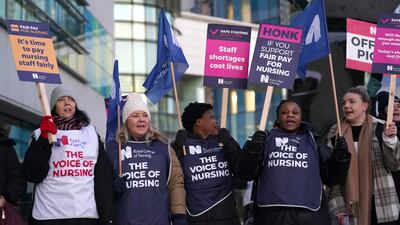
Members of the Royal College of Nursing on the picket line outside Queen Elizabeth Hospital in Birmingham, as nurses in England, Wales and Northern Ireland strike over pay. PA -
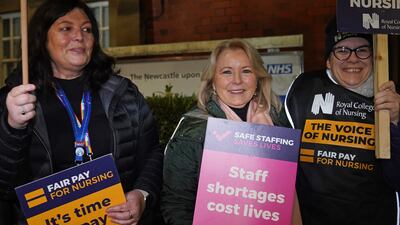
Royal College of Nursing (RCN) General Secretary Pat Cullen joins members on the picket line outside the Royal Victoria Infirmary in Newcastle. PA -
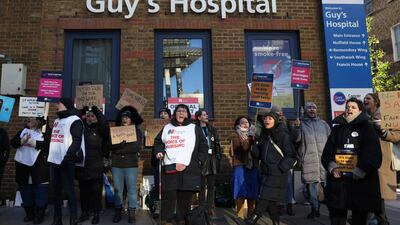
NHS nursing staff outside Guy's Hospital in London. Bloomberg -

Demonstrators outside St Thomas' Hospital in London. Bloomberg -
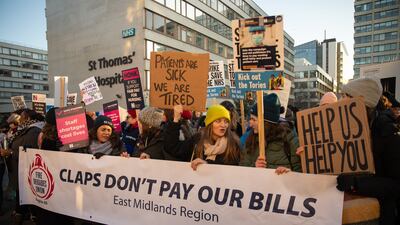
The picket line outside St Thomas' Hospital. PA -
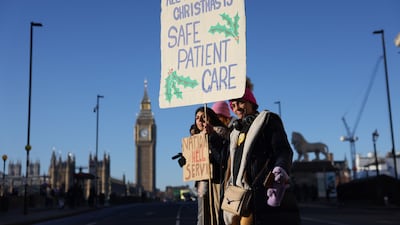
About a quarter of hospitals and community teams in England are striking, alongside all trusts in Northern Ireland and all but one health board in Wales. Bloomberg -
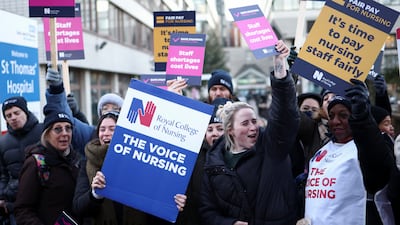
RCN members outside St Thomas' Hospital. Reuters -
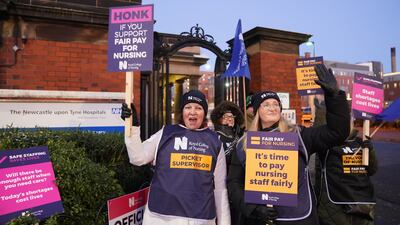
Nurses on strike outside Royal Victoria Infirmary in Newcastle. PA -

A message to the government outside St Thomas' Hospital. Reuters -
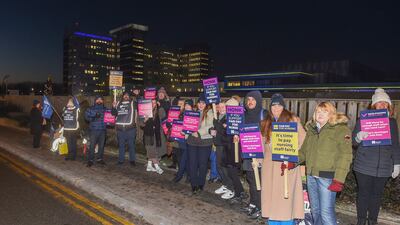
Nurses on the picket line outside Aintree University Hospital in Liverpool. PA -

Nurses brave the cold for the strike in London. Reuters -
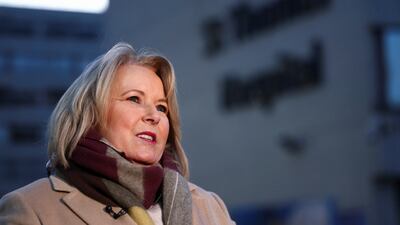
Ms Cullen, head of the RCN union, speaks to the media outside St Thomas' Hospital. Reuters -

A sign, right, referring to the Clap for our Carers campaign during the Covid-19 pandemic. Many nurses say they would rather be rewarded with a pay rise. Reuters


He said the “door has always been open” to “talk about things that are reasonable, affordable and responsible for the country”.
“When it comes to pay, as I’ve said, it’s not appropriate for those conversations to happen in public but the most important thing is that we are talking,” he said.
Ms Cullen said she heard “a chink of optimism” in his comments.
She said Monday's meeting was "not addressing the issues that are at dispute, and that is addressing pay for 2022/23".
She added: “What the government wants to talk about tomorrow is pay moving forward and in the broadest terms. And that is not going to avert the strike action that’s planned for 10 days’ time.”
Prof Clive Kay, chief executive of King’s College Hospital, who was also on Sunday with Laura Kuenssberg, said the past year was the worst he had experienced “by far” in his 40 years working in the NHS.
After listening to Mr Sunak’s comments, he said he did not think the Prime Minister had grasped the difficulty of the situation.
“This is not just a winter 2022/2023 problem," he said. "[It’s going to take] quite a time to fix this. We need some realistic conversations about the situation we are in, how difficult it is, what the public can expect.
"And I think the suggestion that there's going to be a quick fix is not a reality."
In his BBC interview, Mr Sunak also spoke about inflation, saying it was vital to many issues facing the UK, including nurses’ salary demands.
"We can't help anybody, whether it’s nurses or everyone else, unless we get inflation down and that’s why it’s one of our five priorities.”
He repeated those priorities, which are "to halve inflation, grow the economy, reduce debt, cut waiting lists and stop the [migrant] boats."
Mr Sunak also addressed the crisis in the country’s immigration system, which is suffering from a large backlog in asylum applications.
He said: “My view is if you come here illegally you should not have the right to stay and you will be detained and then swiftly removed, either to your home … or indeed to a safe third alternative.”
He said new laws would be passed early this year and should apply to everyone who arrives in the UK illegally.
He pointed out that Albania, “a safe country”, accounted for almost a third of illegal migrant arrivals last year.
“Other European countries return illegal migrants to Albania, we were not doing that sufficiently,” he said.

