


Liz Truss's government was teetering on the brink on Thursday as Tory MPs called for her to step down following an extraordinary day of chaos in Westminster.
Ms Truss was dealt a a huge blow on Wednesday with the departure of Home Secretary Suella Braverman over a security breach, followed by mayhem in the House of Commons regarding what was seen as a confidence vote in her crumbling government.
Ms Braverman said she had made “a mistake” by sending an official document regarding migration policy via her personal phone and had tendered her resignation. The government's immigration policy is a market-sensitive issue, one tied up with the upcoming financial statement designed to stabilise the markets.
Although her departure was not directly caused by the performance of Ms Truss, she did take a swipe at the prime minister, saying she had concerns over the direction of the government “breaking key pledges to voters” and not “honouring manifesto commitments”.
In her leaving statement, the champion of the Conservative right hinted that Ms Truss should consider her position as prime minister.
“Pretending we haven't made mistakes, carrying on as if everyone can't see we've made them, and hoping things will magically come right is not serious politics,” she said.
Her exit, coming just five days after Kwasi Kwarteng’s sacking as chancellor, means the prime minister has lost two people from the four great offices of state within her first six weeks in office, with all eyes on whether other Cabinet ministers could follow suit.
Chaos in the Commons
There was further chaos in the Commons over a fracking vote and confusion over whether the chief and deputy chief whip had quit. Tory MPs had been told it should be considered a vote of confidence in the government with a “100 per cent hard” three-line whip, meaning any Tory MP that rebelled could be thrown out of the parliamentary party.
The exodus appeared to continue with speculation that Chief Whip Wendy Morton and her deputy Craig Whittaker walked out after a last-minute U-turn on a threat to strip the whip from Conservative MPs if they backed a Labour challenge over fracking. After hours of uncertainty over their departure, Downing Street was forced to issue a clarification that both “remain in post”.
In extraordinary scenes at Westminster, Cabinet ministers Therese Coffey and Jacob Rees-Mogg were among a group of senior Tories accused of pressuring colleagues to go into the “no” lobby, with Labour former minister Chris Bryant saying some MPs had been “physically manhandled into another lobby and being bullied”.
Conservative MP Crispin Blunt said Ms Truss's position was now "untenable" and she should resign today.
Asked how he would describe her position on Thursday morning, he told BBC Radio 4’s Today programme: “Wholly untenable. And if she doesn’t understand that then I would be astonished.
“But one of the qualities she has shown is a lack of self-knowledge to this whole process, because it ought to have been clear that she did not have the capacity to lead our party and I don’t think she should have put herself up for the leadership in the first place.
“All of that has now been confirmed. It’s plain what is required. We need to affect a change, frankly, today, in order to stop this shambles and give our country the governance it needs under our constitution.”
Backbencher Simon Hoare described the scenes as pandemonium, which summed up the day. On Thursday, he told the BBC that MPs were feeling anger and sadness about the situation and today would be a crunch day.
He said the country has a government “which wants to function but is buffeted by huge amounts of bad luck”. It was possible Ms Truss could restore confidence but had around 12 hours to “turn the ship around”.
Tory backbencher Sir Charles Walker, visibly emotional, told BBC News: “As a Tory MP of 17 years … I think it’s a shambles and a disgrace. I think it is utterly appalling. I’m livid.”
Several Tory MPs sided with him, including Maria Caulfield, who tweeted: “Tonight we are all Charles Walker.”
There is speculation that the chairman of the Tory backbench 1922 Committee, Sir Graham Brady, has already received more than 54 letters calling for a no-confidence vote in the Prime Minister, the threshold for triggering one if Ms Truss was not in the 12-month grace period for new leaders.
Grant Shapps, a critic of Ms Truss from the centre of the party and an ally of Rishi Sunak, has replaced Ms Braverman.
The new home secretary said he was looking forward to getting on with the job “regardless of what’s happening otherwise in Westminster”.
Speaking outside the Home Office, he said: “Obviously it has been a turbulent time for the government.
“But the most important thing is to make sure the people of this country know they’ve got security. That’s why it’s a great honour to be appointed as home secretary today.
“I’m looking forward to getting stuck into the role providing the security the British people need regardless of what’s happening otherwise in Westminster."
What did Ms Braverman say in her resignation letter?
In her resignation letter, which she tweeted, Ms Braverman said as home secretary she held herself to the highest standards and that resigning was “the right thing to do”. “The business of government relies upon people accepting responsibility for their mistakes,” she wrote.
It is a hammer blow to the prime minister who is struggling to retain her authority less than seven weeks into her tenure. In her own letter Ms Truss said she accepted the minister's decision to stand down, saying it was important Cabinet confidentiality is respected.
“I accept your resignation and respect the decision you have made. It is important the ministerial code is upheld and that Cabinet confidentiality is respected,” Ms Truss wrote.
Ms Truss has already sacked her original chancellor, Kwasi Kwarteng, after his mini-budget backfired.
Ms Braverman, who was appointed as home secretary in place of Priti Patel when Ms Truss came to power, was previously the attorney general but was promoted to one of the top Cabinet jobs after she raised her profile during an ultimately unsuccessful bid to become party leader in the summer. She was popular with backbench MPs and the party members.
As home secretary, Ms Braverman was in charge of MI5, Britain’s internal security service, that closely monitors extremists and terrorists, providing top secret information on which the politician has to make important decisions.
But she has also been heavily opposed to any relaxation of visas for immigrants, putting her in opposition to the prime minister who wants more migrants to help boost growth.
Downing Street sources have indicated that the security breach was a “genuine, honest mistake”, that the ministerial code had been breached and as a result Ms Braverman had effectively been sacked.
Rumours gripped Westminster after Ms Truss’s poor showing at Prime Minister's Questions after she remained working in her parliamentary office.
What next for the Prime Minister?
It is now thought that Ms Truss was having discussions on the action she should take in regards to the security breach.
The dismissal of a right-wing MP could lead to a reaction to Ms Truss’s authority from the Brexiteer wing of the party, to which Ms Braverman will now return.
There are already fears among Brexiteers that the prime minister might cave in to European Union demands on the Northern Ireland Protocol. This could lead to crucial loss of support from the European Research Group of MPs and further threaten her leadership.
Ms Braverman, who was appointed on September 6, becomes the shortest serving home secretary since the Duke of Wellington, who was in office for just 30 days in 1843.
During her short time in the job she caused controversy by suggesting at Conservative Party conference there had been a coup by MPs forcing Ms Truss's plan to scrap the top rate of tax to be overturned, and caused a row with the Indian government during trade talks over comments about immigrants overstaying and criticised “Guardian-reading, tofu-eating wokerati” for supporting environmental protests.
Separately, one of the prime minister’s senior aides, Jason Stein, has reportedly been suspended pending an investigation by the Cabinet Office propriety and ethics team into briefings against Sajid Javid.
Earlier, Ms Truss faced MPs in the House of Commons for just her third PMQs as she battled to keep her beleaguered premiership intact. How her rebellious MPs judged her performance during the showdown could decide her future, just six weeks into her tenure in Downing Street.
Ms Truss said that she had no intention of stepping down as prime minister, insisting she is “a fighter, not a quitter”.
With elections to the 1922 Committee completed late on Tuesday, the powerful grouping of backbench MPs may set new rules to trigger a confidence vote in Ms Truss’s leadership.
-
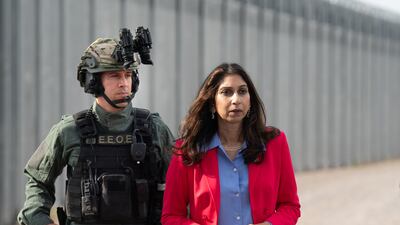
UK Home Secretary Suella Braverman during a visit to Alexandroupolis on the Greek border with Turkey to see surveillance facilities and learn how Greek security forces monitor the land border. PA -

Ms Braverman at the Shoah Wall in November in Ostarrichi Park in Vienna that carries the names of 65,000 Jews from Austria who died in the Holocaust. PA -
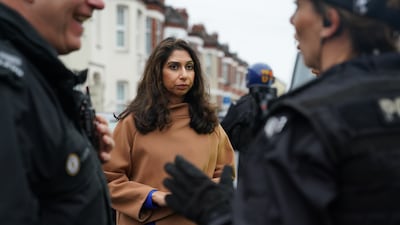
Ms Braverman attends a county lines raid with officers from West Midlands Police in Coventry in October. PA -
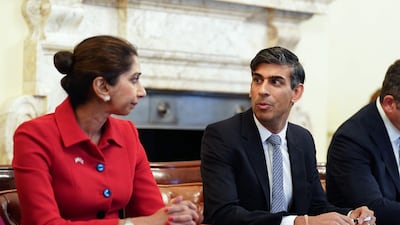
Britain's Prime Minister Rishi Sunak and Ms Braverman at a policing roundtable summit at 10 Downing Street in October. AFP -
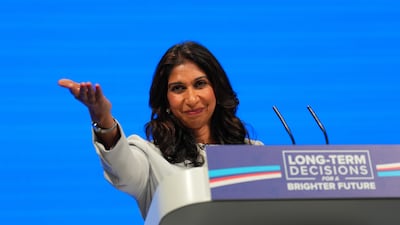
Ms Braverman during the Conservative Party Conference in October in Manchester. Getty Images -

Mr Sunak and Ms Braverman join police for a walkabout in Chelmsford High Street in March. Getty Images -
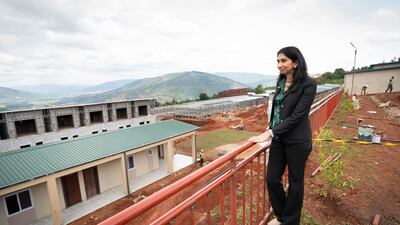
Ms Braverman at a building site on the outskirts of Kigali during her visit to Rwanda in March to see houses being constructed that could eventually house deported migrants from the UK. PA -

Ms Braverman outside No 10 Downing Street in October 2022 after being appointed Britain's home secretary by Mr Sunak. Reuters -
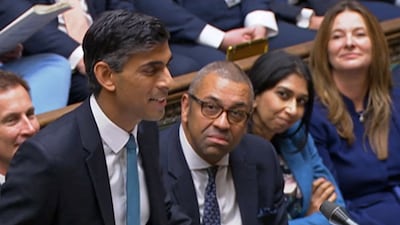
Ms Braverman, second right, watches Mr Sunak during his first Prime Minister's Questions in the House of Commons in 2022. AFP -

Ms Braverman at the scene in Oxfordshire in 2022 where an Albanian woman believed to be responsible for helping transport migrants to the UK in small boats was arrested. PA -
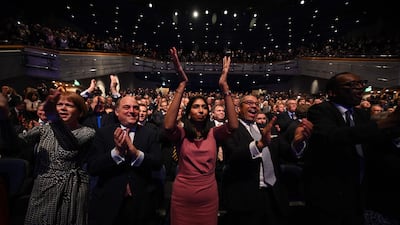
Ms Braverman applauds as Prime Minister Liz Truss delivers her keynote address on the final day of the Conservative Party Conference in Birmingham in 2022. AFP -

Ms Braverman during the Conservative Party Conference in Birmingham in 2022. Getty Images -
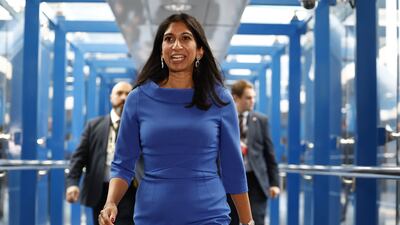
Ms Braverman at the Conservative Party Conference in Birmingham in 2022. Getty Images -

King Charles III greets Mayor of London Sadiq Khan, Suella Braverman and interim Deputy Commissioner of the Metropolitan Police Dame Lynne Owens when meeting emergency service workers in London in 2022. Getty Images -
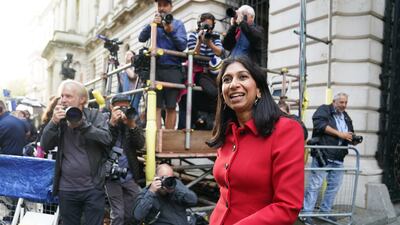
Ms Braverman arriving in Downing Street for the first Cabinet meeting with new Prime Minister Liz Truss in September 2022. PA -
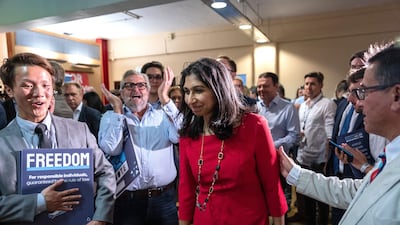
Attorney General for England and Wales and then Conservative Party leadership candidate Ms Braverman at the Conservative Way Forward relaunch event in London in July 2022. Getty Images -
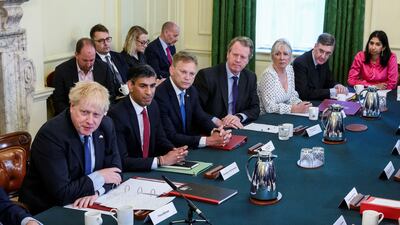
Ms Braverman, in pink, listens as former prime minister Boris Johnson addresses his Cabinet in Downing Street in June 2022. Reuters -
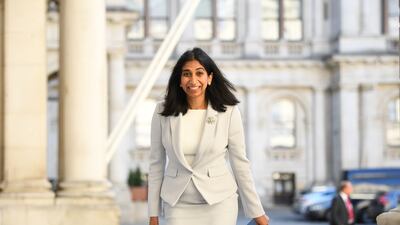
Ms Braverman arrives at the Foreign and Commonwealth Office in London for the first time since the Covid-19 lockdown in 2020. Getty Images


Ms Truss began Wednesday's session by repeating that she accepted she had made mistakes on the economy and again apologised.
She tried to get the upper hand by criticising opposition leader Sir Keir Starmer for refusing to condemn striking railway workers.
She was ridiculed by Sir Keir, who read out a list of her policies which had already been abandoned. He asked if “out by Christmas” was the title or publication date for a book being written about her time in office.
Sir Keir said the government had “crashed the economy” and read out a list of dropped economic policies, with Labour MPs shouting “gone” after each one.
He said: “Economic credibility — gone. And her supposed best friend the former chancellor, he’s gone as well. They’re all gone. So why is she still here?”
Ms Truss replied: “I am a fighter and not a quitter. I have acted in the national interest to make sure that we have economic stability.”

