
A royal guard collapsed while watching over the coffin of Queen Elizabeth II in Westminster Hall overnight.
The guard, who appeared to be a member of the Royal Company of Archers, the sovereign’s bodyguard in Scotland, was standing at the foot off the late monarch's casket when he suddenly fell to the floor.
Footage shared on social media shows police rushing to help as gasps can be heard from mourners queuing to see the queen’s casket.
The Archers guarded the queen’s coffin round the clock while the cortege made its way from Balmoral to Edinburgh earlier in the week. Members are now keeping vigil at Westminster alongside the Gentlemen at Arms, the Yeomen of the Guard, at Westminster Hall.

There are 530 members of the Archers, who must be Scottish or have strong connections to the country. They wear green uniforms with a beret finished off with a feather and carry bows. The company still functions as an archery club, the purpose for which it was originally formed in 1676.
Guards are prone to fainting because they must stand still for long periods of time, leading blood to pool in their legs, making it harder for it to return to the heart. Heat, dehydration and tiredness are also risk factors.
The problem is so common, guards are actually taught to faint in a particular way, toppling forward face first, while still holding their rifles, or bow, in the guard's case on Wednesday night in Westminster.
The queen's casket will lie in state until the morning of Monday's state funeral. Tens of thousands of people are expected to file past to pay their respects before then.
Queen Elizabeth II's coffin procession from Buckingham Palace - in pictures
-
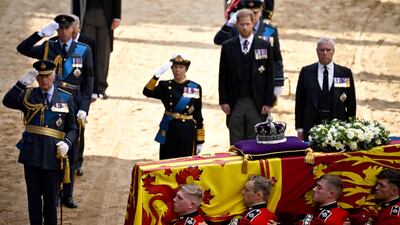
King Charles III, Prince William and Princess Anne salute alongside Prince Harry and Prince Andrew, as the coffin of Queen Elizabeth II arrives at the Palace of Westminster, following a procession from Buckingham Palace. AFP -

Queen Elizabeth lies in state in Westminster Hall before the public is allowed in to pay their respects. Getty Images -
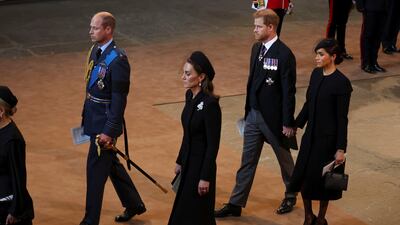
Prince William, Catherine, Princess of Wales, Prince Harry and Meghan, Duchess of Sussex, walk in the procession as it arrives at Westminster Hall. AP -
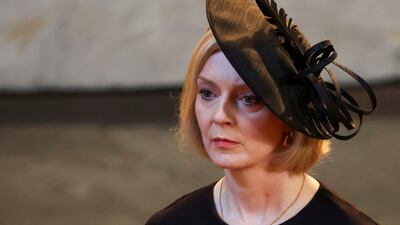
Britain's Prime Minister Liz Truss at Westminster Hall. AP -
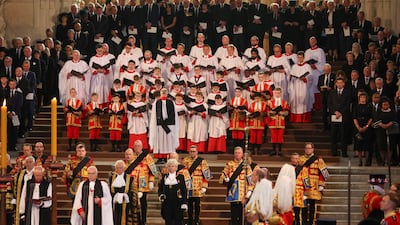
The choir performs at Westminster Hall. Reuters -
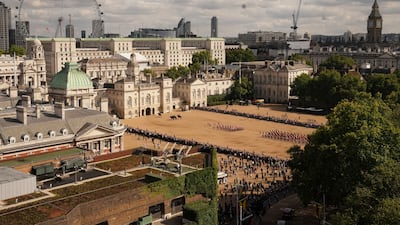
A view of the London skyline during the procession of the coffin. AP -

Zara Tindall, her husband Mike Tindall and Princess Eugenie arrive at Westminster Hall. AP -
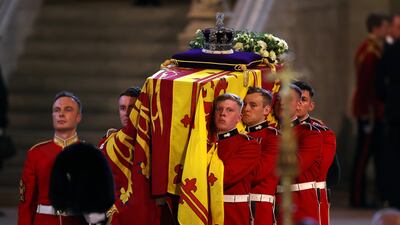
The imperial state crown sits on top of the coffin carrying Queen Elizabeth into Westminster Hall. Getty Images -
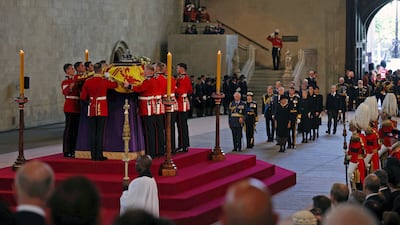
The coffin is laid to rest in Westminster Hall. Getty Images -

Prince Harry, Prince William, and Prince Edward follow the bearer party carrying the coffin of Queen Elizabeth into Westminster Hall. PA -
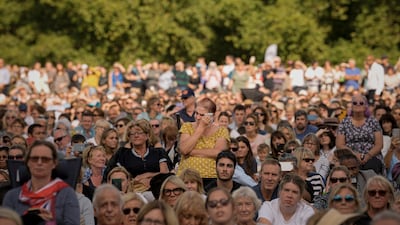
A woman wipes away tears as she joins people sitting in Hyde Park. AP -

Life Guards, a unit of the Household Cavalry, stand guard outside the Palace of Westminster. Getty Images -

Meghan, Duchess of Sussex, and Prince Harry depart after the procession. Getty Images -
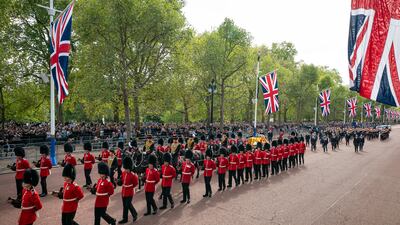
The coffin is carried down The Mall. PA -
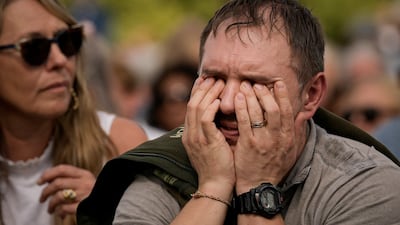
A man overcome with emotion in Hyde Park. AP -
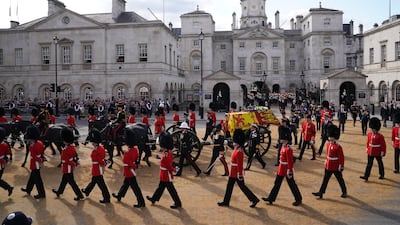
The coffin of Queen Elizabeth is carried on a horse-drawn gun carriage of the King's Troop Royal Horse Artillery. PA -
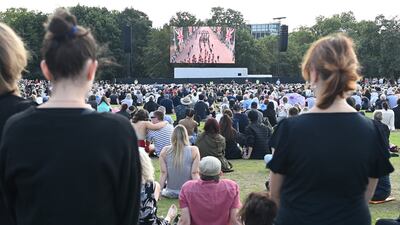
Mourners watch the procession at Hyde Park. Getty Images -
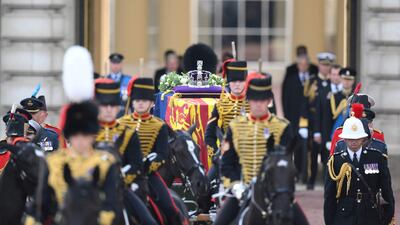
The coffin of Queen Elizabeth, adorned with the royal standard and the imperial state crown, and pulled by a gun carriage of the King's Troop Royal Horse Artillery, during the procession from Buckingham Palace in London. AFP -
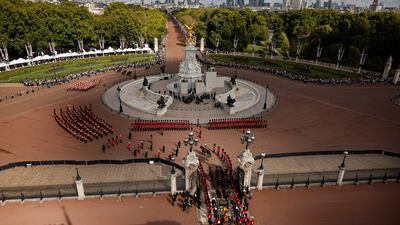
The procession leaves Buckingham Palace. Getty Images -
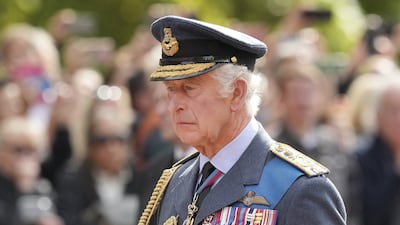
King Charles follows the coffin of Queen Elizabeth. PA -
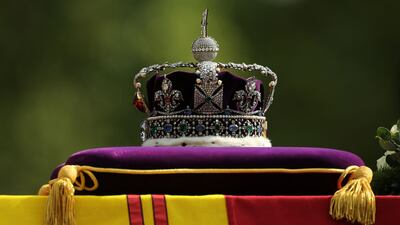
The imperial state crown on the coffin of Queen Elizabeth II. AFP -
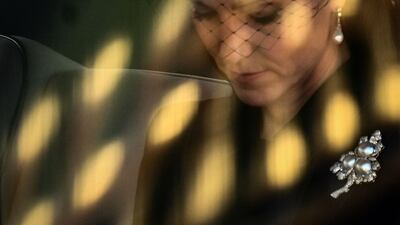
Catherine, Princess of Wales, is driven behind the coffin. AFP -
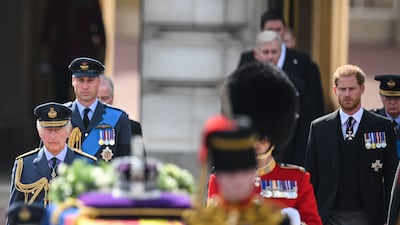
King Charles, Prince William and Prince Harry walk behind the coffin of Queen Elizabeth. AFP -
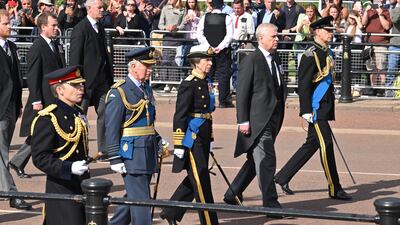
King Charles, Princess Anne, Prince Andrew and Prince Edward walk behind the coffin. Getty -
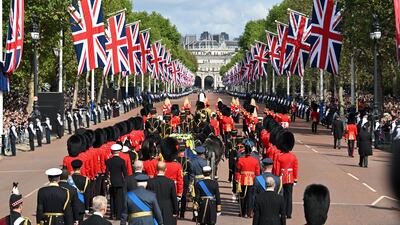
The cortege makes its way along The Mall from Buckingham Palace. Getty -
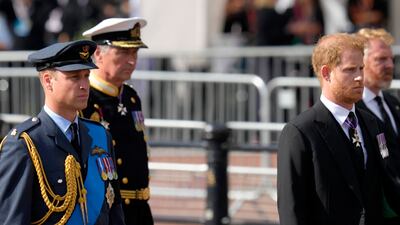
Prince William and Prince Harry follow the coffin. AP -
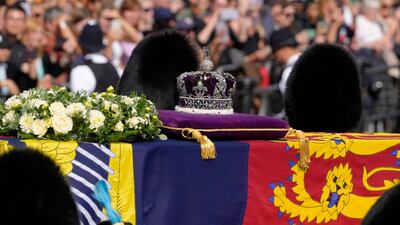
Grenadier Guards flank the coffin of Queen Elizabeth. AP -
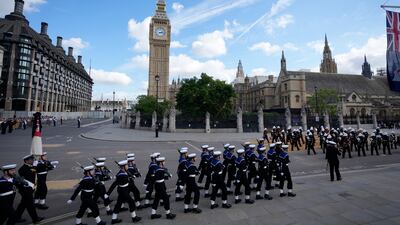
Royal Navy soldiers march ahead of the procession near Big Ben. Getty -
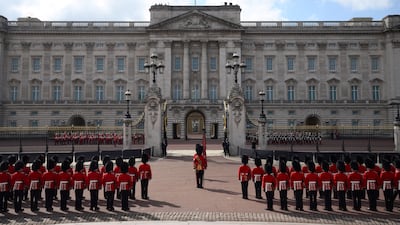
Coldstream Guards prepare outside Buckingham Palace, before the ceremonial procession. PA -

King Charles waves to the crowds after leaving Clarence House in central London, before the procession. AFP -
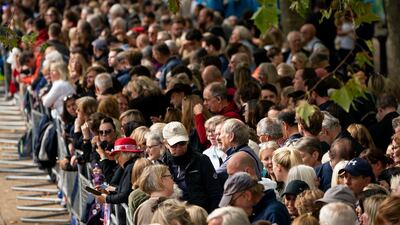
Crowds gather along The Mall. Reuters -

Members of the Life Guards leave Wellington Barracks ahead of the procession. AP -
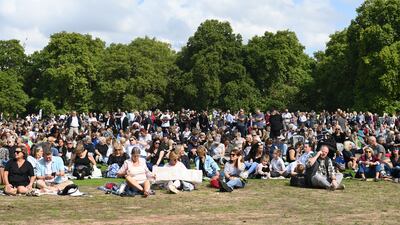
Mourners gather to watch the procession in Hyde Park. Getty -
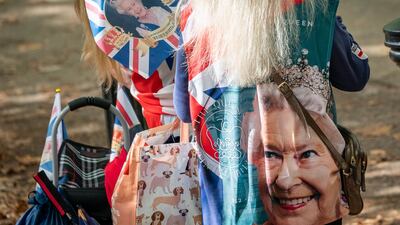
A mourner at The Mall decorated with images of Queen Elizabeth. PA -
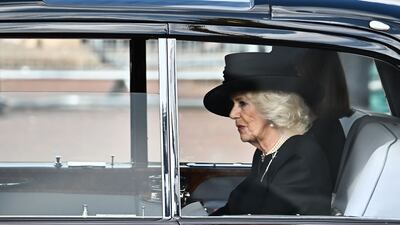
Queen Consort Camilla arriving at Buckingham Palace. AFP
The burning issue
The internal combustion engine is facing a watershed moment – major manufacturer Volvo is to stop producing petroleum-powered vehicles by 2021 and countries in Europe, including the UK, have vowed to ban their sale before 2040. The National takes a look at the story of one of the most successful technologies of the last 100 years and how it has impacted life in the UAE.
Read part four: an affection for classic cars lives on
Read part three: the age of the electric vehicle begins
Read part one: how cars came to the UAE
Company%20profile
Suggested picnic spots
Abu Dhabi
Umm Al Emarat Park
Yas Gateway Park
Delma Park
Al Bateen beach
Saadiyaat beach
The Corniche
Zayed Sports City
Dubai
Kite Beach
Zabeel Park
Al Nahda Pond Park
Mushrif Park
Safa Park
Al Mamzar Beach Park
Al Qudrah Lakes
Ten tax points to be aware of in 2026
1. Domestic VAT refund amendments: request your refund within five years
If a business does not apply for the refund on time, they lose their credit.
2. E-invoicing in the UAE
Businesses should continue preparing for the implementation of e-invoicing in the UAE, with 2026 a preparation and transition period ahead of phased mandatory adoption.
3. More tax audits
Tax authorities are increasingly using data already available across multiple filings to identify audit risks.
4. More beneficial VAT and excise tax penalty regime
Tax disputes are expected to become more frequent and more structured, with clearer administrative objection and appeal processes. The UAE has adopted a new penalty regime for VAT and excise disputes, which now mirrors the penalty regime for corporate tax.
5. Greater emphasis on statutory audit
There is a greater need for the accuracy of financial statements. The International Financial Reporting Standards standards need to be strictly adhered to and, as a result, the quality of the audits will need to increase.
6. Further transfer pricing enforcement
Transfer pricing enforcement, which refers to the practice of establishing prices for internal transactions between related entities, is expected to broaden in scope. The UAE will shortly open the possibility to negotiate advance pricing agreements, or essentially rulings for transfer pricing purposes.
7. Limited time periods for audits
Recent amendments also introduce a default five-year limitation period for tax audits and assessments, subject to specific statutory exceptions. While the standard audit and assessment period is five years, this may be extended to up to 15 years in cases involving fraud or tax evasion.
8. Pillar 2 implementation
Many multinational groups will begin to feel the practical effect of the Domestic Minimum Top-Up Tax (DMTT), the UAE's implementation of the OECD’s global minimum tax under Pillar 2. While the rules apply for financial years starting on or after January 1, 2025, it is 2026 that marks the transition to an operational phase.
9. Reduced compliance obligations for imported goods and services
Businesses that apply the reverse-charge mechanism for VAT purposes in the UAE may benefit from reduced compliance obligations.
10. Substance and CbC reporting focus
Tax authorities are expected to continue strengthening the enforcement of economic substance and Country-by-Country (CbC) reporting frameworks. In the UAE, these regimes are increasingly being used as risk-assessment tools, providing tax authorities with a comprehensive view of multinational groups’ global footprints and enabling them to assess whether profits are aligned with real economic activity.
Contributed by Thomas Vanhee and Hend Rashwan, Aurifer
COMPANY%20PROFILE
UFC%20FIGHT%20NIGHT%3A%20SAUDI%20ARABIA%20RESULTS
Why it pays to compare
A comparison of sending Dh20,000 from the UAE using two different routes at the same time - the first direct from a UAE bank to a bank in Germany, and the second from the same UAE bank via an online platform to Germany - found key differences in cost and speed. The transfers were both initiated on January 30.
Route 1: bank transfer
The UAE bank charged Dh152.25 for the Dh20,000 transfer. On top of that, their exchange rate margin added a difference of around Dh415, compared with the mid-market rate.
Total cost: Dh567.25 - around 2.9 per cent of the total amount
Total received: €4,670.30
Route 2: online platform
The UAE bank’s charge for sending Dh20,000 to a UK dirham-denominated account was Dh2.10. The exchange rate margin cost was Dh60, plus a Dh12 fee.
Total cost: Dh74.10, around 0.4 per cent of the transaction
Total received: €4,756
The UAE bank transfer was far quicker – around two to three working days, while the online platform took around four to five days, but was considerably cheaper. In the online platform transfer, the funds were also exposed to currency risk during the period it took for them to arrive.
ALRAWABI%20SCHOOL%20FOR%20GIRLS
Director: Romany Saad
Starring: Mirfat Amin, Boumi Fouad and Tariq Al Ibyari
While you're here
Hussein Ibish: America's attitude to Palestine and Israel has subtly shifted
Con Coughlin: With every missile fired in Israel-Gaza, Biden's clout reduces
Anwar Mhajne: The moral burden of being a Palestinian citizen of Israel
The%20Afghan%20connection
The specs
Engine: 1.5-litre turbo
Power: 181hp
Torque: 230Nm
Transmission: 6-speed automatic
Starting price: Dh79,000
On sale: Now
The President's Cake
Director: Hasan Hadi
Starring: Baneen Ahmad Nayyef, Waheed Thabet Khreibat, Sajad Mohamad Qasem
Rating: 4/5
While you're here
Con Coughlin: Grandstanding in Turkey leads to terrorism in France
Con Coughlin: The terror threat in Europe remains as potent as ever
Sholto Byrnes: After Charlie Hebdo, is religion dividing the world?
About Housecall
Date started: July 2020
Founders: Omar and Humaid Alzaabi
Based: Abu Dhabi
Sector: HealthTech
# of staff: 10
Funding to date: Self-funded
Dust and sand storms compared
Sand storm
- Particle size: Larger, heavier sand grains
- Visibility: Often dramatic with thick "walls" of sand
- Duration: Short-lived, typically localised
- Travel distance: Limited
- Source: Open desert areas with strong winds
Dust storm
- Particle size: Much finer, lightweight particles
- Visibility: Hazy skies but less intense
- Duration: Can linger for days
- Travel distance: Long-range, up to thousands of kilometres
- Source: Can be carried from distant regions


