

As a sweltering weekend begins in the UK, a drought has been declared in several parts of England and its capital London amid plummeting water levels.
While communities grapple with the driest summer for almost 50 years, the National Drought Group — composed of decision makers from the government, the Environment Agency public body, water companies and farming and environmental groups — has moved parts of England into official drought status.
These areas are Devon and Cornwall, Solent and South Downs, Kent and South London, Herts and North London, East Anglia, Thames, Lincolnshire and Northamptonshire, and East Midlands.
The declaration gives water companies increased powers to reduce usage, but also raises awareness of the shortage of water and encourages people to act wisely.
Water companies will also not need further permission from the government to impose some restrictions on water use.
It could lead to the introduction of more contingency measures including hosepipe bans. However, the Environment Agency has told the public that essential water supplies are safe. The drought status is likely to remain for months.
A drought is defined as a prolonged shortage of water whether in the atmosphere, on the surface or in the ground.
The UK has endured the driest first six months of the year since 1976, with no end in sight.
Chris Thomas, professor of biology at the University of York, said the situation is already showing signs of being a possible repeat of the 1976 drought.
After months of low rainfall and high temperatures, the second heatwave to blast Britain this summer has prompted health and environmental fears.
Water Minister Steve Double said action was already being taken by the government, the Environment Agency and others to manage the impact.
“All water companies have reassured us that essential supplies are still safe, and we have made it clear it is their duty to maintain those supplies”, he said.
-
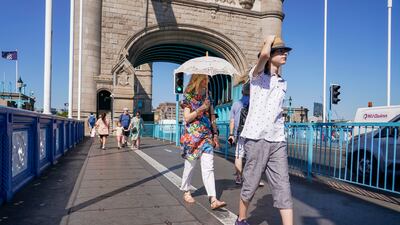
A woman shelters from the sun on Tower Bridge, in London. AP -
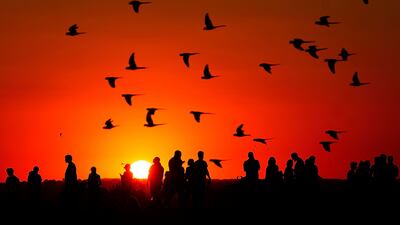
A crowd of people watch the setting sun from a hill in Ealing, west London. AP -
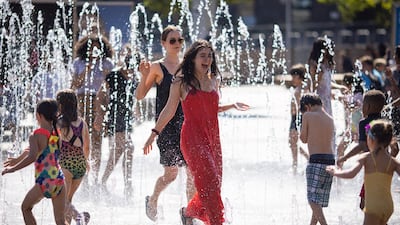
People enjoy the water fountains in King's Cross, London. EPA -

The low water level at Pontsticill Reservoir near Merthyr Tydfil, Wales. Getty Images -
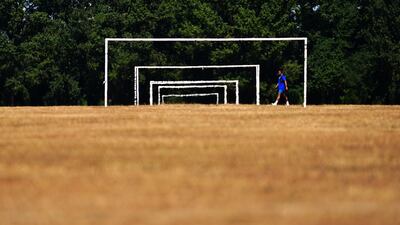
Dry grass on the football pitches at Hackney Marshes in east London. PA -
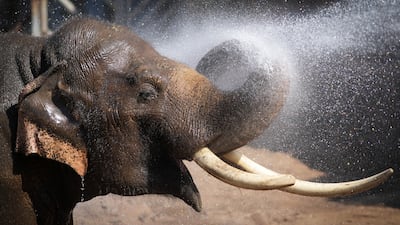
Aung-Bo, a 21-year-old Asian elephant, is cooled down by a keeper at Chester Zoo. Getty Images -

People walk on parched grass of The Long Walk towards Windsor Castle. Reuters -
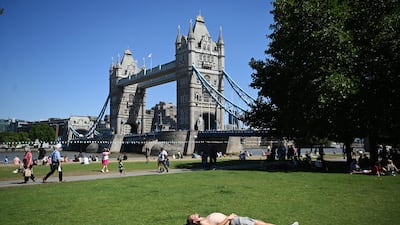
A sunbather enjoys the warm weather in London. EPA -
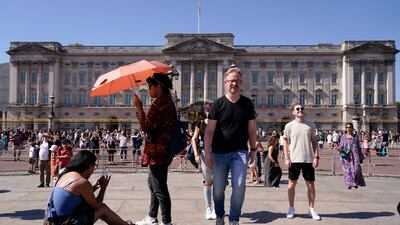
Tourists shelter from the sun as they stand outside Buckingham Palace in London. AP -

People enjoy the hot weather as they zorb on the canal at Paddington Basin in London. PA -
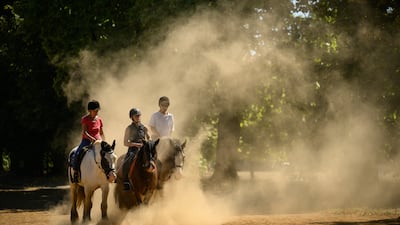
Horses from Hyde Park stables are surrounded by clouds of dust as they are ridden along a dry bridleway in the London park. Getty Images -
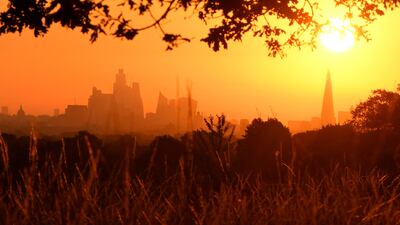
The sun rises above the London skyline on Thursday morning. Reuters -
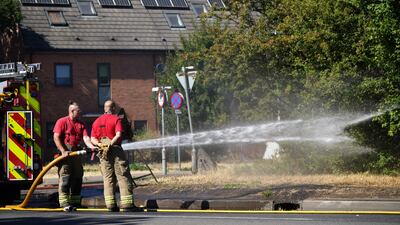
London Fire Brigade dealing with the aftermath of a grass fire in Rainham, east London. PA -
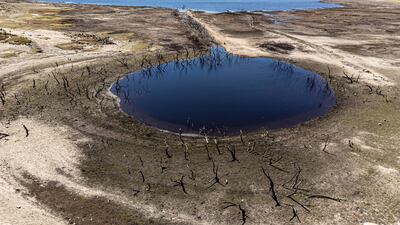
A water basin is cut off at Colliford Lake, where water levels have dropped to expose previously unseen trees at Cornwall's largest reservoir. AP -
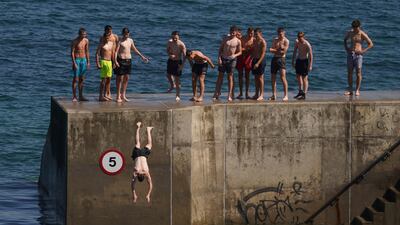
Men cool off by diving into the water at Cullercoats Bay in North Tyneside. AP -
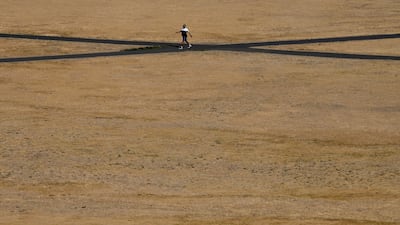
Scorched grass at Greenwich Park in London. AP -
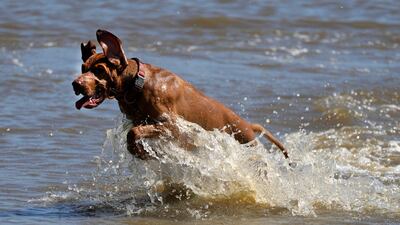
A dog cools off in a pond at Richmond Park in London. AP -
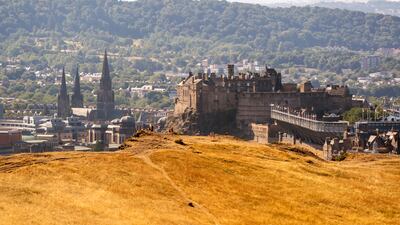
Large areas of grass have turned yellow due to the dry conditions in Edinburgh. AP -
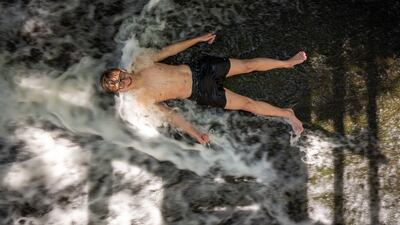
A young man takes a dip in the Peover Eye, a small river that meanders through the Cheshire countryside. Getty Images -

Dry fairways at Chelsfield Lakes club in Orpington have made for bouncy, unpredictable golfing conditions. Getty Images


“We are better prepared than ever before for periods of dry weather, but we will continue to closely monitor the situation, including impacts on farmers and the environment, and take further action as needed.”
Asked by LBC London-based radio station what a drought means for the UK and what action water companies should be taking, Work and Pensions Secretary Therese Coffey said: “This isn’t going to be like the 70s where there were stand pipes around the country when we had similar sort of temperatures.
“Indeed, since the private investment went into the water industry, we have seen a lot more improvements in things like leakages and similar.
“We need to continue to keep that focus, but, overall, I think it is about people being careful with water.”
The National Drought Group, made up of government and agency officials, water companies and groups such as the National Farmers’ Union, met on Friday to discuss the prolonged dry weather.
The Environment Agency and water companies are set to put more of their plans to manage the effects of low water levels into action.
The Wildlife Trust has called for an England-wide hosepipe ban to protect nature and rivers. Yorkshire Water on Friday became the fifth company to announce such a ban as the area grapples with plummeting water levels. The company, which has more than five million customers, made the announcement early on Friday, with the restrictions coming into effect from August 26.
Its director of water Neil Dewis said the extended heatwave left the company with little choice.
“Parts of Yorkshire have seen the lowest rainfall since our records began more than 130 years ago,” he said. “The hot, dry weather means that Yorkshire’s rivers are running low and our reservoirs are around 20 per cent lower than we would expect for this time of year. We’ve been doing everything we can to avoid putting in restrictions but, unfortunately, they’re now necessary as part of our drought planning.”
Prof Isabel Oliver, the UK Health Security Agency’s chief scientific adviser, said drought was a consequence of a changing climate and environment, and warned such changes left the world prone to the spread of infectious disease.
“These changes are associated with an increasing risk of new and emerging infectious diseases — so, diseases that we might not have seen before, because of our changing environment, we are at greater risk of experiencing,” she told Sky News.
“It’s really important that we continue to work to make sure that we prevent and mitigate those threats to health.”
Supermarkets on Friday began rationing bottled water, placing limits on how much customers could buy
The agency this week announced it would be imposing a heat health alert from Thursday to Sunday, as temperatures in parts of the UK are expected to rocket to 36°C. Prof Oliver said people should take measures to protect their health in sweltering conditions including staying hydrated, avoiding direct sunlight during the hottest hours and keeping curtains closed.
“If we all take measures to protect our health, we can also help the health system by avoiding attendances to hospital if we just take simple measures,” she said.
Parts of Britain will be hotter than the Caribbean this weekend, forecasters have said, as the public were warned about the danger of wildfires.
Temperatures reached 34.2°C at Wiggonholt, West Sussex, on Thursday afternoon, while many areas in southern England and Wales exceeded 30°C.
Fires broke out across various areas, including London, Essex, Gloucestershire, Surrey and Cheshire.
Andy Elliott, a member of the National Fire Chiefs Council wildfire group, advised drivers against pulling on to grass verges during the heatwave due to the fire risk.
“If you need to pull over, don’t park on areas of dry grass,” he said. “The catalytic converter can get very hot and can start a fire.”
Europe's waterways hit by heatwaves and drought - in pictures
-
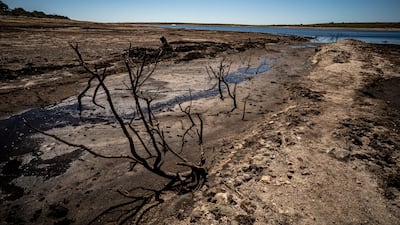
Dried mud and old trees at Colliford Lake in Cornwall, England, where water levels have severely dropped exposing the unseen trees and rocks in Cornwall's largest lake and reservoir. PA -
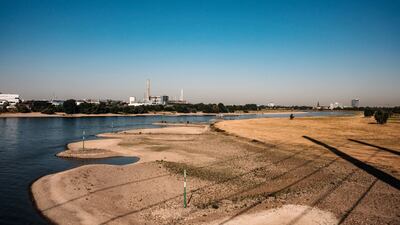
A large section of exposed River Rhine riverbed, due to low water levels caused by drought, in Duesseldorf, Germany. Bloomberg -
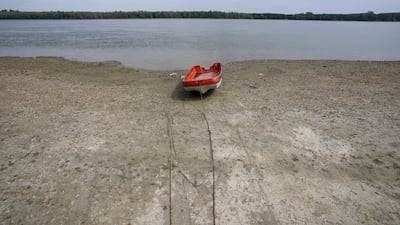
A boat on a bank of the receding Danube river, after a lengthy drought near the village of Cortanovci, Serbia. AP -
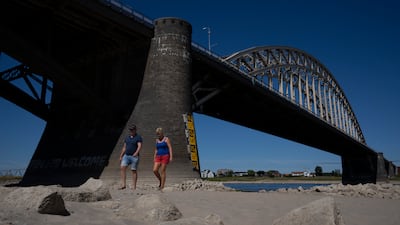
People take a stroll on the river bed of the Waal as water levels dropped because of drought in Nijmegen, Netherlands. AP -
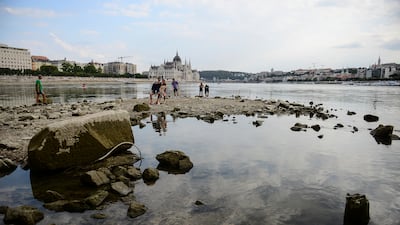
People take photos on the southern tip of Margaret Island, which can be seen due to low water level of the River Danube, in Budapest, Hungary. AP -
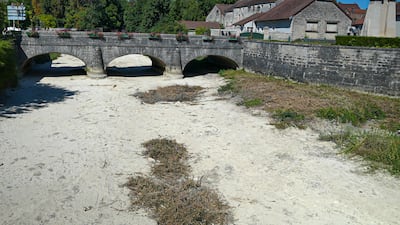
The dried-up river Tille in Lux, France. AP -

A bridge, which is usually submerged, over the dried bed of Llwyn-on Reservoir, during a heatwave in Wales. Reuters -
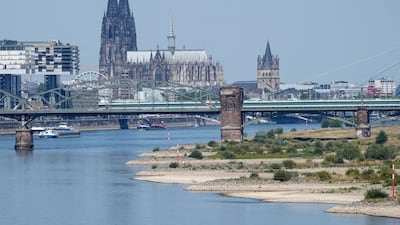
The Rhine river with low water levels in Cologne, Germany. AP -
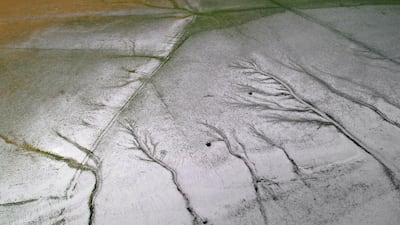
The Yesa reservoir and the Aragon River are practically without water in Yesa, Navarra, Spain. EPA -
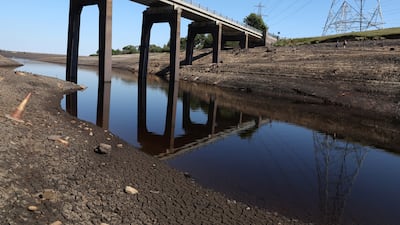
Low water levels at Baitings Reservoir in Ripponden, West Yorkshire, England. Reuters -
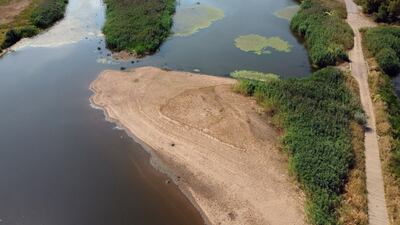
Low water levels at the Odra river near Czelin village, north-western Poland. EPA -
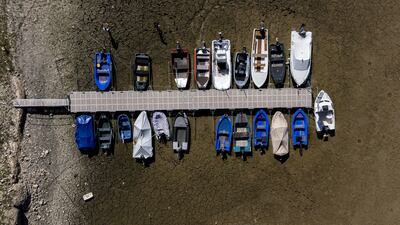
Boats on the dried bed of the drought-affected Doubs river on the border with France in Les Brenets, Switzerland. Reuters -
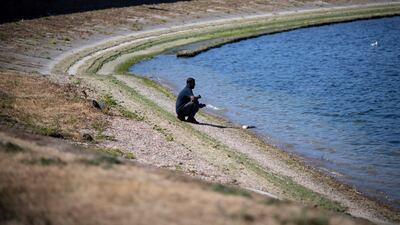
A person sits by a reservoir with low water levels and dried grass at Walthamstow Wetlands in London, England. EPA -
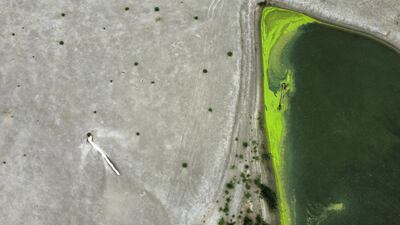
The dried-up River Po that has been affected by the worst drought in 70 years, near Borgo Virgilio, Italy. Reuters


Meanwhile, firefighters from Germany, Romania and Greece have headed to south-western France to battle raging wildfires.
High temperatures and a worsening drought brought a high risk of new fires breaking out, officials in the region said on Friday, even after an overnight reprieve held a monster wildfire that had been burning for days in check.
The Gironde region — home to Bordeaux wine — is among the areas hardest hit.
The danger of new fires is “very severe” given the tinderbox conditions, the Gironde prefecture said.
“The day is likely to be complicated since temperatures continue to increase and humidity continues to drop, so obviously we remain vigilant and mobilised,” senior local official Ronan Leaustic told a news conference.

