

At only 31, Aleem has already endured a lifetime of threat and trauma. More than a decade of military service alongside British Special Forces in Afghanistan culminated in a nail-biting evacuation after the Taliban took control of the country last August.
Escaping the retributive clutches of the hardline group was a journey he made while being consumed by inner conflict. His acute pain and guilt at the separation from his family was eased only by the dramatic birth of his daughter on board his flight to the UK.
Nearly a year after arriving in England, the guilt lives on but Aleem – not his real name – and his family are feeling lucky.
He cycles to and from his daily English lessons, returning home to a modest semi-detached house in which he, his wife and three children, aged 10, 5 and 11 months, have been resettled in the ancient city of Cambridge.
After eight months spent in three holding hotels around London, the family were moved to a home of their own in March.
Life in limbo for Afghanistan's refugees

Of the 18,000 Afghan and British citizens who were evacuated under Operation Pitting and promised a “warm welcome” in the UK, only 7,000 have been moved into permanent lodgings. About 9,500 Afghan evacuees are still living in holding hotels.
“Most people in the hotels are thinking primarily about getting a house, ideally in a Muslim community so that there are halal shops around them,” says Aleem.
“It’s their biggest concern because only when they are settled can they begin their lives.”
Four months after moving in, the walls and tables still lack the personal pictures and trinkets that turn a house into a home, but a deliciously comforting aroma of freshly cooked biryani more than compensates.
A back garden dotted with various playground toys reveals where the couple’s furnishing priorities lie.
“I built the swings and slide myself,” says Aleem, with a pride also for the flowers and vegetables they have planted outside.
But his relaxed attitude suddenly sharpens when he begins to tell the tale of his escape from Afghanistan.
Despite the almost 6000 kilometres between them, Aleem's fear of the Taliban remains high and he asks for anonymity. Having already lost two siblings to the militants' gunfire this year, those fears are far from unfounded.
Serving Afghanistan with British soldiers
Soon after leaving high school in 2010, Aleem joined the army to “serve my country”, he tells The National proudly, and worked with British Special Forces.
Nearly a decade on from the 2001 US-led invasion of Afghanistan that toppled the Taliban regime, the early days of victory and democracy-building were soon replaced by a deteriorating security situation that claimed at least 176,000 lives over 20 years.
By the time Aleem joined the military, British troops, numbering more than 150,000 over the two decades, were regularly part of joint offensives with the Afghan army against the Taliban.
“I have been fighting them everywhere for years so when they came back into power there was no doubt that I would be killed,” he says.
Later, over the fluffed and spiced rice dish made by his wife, he said dropping his weapons after the withdrawal of Nato troops ushered the Taliban back to power was “one of the most shameful things you can do as a soldier”.
But it was time to recognise the fight was over.
Kabul has fallen, time to leave
-
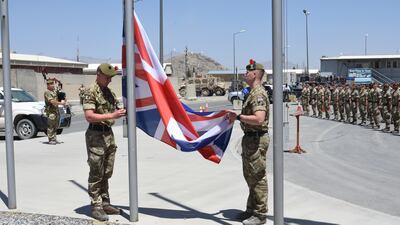
Military leaders attend a flag-lowering ceremony in Afghanistan on June 24, 2021 as the UK’s contribution in the country draws to a close. A number of troops were to remain to offer diplomatic assurance to the international community in Kabul. Getty Images -

A member of the Afghan security personnel looks distraught as he stands guard at the site of a car bomb explosion near the defence minister's home in Kabul, on August 4, 2021. AFP -
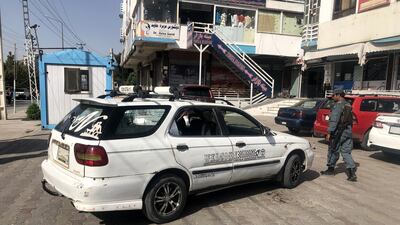
Security officials inspect the scene of an attack on Dawa Khan Menapal, the head of the Afghan government's information centre, in Kabul on August 6, 2021. Taliban militants shot him dead. EPA -

People are stranded at the Pakistani-Afghan border which has been closed by the Taliban, who have taken control of the Afghan side, on August 9, 2021. EPA -
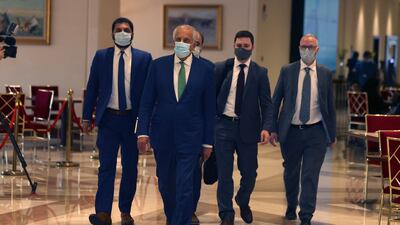
US special envoy for Afghanistan Zalmay Khalilzad (2nd L) arrives at a hotel in Qatar's capital Doha for a meeting on the escalating conflict in Afghanistan, on August 10, 2021. AFP -
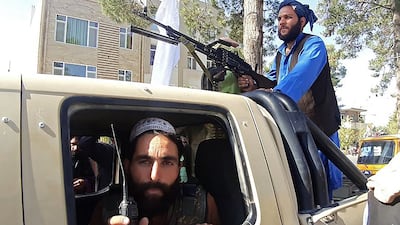
Taliban fighters driving through Herat, Afghanistan's third-biggest city, on August 13, 2021 after under-siege government forces had pulled out the previous day. AFP -
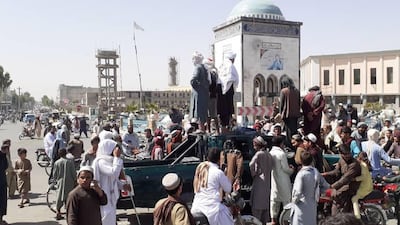
Taliban militants gather in the main square after taking control of Kandahar, Afghanistan, on August 13, 2021. The fall of Kandahar came hours after the Taliban had captured Herat. EPA -

Afghanistan's president Ashraf Ghani and acting defence minister Bismillah Khan Mohammadi visit military corps in Kabul on August 14, 2021. Reuters -
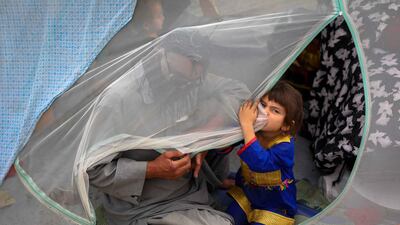
Internally displaced families from northern provinces, who fled from their homes due to the fighting between Taliban and Afghan security forces, take shelter in a public park in Kabul, Afghanistan, on August 14, 2021. EPA -
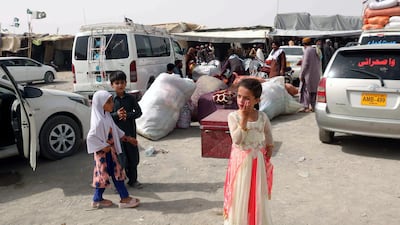
People at the border checkpoint at Chaman, Pakistan on August 15, 2021. Pakistani authorities had reopened the frontier with Afghanistan on August 13 after several days of closure. EPA -
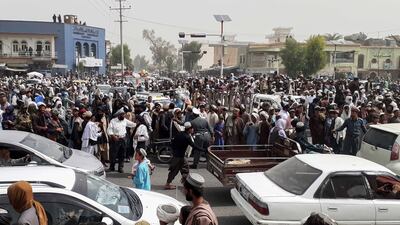
Afghan police on duty on August 15, 2021 after the Taliban had taken over Kandahar. The militants have by this stage reached the outskirts of Kabul, the capital of Afghanistan. EPA -
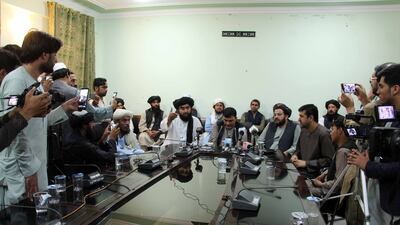
Ahmadullah Muttaqi, the Taliban's director for information and culture, talks to journalists after the government in Kandahar had surrendered to the militants. EPA -
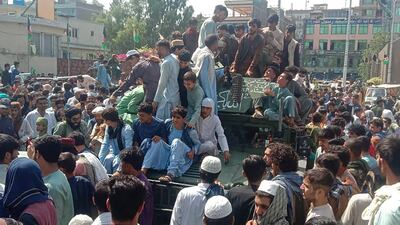
Taliban fighters and local people sit on an Afghan National Army armoured vehicle on a street in Jalalabad province on August 15, 2021. AFP -
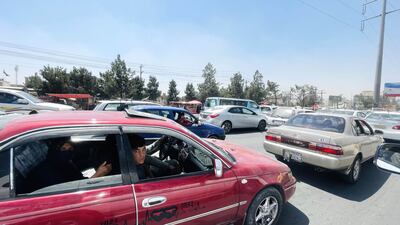
Afghan families flee Kabul on August 15, 2021. The Taliban said they do not intend to enter Kabul 'by force or war, but to negotiate with the other side to enter peacefully". Getty Images -
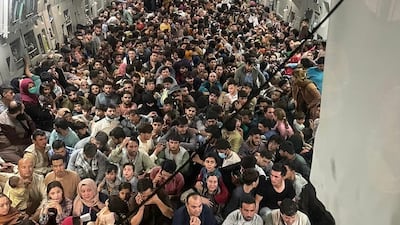
Tens of thousands of people attempt to flee Afghanistan to escape the hardline rule expected under the Taliban, on August 15, 2021. AFP -
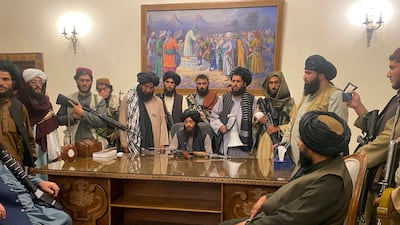
Taliban fighters take control of the Afghan presidential palace in Kabul, after the president Ashraf Ghani had fled the country, on August 15, 2021. AP -
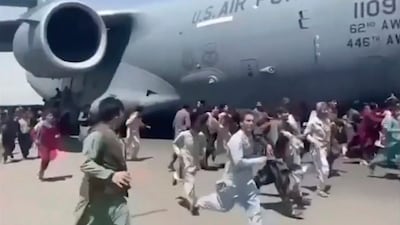
Hundreds of people run alongside a US Air Force transport plane on the runway of the international airport in Kabul on August 16, 2021, desperate to escape the Taliban capture of their country. Some held on to the jet as it took off and fell to their death. AP -
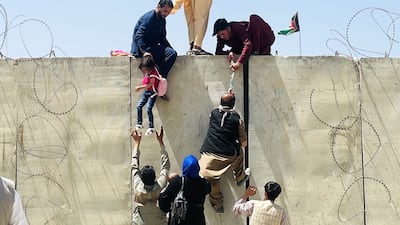
Thousands of Afghans rush to the Hamid Karzai International Airport as they try to flee the Afghan capital of Kabul, on August 16, 2021. Getty Images -
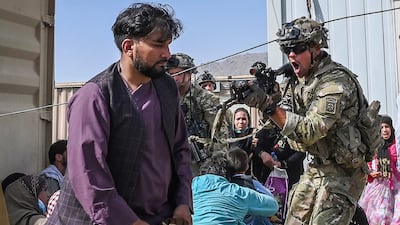
A US soldier points his gun at a man at Kabul airport on August 16, 2021, after a swift end to Afghanistan's 20-year war. Thousands of people mobbed the airport in a bid to flee. AFP -
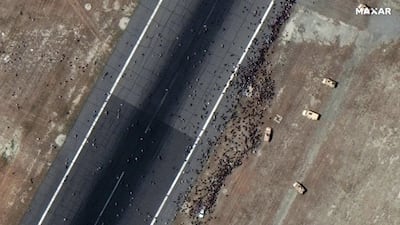
Crowds on the tarmac of Kabul International Airport, Afghanistan, on August 16, 2021. EPA -
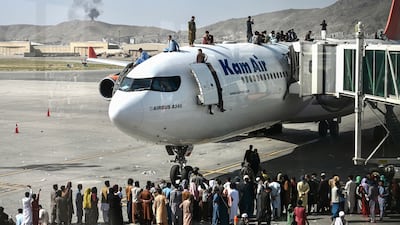
People clamber on top a plane at the Kabul airport on August 16, 2021. AFP -
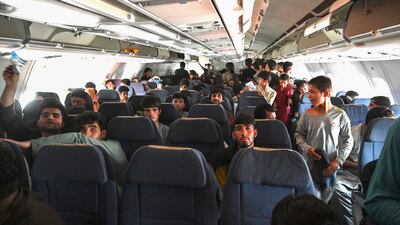
These Afghan passengers made it. They sit inside a plane and wait to leave Kabul. AFP -
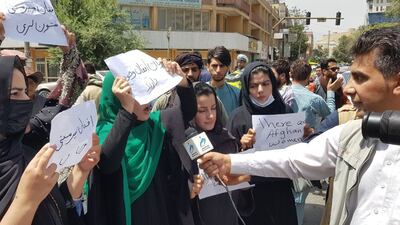
Afghan women, holding placards, gather to demand the protection of women's rights in front of the Presidential Palace in Kabul, on August 17, 2021. Getty Images -
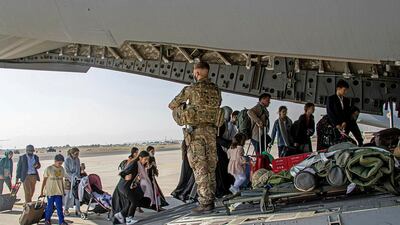
British citizens living in Afghanistan board a military plane to leave Kabul Airport, on August 16, 2021. Reuters -
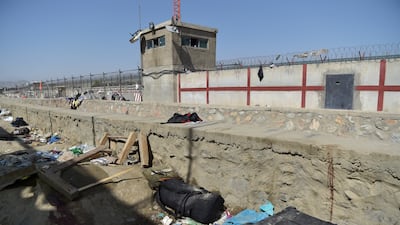
Luggage belonging to Afghan people, who were waiting to be evacuated. at the site of two suicide bombs, which killed scores of people including 13 US troops, at Kabul airport on August 27, 2021. AFP -
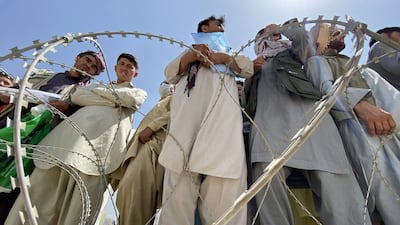
Afghans, including those who worked for the US, Nato, the European Union and the United Nations, wait outside Hamid Karzai International Airport to flee the country, after Taliban took control of Kabul, on August 17, 2021. EPA -
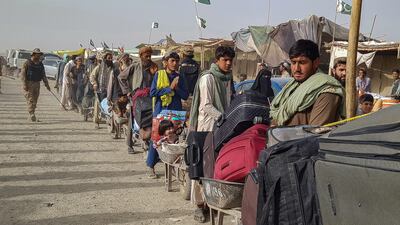
People queue at the Pakistan-Afghanistan border point in Chaman on August 17, 2021 to cross back to Afghanistan. AFP -
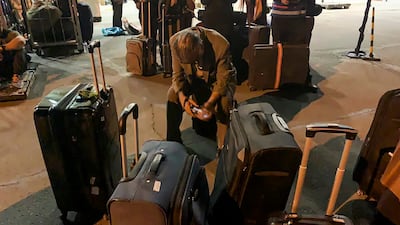
People wait to board a French military transport plane on August 17, 2021 to escape Kabul and Taliban rule. AFP -
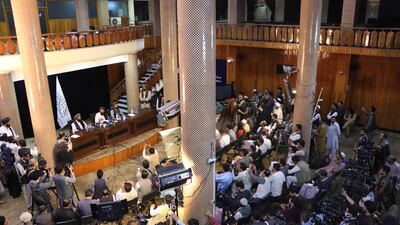
Zabihullah Mujahid, Taliban spokesman, gives his first press conference in Kabul on August 17, 2021. The new leadership said it would not seek revenge on those who had fought against them and would protect the rights of Afghan women within the rules of Sharia. EPA -

Young men who say they deserted the Afghan military trudge through the countryside in Tatvan, eastern Turkey, on August 17, 2021. Turkey was concerned about increased migration across the Iranian border as Afghans fled from the Taliban. AP -
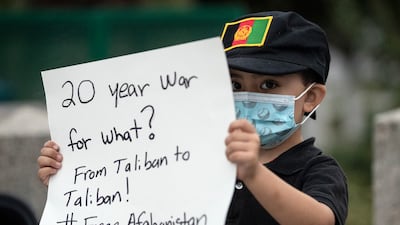
A young demonstrator at a vigil in support of Afghanistan at the West Los Angeles Federal Building, California on August 17, 2021. EPA -
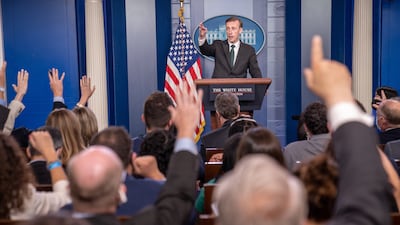
US National Security Adviser Jake Sullivan holds a press briefing to talk about the recent events in Afghanistan, at the White House on August 17,2021. EPA -
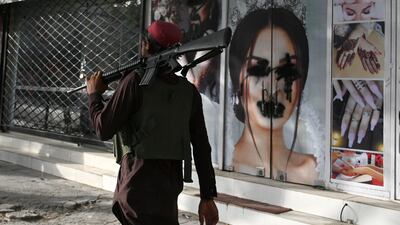
A Taliban fighter walks past a beauty salon with images of women defaced using spray paint in Shar-e-Naw in Kabul on August 18, 2021. AFP -
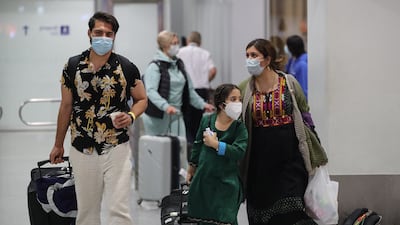
People among the first evacuees from Kabul, arrive at Frankfurt International Airport in western Germany in the early hours of August 18, 2021. AFP -
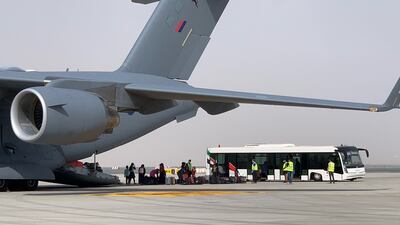
A transport plane evacuating refugees out of Afghanistan lands at Al Maktoum International Airport in Dubai, August 19, 2021. Pawan Singh / The National -

Afghanistan's former president Ashraf Ghani talks in video message, somewhere in the UAE, on August 18, 2021, in his first media appearance since the fall of Kabul only days earlier. Reuters -
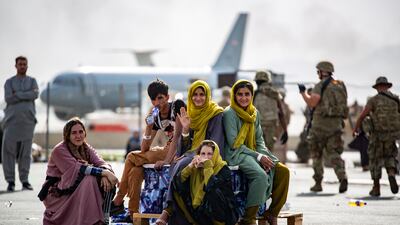
Displaced children wait for the next flight at Hamid Karzai International Airport, Kabul on August 19, 2021. AFP -
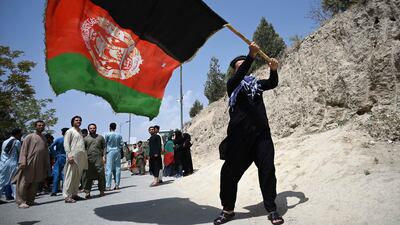
An Afghan man waves a national flag to celebrate the 102nd Independence Day of Afghanistan in Kabul on August 19, 2021, days after the Taliban's military takeover of the country. AFP -
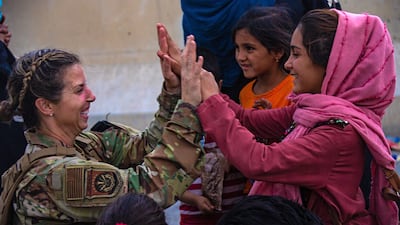
The US military helps to reunite families at Hamid Karzai International Airport on August 20, 2021. AFP -
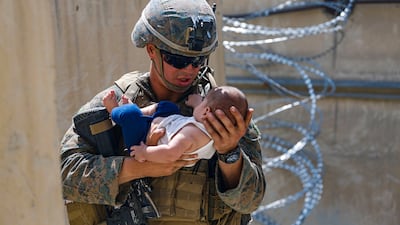
A US Marine comforts an infant while they wait for the mother during an evacuation at Hamid Karzai International Airport on August 21, 2021. Reuters -
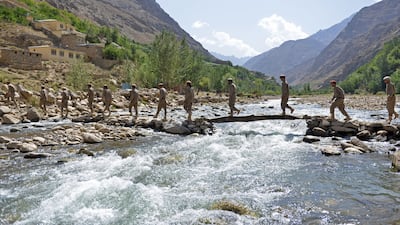
New personnel in the Afghan security forces take part in military training in Panjshir province on August 21, 2021. AFP -
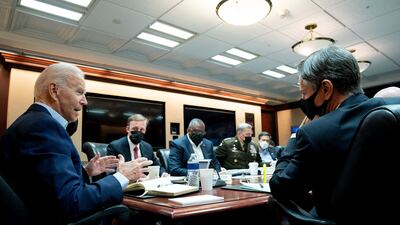
US President Joe Biden speaks to his national security team during a briefing on the situation in Afghanistan, on August 22, 2021, in Washington. AFP -
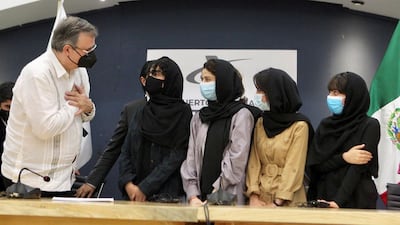
Mexico's Foreign Minister Marcelo Ebrard welcomes members of Afghanistan's robotics team after arriving in Mexico to apply for humanitarian status on August 24, 2021. Reuters -
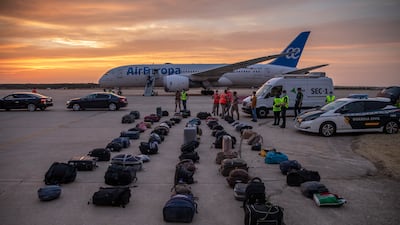
Belongings of Afghan people, who were evacuated from Kabul, are laid on the ground at Torrejon Military Air Base on August 24, 2021 in Madrid. Getty Images -
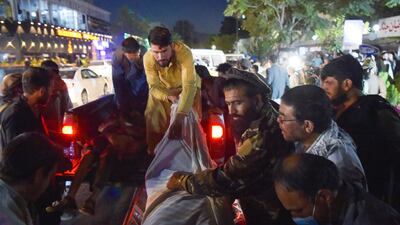
Volunteers and medical staff unload bodies from a pickup truck outside a hospital after two powerful explosions, which killed at least six people, outside the airport in Kabul on August 26, 2021. AFP -
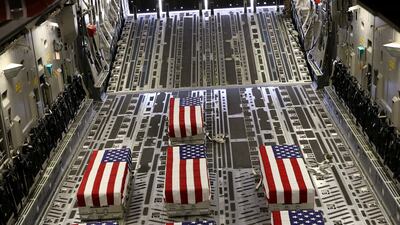
Flag-draped coffins of service members killed in action are loaded on to a transport aircraft during a ramp ceremony at Hamid Karzai International Airport in Kabul on August 27, 2021. Reuters -
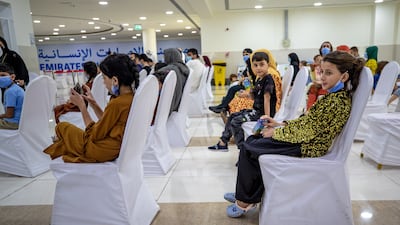
Afghan evacuees at the Emirates Humanitarian City, Abu Dhabi, on August 28, 2021. Victor Besa / The National -
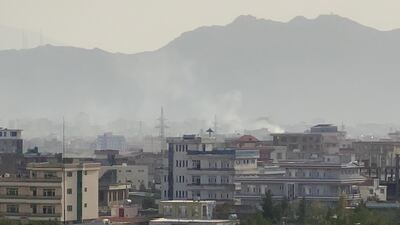
Smoke billows after an explosion near the Hamid Karzai International Airport, in Kabul on August 29, 2021. EPA -
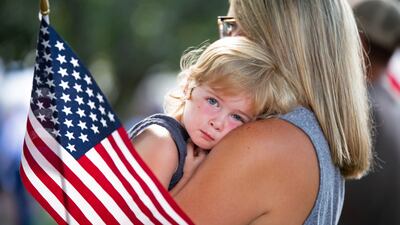
A vigil for Max Soviak, one of 13 US service members killed in the airport suicide bombing in Afghanistan's capital Kabul, in Berlin Heights, Ohio on August 29, 2021. Reuters -

A Taliban member stands guard near a vehicle which was used to fire rockets at the Hamid Karzai International Airport in Kabul on August 30, 2021. EPA -
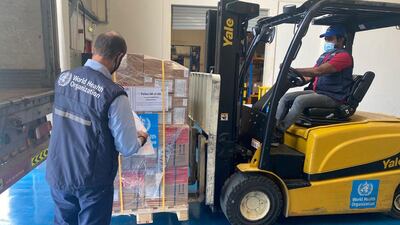
World Health Organisation supplies land in Afghanistan. Photo: WHO -
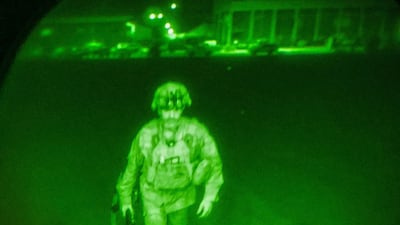
Major Gen Chris Donahue, commander of the US Army 82nd Airborne Division, XVIII Airborne Corps, boards a C-17 cargo plane at the Hamid Karzai International Airport in Kabul on August 30, 2021. His departure closes the US mission to evacuate US citizens, Afghan Special Immigrant Visa applicants and vulnerable Afghans. AFP -
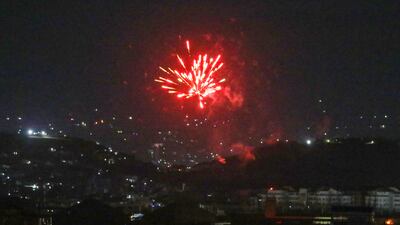
Fireworks after the last US aircraft took off from the airport in Kabul early on August 31, 2021, signalling its complete withdrawal after 20 years in the country. AFP -

Afghans wait for the banks to open in Kabul on August 31, 2021. AFP -
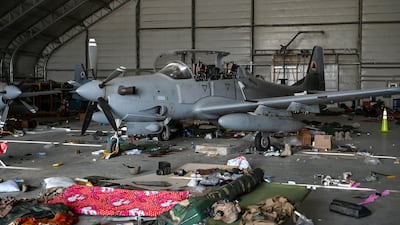
An Afghan Air Force A-29 attack aircraft inside a hangar at the airport in Kabul on August 31, 2021, after the US pulled all its troops out of the country. AFP -
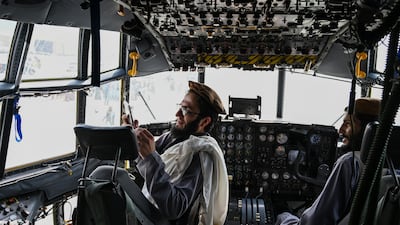
Taliban fighters sit in the cockpit of an Afghan Air Force aircraft at the airport in Kabul on August 31, 2021. AFP -
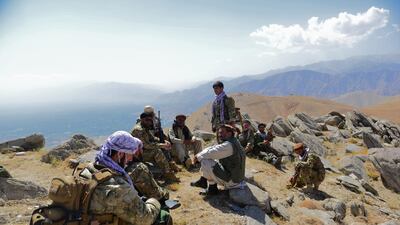
An Afghan resistance movement and anti-Taliban uprising forces rest as they patrol on a hilltop in Panjshir province on September 1,2021. Panjshir remains the last major holdout of anti-Taliban forces led by Ahmad Massoud, son of the famed mujahideen leader Ahmed Shah Massoud. AFP -

The UAE sends a plane carrying urgent medical and food aid to Afghanistan, as part of its contribution to provide the basic and necessary needs of thousands of Afghan families, especially the most vulnerable groups such as women, children and the elderly, September 3, 2021. Wam -
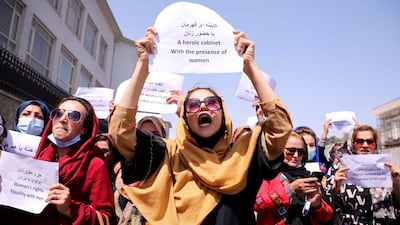
Afghan women's rights defenders and civil activists protest to call on the Taliban for the preservation of their achievements and education, in front of the presidential palace in Kabul on September 3, 2021. Reuters -
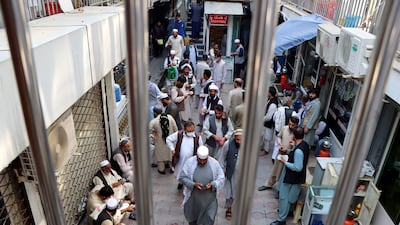
The main money exchange market in Kabul reopens on September 4, 10 days after the Taliban takeover. Currency dealers have been hit hard by the fall in value of the Afghani currency. EPA -
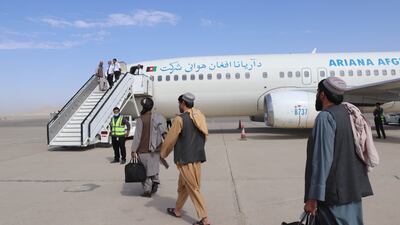
Passengers board a plane as domestic flights resume across Afghanistan, at Ahmad Shah Baba International Airport in Kandahar on September 5, 2021. EPA -
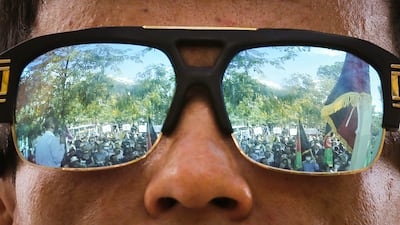
Protesters reflected in the sunglasses of a demonstrator during a rally in support of Afghanistan's people after the takeover of the country by the Taliban, at the Place de la Republique, in Paris on September 5, 2021. AFP -
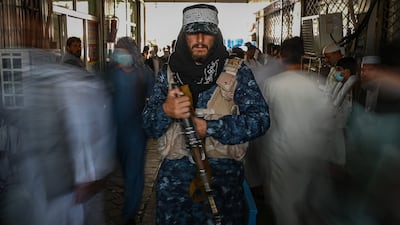
A Taliban fighter stands guard at a market in Kabul on September 5, 2021. AFP -
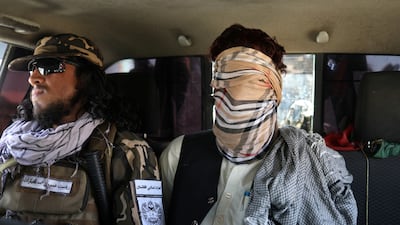
A suspected ISIS member sits blindfolded in a Taliban Special Forces' car in Kabul on September 5, 2021. Reuters -
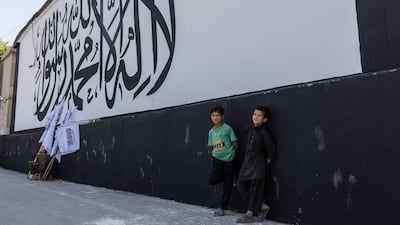
Children stand outside the former US embassy in Kabul where the banner of the 'Islamic Emirate' has replaced previous murals, on September 8, 2021. Stefanie Glinski for The National -
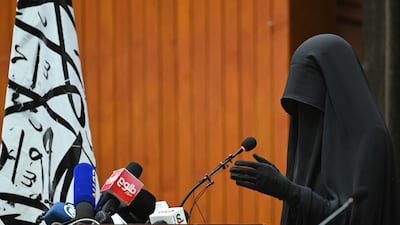
A veiled student speaks to a gathering of female students before a pro-Taliban rally at the Shaheed Rabbani Education University in Kabul on September 11, 2021. AFP -
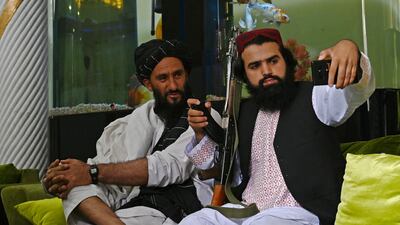
Taliban fighters take a selfie after they stormed and overran the home of the Afghan warlord Abdul Rashid Dostum in the Sherpur neighborhood of Kabul. on September 11, 2021. AFP -
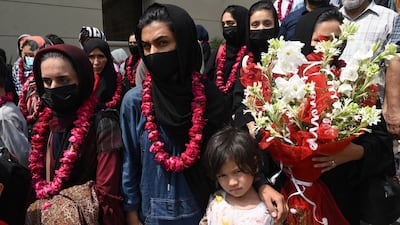
Members of Afghanistan's national girls football team arrive at the Pakistan Football Federation in Lahore on September 15, 2021, a month after the hardline Taliban swept back into power. AFP -

Afghan students separated by a partition attend a class at Mirwais Neeka University in Kandahar on September 20, 2021. The Taliban had officially announced the segregation of male and female students in all government and private universities. EPA -
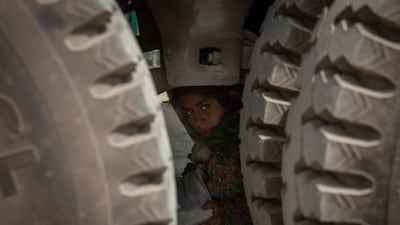
A young girl from Afghanistan hides under a truck carrying fruit and vegetables as she attempts to smuggle herself over the border from Afghanistan into Pakistan on September 12, 2021. Everyday dozens of children from Afghanistan smuggle themselves over the border into Pakistan to sell Paan and other goods before smuggling themselves back again. At least one child is injured each day trying to cross the border like this. Oliver Marsden for The National -

Afghan girls at a school in Kandahar on September 26, 2021. AFP -

Afghans gather outside the passport office after Taliban officials announced they will start issuing passports to its citizens again, in Kabul, October 6, 2021. Reuters -
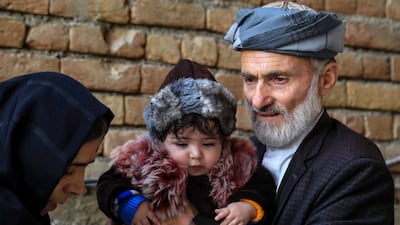
Sohail Ahmadi, an Afghan baby boy who went missing during the disordered evacuation process in Kabul after the takeover by the Taliban in August 2021, is reunited with his grandfather and aunt on January 10, 2022. EPA -
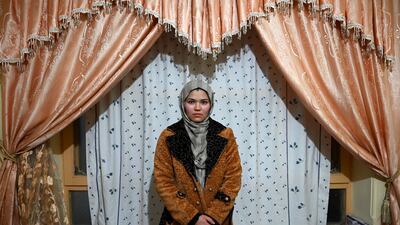
Zakia, an economics student who dropped out of university after the Taliban took power, at her home on the outskirts of Kabul on January 24, 2022. AFP -
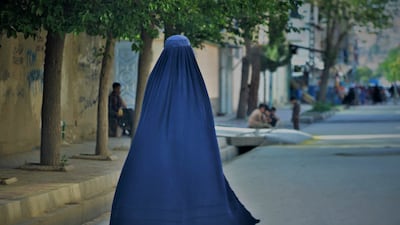
A burqa-clad woman walks along a street in Kabul on May 7, 2022. The Taliban had just imposed some of the harshest restrictions on Afghanistan's women since they seized power, ordering them to cover fully in public, ideally with the traditional burqa. AFP -
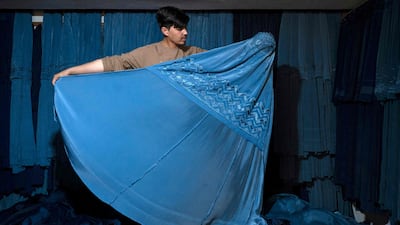
An Afghan vendor displays a burqa at his shop at Mandawi market in Kabul on May 8, 2022. AFP -
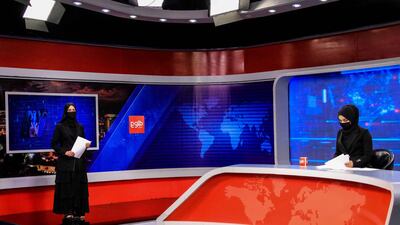
Khatira Ahmadi (L) and Tehmina (R), Afghan presenters at Tolo TV, read news at the studio in Kabul on May 23. Female television presenters and reporters in Afghanistan appeared with their faces covered to comply with a mandate issued by the Taliban. EPA -
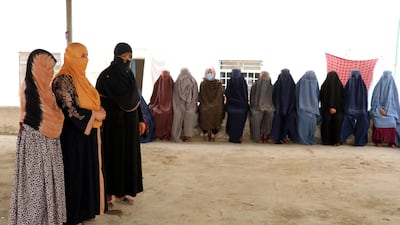
Afghan women prisoners in Kandahar on July 26. EPA


His years of service alongside British troops made him eligible for the Afghan Relocations and Assistance Policy (Arap) scheme, which opened in April 2021 to former locally employed staff in Afghanistan.
Some Afghans had already applied and moved to the UK in the months before the Taliban resumed power. Once the group took control of the capital city of Kabul on August 15, 2021, the numbers of people wanting to flee soared.
In the two weeks that followed, the US and coalition partners evacuated more than 123,000 people from Kabul’s main airport.
During that time, thousands of terrified Afghans thronged the airport inside and outside, seeking an escape route. People queued for hours in the heat, or hid in the sewers, carrying their children and a few precious belongings, waving documents proving their eligibility for evacuation.
One day, Aleem got a call from a friend who had made it inside the airport telling him to come too.
“I had some very tough times in my military career but what I saw there was the toughest," he says.
“Someone was asking for water, another for food, another for help, but there was no one to help them.”
After struggling to make his way through the crowd for seven hours, he reached one of the British soldiers letting people into the terminal.
“But there were Taliban members around too and I was scared," he says. "If I showed him my documents, they’d know I had been in the army and that I had fought them and I would be a marked man. If the British soldiers didn’t let me in, I would be dead.”
Eventually, he found his way into the airport through another entrance next to the Baron Hotel.
A few hours later he would hear the explosions that ripped through the crowd at the Abbey Gate, killing at least 95 people and wounding 150 others.
“It was a short distance between dying and living,” says Aleem.
And it was only the beginning.
Kabul to Birmingham and a baby born on board

It would be some time before Aleem was able to get himself on an evacuation list, appealing to the British soldiers with whom he had worked side-by-side for help.
Once approved, he asked his brother, who had also served in the military, to bring Aleem's heavily pregnant wife and two young boys to the airport gates.
“When I opened the door and saw the crowd outside, I could see some of the friends I had worked on missions with for 12 years. They raised their hands and asked me for help. But there was nothing I could do so I ignored them. I felt so helpless and ashamed,” he says.
Aleem describes what seemed like a haphazard process of selection. Some were rejected, some were accepted and it was not clear why – a criticism made by several people in the UK government who were working on the evacuation process at the time.
His brother was not allowed to join him on the flight out.
“I told them he had been in the army too, that he had been injured fighting the Taliban but they said no, he couldn’t come with us, so I had to say goodbye to him,” he says, his voice breaking and tears streaming down his face. “And then he was gone.”
It was the last time he would ever see him. A few months later, two of Aleem's brothers, including the one left behind at Kabul airport, were shot and killed at a checkpoint while attempting to flee to Iran.
But there would be little time for Aleem to process what he had just left behind – country, family, friends, career – because a new life was quite literally awaiting him.
After first disembarking in the UAE, the evacuees were put on another flight headed for the UK but no sooner had they taken off than Aleem's wife went into labour. There was no doctor on the plane so the cabin crew relied on their training to help deliver the baby girl.
After an emergency landing in Qatar and a visit by the doctor, the family continued their journey to Birmingham and arrived laden with mixed feelings.
“It was complicated, I was happy because we had a new baby girl but I had also just left my brother in the airport, and the rest of my family in a country where the situation was changing dangerously, so my happiness and my sadness were mixed.”
They named their daughter Havva, meaning ‘air’ in Dari, but the novelty of having a baby mid-flight quickly wore off once the bureaucratic difficulties set in.
Confusion over where to obtain her birth certificate – the UAE, from where the plane had departed, Turkey, the aircraft operator’s origins, Qatar, where they had landed or the UK, their destination – has reigned since Havva’s birth.
Conversations with the local authority and Home Office case workers have not proved fruitful. Some even suggested Aleem get her birth certificate from Afghanistan.
“People are normally excited about this exceptional case of being born on a plane but I am the opposite because it is causing problems,” he says.
Havva will turn 1 in a few weeks and still doesn’t have a birth certificate.
From unsettling hotels to a home of their own

When the family arrived to England in September 2021, existing Covid restrictions meant they had to quarantine in a hotel for two weeks.
They were later moved to a bridging hotel in central London where they stayed for two-and-a-half months.
“There were too many of us in that hotel,” he says of a place that housed several hundred Afghan refugees. “It was disorganised, the food wasn’t good either but it was a lot better than the next place they put us in.”
The next hotel had loose wiring, broken cupboards and an insect infestation that left his children with rashes.
Continuing to weigh on Aleem's mind were the people left behind in Afghanistan.
A cousin had been imprisoned by the Taliban. His sisters were no longer allowed to continue their education.
His brothers are dead.
“I never saw them, I never saw their bodies or went to their funeral, I just can’t really believe that they’re gone,” he says.
But, life must move on. Aleem has been trying to take the advice of his fellow Afghans: “Make yourself ready for your family, be strong and look forward.”
Once his English is good enough, he’ll start looking for a job. Becoming a plumber appeals to him.
Until then, language classes, taking his children to school and long walks around the capital occupy his time.
“I think we must have visited all the museums in London,” he says with a reminiscent smile.
When asked how he feels now, he says: “I’m happy.
“My only concern is that I wish I could bring my family here, I have three sisters and one young brother left. My parents are getting old, I wish they could be here with me.”

