

Authorities warned of a risk of disruption at the Port of Dover and the Eurotunnel terminal in southern England every weekend until the summer ends because of how “vulnerable” the crossing points are.
Drivers were forced to queue for up to six hours to board ferries to cross the English Channel at the weekend when bumper-to-bumper traffic stretched for kilometres and families were stranded in cars after schools closed for the holidays.
“This has been an incredible weekend of traffic jams into Dover and Folkestone, and holidaymakers will have been frustrated and angry at the delays,” said Jack Cousens, roads policy chief at the AA.
“Drivers due to use both Dover and Folkestone to head into Europe on Fridays, Saturdays and Sunday mornings, between now and the reopening of schools, may see a repetition of these delays across the summer.”
Holidaymakers were told a summer of disruption for those travelling through Dover and the Eurotunnel terminal in Kent was likely after port authorities on Friday declared a “critical incident” to cope with the disruption.
While queues at Dover had cleared by Sunday morning, the Automobile Association (AA) called Folkestone the new “hotspot of holiday hell” as people faced long delays on the approach to the Eurotunnel.
Toby Howe, senior highways manager at Kent County Council and tactical leader at the Kent Resilience Forum, said the situation at Dover on Monday morning was normal for the beginning of the working week.
-

Cars form long queues at the check-in at the Port of Dover in Kent. PA -

People decide to go by foot into the Port of Dover. Many families are embarking on getaways at the start of summer holidays for many schools in England and Wales. PA -
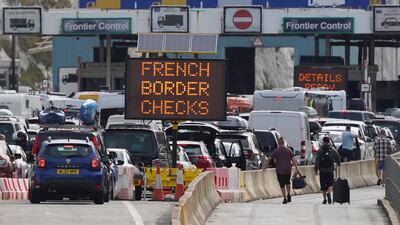
Staffing at French border control at the Port of Dover is 'woefully inadequate', causing holidaymakers to be stuck in long queues, the Kent port said. PA -
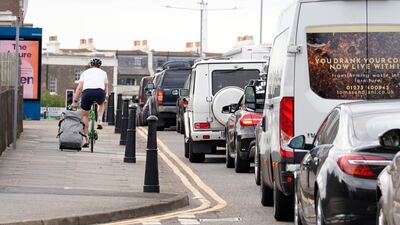
A man cycles with a suitcase past traffic jams in Dover. AP -
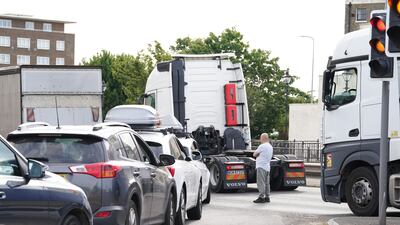
Traffic jams leading to the ferry in Dover. PA -

Long car queues at Dover. PA


But he warned of a possible repeat of the disruption that has taken place over the past few days and said that next weekend could be “very busy”.
Mr Howe told The National that the forum had plans in place “for the whole summer holiday period as we are expecting high tourist travel every weekend”.
He said last weekend was expected to be the busiest this summer while next weekend is likely to be the second-busiest.
“As we have just found out the weekend just gone, traffic numbers travelling across the Channel were back to pre-pandemic levels and with the increased checks, it is slower to get through, so it takes very little to cause those tailbacks,” Mr Howe told BBC Radio 4's Today programme.
On what the rest of the summer could bring, he said: “Basically, it is a very vulnerable situation. It takes very little to cause further issues.”
John Keefe, director of public affairs at Eurotunnel owner Getlink, said “our services ran on time” but there was “much more congestion on the roads”.
He said a new online passport checking system should be used to prevent backlogs.
“A lot of modern technology exists that would reduce the reliance on staff to conduct those processes in situ,” Mr Keefe told BBC One’s Breakfast programme.
“There is a lot of work that can be done around improving the border.”
He also said better rail connections to Folkestone were needed to reduce the number of people arriving in vehicles.
Mr Keefe also pointed out how a lack of road connections to the terminal was having a knock-on effect on congestion and said “we need to have more resilience in the motorway network”.
“There are definitely solutions. These solutions are not new. They have been on the table for many, many years,” he said. “But, hopefully, something like this will actually focus attention.”
The AA said long waits at Folkestone had “fallen considerably” by late afternoon on Sunday but raised concerns that such congestion could be repeated this summer.
“Good progress has been made throughout the day, and those waiting for more than five hours before reaching the check-in desk have fallen considerably,” said Mr Cousens.
“We hope that by tonight, we should be back to usual traffic levels. However, we are concerned that we could be in for a repeat of this congestion across the summer.”
The Port of Dover said its ability to clear traffic this weekend demonstrated that its summer plan would work for the rest of the holiday period.
But the AA said significant progress would be needed to help reduce congestion in the weeks ahead.
With the coastbound carriageway of the M20 closed to non-freight traffic as part of Operation Brock to manage traffic, National Highways warned on Sunday of “severe delays” in Kent for people heading towards Dover or the Eurotunnel.
Waiting in line at the Port of Dover was reduced to about an hour on Sunday, with relatively empty lanes, in contrast to the jams of the previous two days.
One man, who was travelling with his wife and two children on Sunday by Eurotunnel, said it was a “stressful” experience being stuck for eight hours in the car before boarding a train.
Another who was caught in the delays said travelling to France by car suits his family but he would rethink the trip if every journey was likely to involve such delays.
“I have made this journey a number of times pre-pandemic and pre-Brexit,” he said. “No such issues apart from the occasional minor delay. A shame that this has occurred.”
A spokesman for the port said the French border was “fully manned and everything is flowing normally” on Sunday morning.
Extra border checks after Brexit and understaffing of French checkpoints in Dover were blamed for the hold-ups.
The British government has insisted that changes to border control measures after Brexit did not have a “significant role” in the disruption at Dover.
It repeated its claim that problems occurred because French authorities did not provide enough border officials on Friday during what was a peak period of travel.
“We will continue work with the relevant authorities and operators to minimise disruption and provide on-the-ground support,” the government said.
Port authorities said work undertaken by them and their partners, “including strong support from French border colleagues”, to clear traffic this weekend showed that their “summer plan will work for the rest of the holiday period”.
About 72,000 passengers — comprising more than 320 kilometres of tourist and freight traffic combined — were processed at the weekend until Sunday morning.
Port chief executive Doug Bannister thanked travellers and Dover residents for their understanding during what he described as a “challenging period”.
Mr Bannister said he was “incredibly grateful to everyone who has turned this situation around, from the French and UK authorities to our ferry operators, Kent partners and our own port staff”.
Passengers sailing across the Channel from Dover must pass through French border checks before they can board a ferry.
Elsewhere on the roads, the AA said traffic appeared to be flowing well on Sunday, “bar some isolated pockets of congestion”.

