


British Prime Minister Boris Johnson has said that “of course” he can lead the Tories in the next general election, despite continued questions over his leadership linked to lockdown parties in Downing Street.
The prime minister has been sent a legal questionnaire from Scotland Yard officers to complete, as they investigate whether he broke his own pandemic restrictions.
Revelations about events in Downing Street during coronavirus lockdowns have resulted in Scottish Tory leader Douglas Ross calling for Mr Johnson to quit, claiming his position is no longer tenable.
Despite this, Mr Johnson, who did not meet the Scottish Conservative leader on a trip north of the border on Monday, said Mr Ross was doing a “very good job”.
And he said that they could both still be in post as party leaders at the next general election.
Asked whether he believed they will both lead the Conservatives into the next general election, Mr Johnson said: “Of course.”
His comments came as he again made clear his view that Scottish independence is “just not going to happen”.
The prime minister told The Daily Mail that over the course of the Covid pandemic, “Scotland and the whole of the UK has benefited massively from the might of the UK Exchequer”, highlighting the impact of programmes such as furlough.
“I think most people could see that it would be an economic disaster to split up our country,” he said.
“That is why it is just not going to happen.”
Speaking about the Scottish Tory leader, he insisted that Mr Ross “has done a very good job indeed of leading the Scottish Conservatives”.
-

The Metropolitan Police have announced a formal investigation into alleged lockdown-breaching parties in Downing Street, dealing a heavy blow to Boris Johnson's authority as he faces fresh calls to step down as British Prime Minister over the 'partygate' scandal. Getty Images -
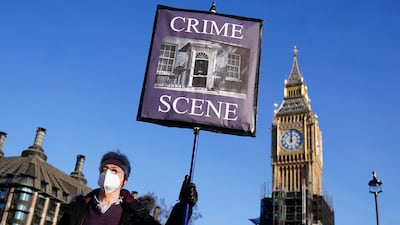
A protester in Parliament Square, London. PA -
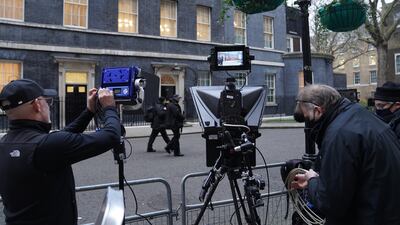
Armed police officers walk past the gathered media outside No 10 Downing Street on Tuesday morning. PA -
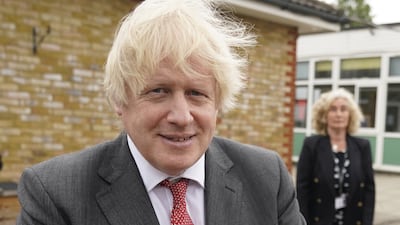
Mr Johnson holds up a birthday cake - baked for him by school staff - during a visit to Bovingdon Primary Academy in June 2020. The prime minister is facing new allegations of breaking coronavirus rules after it was reported that a gathering to wish him a happy birthday was held inside No 10 during the first nationwide lockdown. PA -
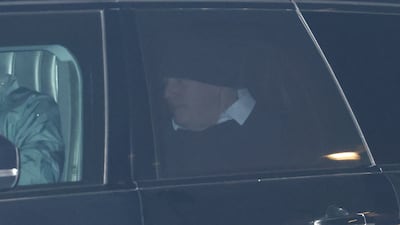
Mr Johnson is driven from Downing Street. Reuters -
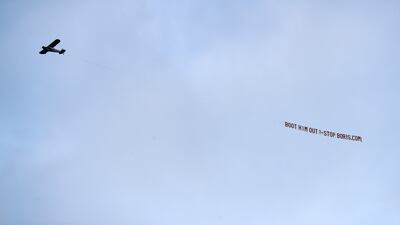
A plane flies over Elland Road stadium in Leeds with a message directed to Mr Johnson during the Premier League match between Leeds United and Newcastle United. Getty Images -
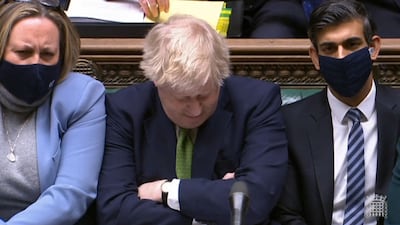
The prime minister seems unimpressed as Britain's main opposition Labour Party leader Sir Keir Starmer speaks during Prime Minister's Questions in Parliament. AFP -
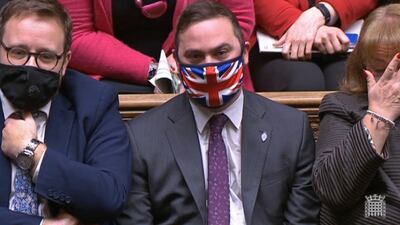
Labour MP for Bury South, Christian Wakeford, who defected from the Conservative Party earlier that day, attending Prime Minister's Questions. AFP -
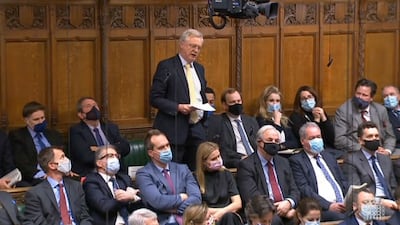
David Davis, Conservative MP for Haltemprice and Howden, quoted a comment made to Neville Chamberlain before his 1940 resignation as prime minister, telling the beleaguered Mr Johnson: ‘I will remind him of a quotation all too familiar to him ... 'in the name of God, go'.’ AFP -

Dominic Cummings, former adviser to Mr Johnson, speaks to the media outside his home. Getty Images -
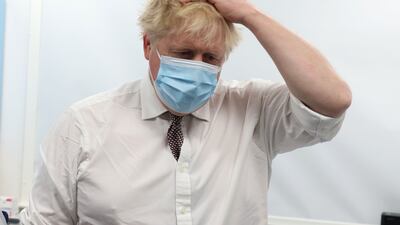
Mr Johnson looks as if he is feeling the pressure on a visit to Finchley Memorial Hospital in London. Getty Images -

The shuttered constituency office of Mr Wakeford in Radcliffe, Bury, after he switched his party political allegiance. Getty Images -
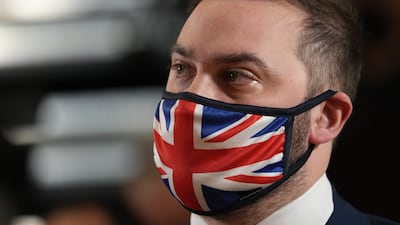
Mr Wakeford looks on during a visit by Labour’s Shadow Chancellor, Rachel Reeves, to Bury. Getty Images


In the 2021 Holyrood elections, he said that Mr Ross won “about 100,000 more votes than any previous Scottish Conservative leader” and had also “stopped the Scottish National Party from getting the outright majority that they thought they could get”.
“Every day, Douglas gets up and campaigns for the union of our country in a way that is absolutely passionate and I totally share,” Mr Johnson added.
“All I would say is there is far, far more that brings us together than separates us.”
But Kirsten Oswald MP, the SNP’s deputy Westminster leader, said: “It is utterly absurd that Boris Johnson and Douglas Ross believe that they can both remain in office.
“How can Ross and the Scottish Tories possibly fight an election under a leader they think is unfit for office and should resign — not to forget that their Westminster bosses dismissed their Scottish Tory leader as a ‘lightweight’.
“It’s clear that Boris Johnson and Douglas Ross can’t both remain in post with any credibility.”
“If Boris Johnson refuses to do the right thing and resign, then people will rightly question if they can take Douglas Ross seriously if he continues to limp on.”
Meanwhile, Scottish Liberal Democrat leader Alex Cole-Hamilton said: “Boris Johnson is on a delusion tour if he thinks the British public will still want him as prime minister for another week, let alone until the next general election.
“If he had a shred of dignity, he would offer his resignation as soon as he returns to London.”
Instead of focusing on what really matters, Mr Cole-Hamilton said, the prime minister's primary concern is distracting people from the problems within his own party.
“The Conservatives must stop taking the electorate for fools,” he said.
“The public made countless sacrifices and did all that was asked of them, they do not deserve a prime minister that cannot abide by his own laws.”

