


A first Afghan family has been given leave to remain in the UK under a programme to resettle up to 20,000 refugees.
Victoria Atkins, the minister in charge of Afghan resettlement, said it was "time to pick up the pace" of the programme but said that the UK's capacity to admit migrants was not unlimited.
Formally opening the scheme for those trying to escape Afghanistan after the Taliban takeover, Ms Atkins said the government was expecting to exceed its target of taking in 5,000 refugees in the first year of the Afghan Citizens Resettlement Scheme.
Ms Atkins called for other countries to “step up” and follow the UK’s lead.
She said new safe routes for refugees would be launched as part of the scheme, including one that will honour the UK’s commitment to British Council workers and contractors used by UK companies.
The UK opposition Labour Party said delays to opening up the scheme had “put lives at risk”.
“The capacity of the UK to resettle people is not unlimited." Ms Atkins told the House of Commons.
“We have had to take some very difficult decisions about who will be prioritised for resettlement, and it is frankly for other countries to step up and follow the United Kingdom’s ambitious lead.”
Emphasising that the Afghan scheme was “the government’s new plan for immigration in action”, Ms Atkins said: “In September, we announced our aim to settle 5,000 people in the first year of the ACRS.
“In light of the emerging situation and the success of our evacuation efforts, we will exceed that aim.”
She confirmed that 1,500 people brought to the UK after the British withdrawal from Kabul last August were the first to be resettled under the scheme, which aims to take in 20,000 in the coming years.
“The first to be resettled under the new ACRS will be those already evacuated and in the UK," Ms Atkins said.
"They include women’s rights activists, journalists and prosecutors, as well as the Afghan families of British nationals."
Two new safe routes to help Afghans escape to Britain are also expected to be opened through the scheme in coming months.
The first will open “from the spring”, Ms Atkins said, and the UN High Commissioner for Refugees will recommend migrants in “need of resettlement” to the UK.
In the second the government will “honour our commitments and offer ACRS places to the most at-risk British Council, GardaWorld contractors, and Chevening alumni” still in Afghanistan, she said.
The Foreign Office, which will manage the second route, will in future years “work with international partners and NGOs” to expand it to others in need.
They will include “those who are particularly vulnerable, such as women and girls at risk and members of minority groups”.
Yvette Cooper, Labour’s shadow home secretary, said the delays in setting up the Afghan resettlement scheme have put “lives at risk”.
“We have seen a truly dire humanitarian crisis escalate in Afghanistan, with those we promised to help still in peril, British nationals and British Council staff and others still in hiding," Ms Cooper said.
"Family members have been executed, and NGOs with staff who worked on UK contracts say that 95 per cent of those staff not only did not get out but they still haven’t even had replies from the British government to their Arap [Afghan Relocations and Assistance Policy] applications.
“That is shameful.”
-
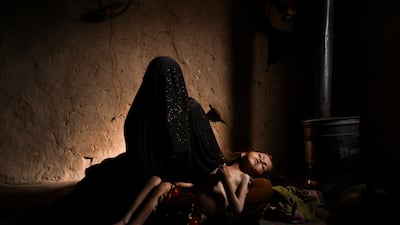
Fatima holds her daughter Nazia, 4, who is suffering from acute malnutrition, at their house near Herat, western Afghanistan, December 16, 2021. Two years ago, Nazia was a plump toddler, Fatima says. Aid groups say more than half the population faces acute food shortages. AP Photo -
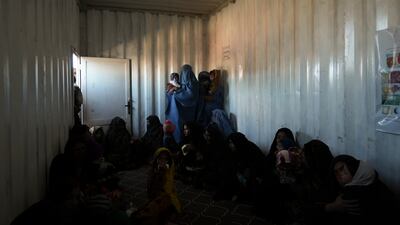
Afghan women at a makeshift clinic run by World Vision at a settlement near Herat. The aid-dependent country’s economy was already teetering when the Taliban seized power in mid-August. The consequences have been devastating for a country battered by four decades of war, a punishing drought and the coronavirus pandemic. AP Photo -
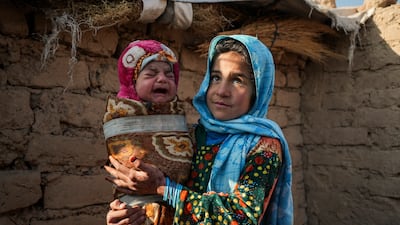
Qandi Gul holds her brother outside their home in a camp for those displaced by war and drought near Herat. Qandi's father sold her into marriage without telling his wife, taking a down payment so he could feed his family of five children. AP Photo -
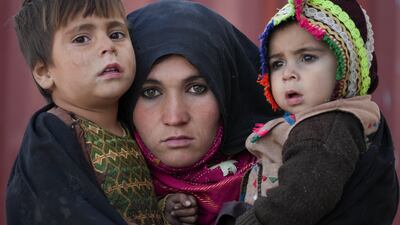
An Afghan woman with her children outside a makeshift clinic at a sprawling settlement of mud brick huts housing those displaced by war and drought near Herat. AP Photo -
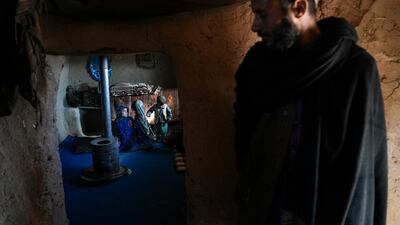
Hamid Abdullah outside a room where his children are playing at a settlement near Herat. Mr Abdullah is selling his young daughters into arranged marriages, desperate for money to treat his chronically ill wife, who is pregnant with their fifth child. AP Photo -
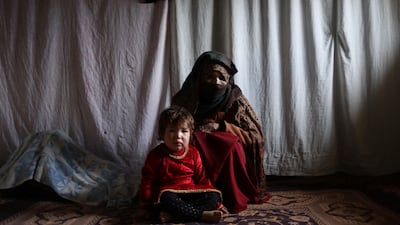
Kubra, 57, with her grandchild in a house in Bamiyan, Afghanistan, December 22, 2021. 'We got two sacks of flour last spring that we're still using. After that, we have to have faith that God will help us," Kubra says. Reuters -
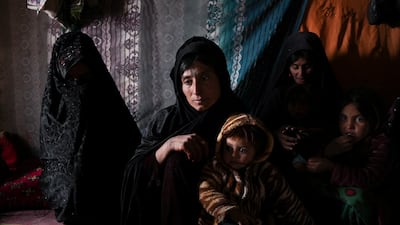
Guldasta and members of her family in their house at a settlement near Qala-e-Naw, Afghanistan. Guldasta says that after days with nothing to eat, she told her husband to take their son Salahuddin, 8, to the bazaar and sell him to buy food for the others. AP Photo -
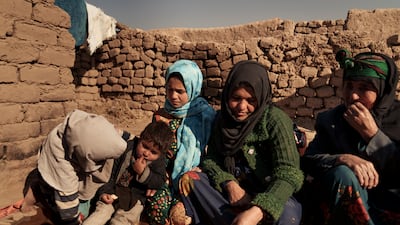
Aziz Gul, second from right, and her 10-year-old daughter Qandi, centre, outside their home with other family members, near Hera. Qandi's father sold her into marriage without telling his wife, Aziz, taking a down-payment so he could feed his family. AP Photo


Ms Atkins said the government received more than 99,000 applications to the scheme and was working to “assess these on a case-by-case basis”.
“We are deeply disappointed and dismayed that today’s announcement fails to open the scheme for people at risk in Afghanistan or those who have already fled into neighbouring countries," said Enver Solomon, chief executive of the Refugee Council.
“While we welcome the fact that the government announcement confirms they have started granting indefinite leave to remain to Afghans who arrived during the evacuation, we are very concerned the target of supporting up to 20,000 people through this scheme will include Afghans who have already arrived in the UK, meaning that not all of these places will be ‘new’ places.”
The Home Office said claims that women and children might not be given priority in the scheme were incorrect.
“The government has already evacuated thousands of women and girls from Afghanistan," a spokesman said.
"Women and girls are being immediately prioritised for resettlement through the Afghan Citizens Resettlement Scheme.”

