


Emmanuel Macron faces a twin threat from far-right candidates and the disruptive prospect of a resurgence of mass protest against his government in the run-up to the April poll that will determine if he secures a second term in the Elysee Palace.
Mr Macron's backers this week launched the grassroots Citizens Assemble movement to rally support for his candidacy. A day later the polemicist Eric Zemmour threw his hat in the ring to try to eclipse another far-right standard bearer who also ran in the previous race, Marine Le Pen.
When the mainstream Republicans and Socialists choose their standard bearers there will be a crowded political field that will spend months jockeying for power. Where the race could turn combustible is the parallel threat from radicals from the political extremes who are urging a return to the huge rallies and paralysing blockades that brought chaos to France during the gilets jaunes, or yellow-vest, rebellion.
Opinion polls show concerns over the cost of living to be the dominant factor affecting voting intentions. With only five months left before France decides whether to grant him a second term, Mr Macron enjoys reasonably high approval ratings – 40 per cent and above – for a president nearing the end of a five-year mandate.
Of Mr Macron’s two far-right opponents, his main 2017 rival Ms Le Pen is gaining ground in the polls, the latest putting the gap between them at only 5 per cent. Mr Zemmour also polled in double figures.
Conscious of the populist threat to his ambitions, Mr Macron is anxious to avoid a repeat of the destruction, disruption and violence that marked the earlier phase of the movement.
The presidency views the judgment of French people on his domestic policies as far more important than post-Brexit spats with Britain unless, as has happened to some extent in the dispute over fishing, he is seen to stand up for French interests.
So far the renewed protests have been small and not all prominent figures from the original movement are convinced how much scope exists for a resumption of large-scale rebellion.
But whether or not reaction on the street to rising fuel and energy prices grows significantly, the gilets jaunes have already left an indelible mark on French society and Mr Macron’s presidency. If they did not attain the revolutionary goals of more idealistic activists, they did – according to some analysis – force a strong head of state to listen.
One political scientist, Jean-Christophe Gallien, reminded the French broadcaster CNews that by comparison with the limited success of union-led strikes, the gilets jaunes were quick to achieve results, forcing government concessions in a few months.
Pierre Madec, an economist with the Sciences-Po university’s independent research group, the French Economic Observatory (OFCE), believes that while most of Mr Macron’s economic reforms have aided the better off, their effect on lower income groups would have been more severe without the pressure the protest movement imposed on him.
Mr Madec identified the rich and middle classes as the main winners from reforms. For him, the losers are pensioners, the unemployed and some of the young, including students. "But if there had not been the gilets jaunes crisis, one can consider the losers would have been more numerous," he said.
Yellow Vests protests in France through the years - in pictures
-

Protesters take part in a yellow vest demonstration in February 2019, in Paris. The start of the gilets jaunes movement in 2017 was triggered by anger at soaring energy prices. All photos: Getty Images -

People wear yellow jackets in a protest against rising prices of fuel and oil in November 2018 in Avignon, France. -
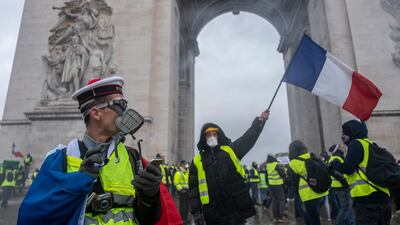
Tear gas surrounds protesters as they clash with riot police during a yellow vest demonstration near the Arc de Triomphe in December 2018 in Paris. -
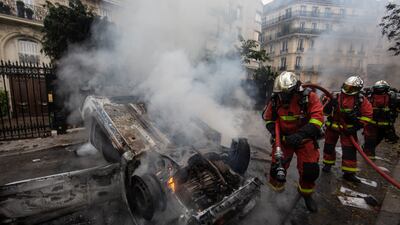
Firefighters work to put out cars set alight on a road near the Arc de Triomphe in December 2018 after yellow vest demonstrations. -
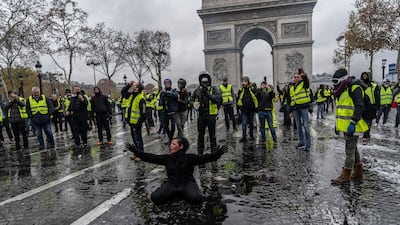
Yellow vest protesters clash with riot police near the Arc de Triomphe in December 2018. -

Yellow vest protesters chant slogans against President Macron and his government in front of Sacre Coeur in Paris in March 2019. -
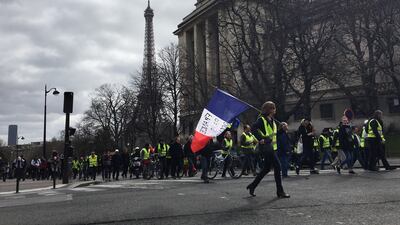
Yellow vest protesters walk past the Eiffel Tower in March 2019. -

Yellow vest protesters demonstrate in front of the Palais de Justice in Paris in March 2019. -
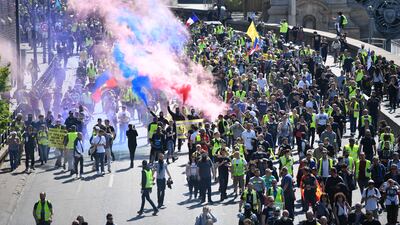
Yellow vest demonstrators gather in the Bercy neighbourhood of Paris to protest for a 23rd week in April 2019. -
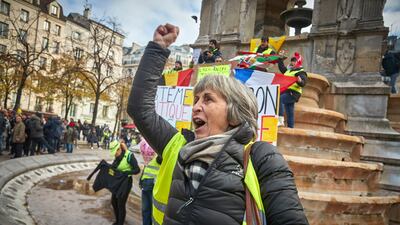
Yellow vest protesters chant against President Macron at the Fontaine des Innocents in Paris during the second day of protests to mark the first anniversary of the movement, in November 2019. -
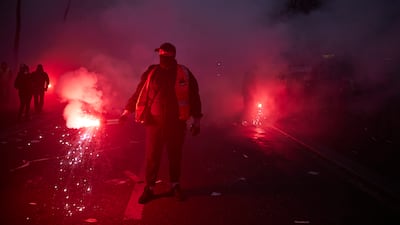
Yellow vests and railway workers walk towards French riot police holding flares amid violent clashes between officers and protesters during a rally near Place de Republique, in support of a national strike in France in December 2019. -

A yellow vest protester stands defiantly in front of French riot police during Bastille Day anti-government demonstrations at Place de la Bastille in July 2020. -
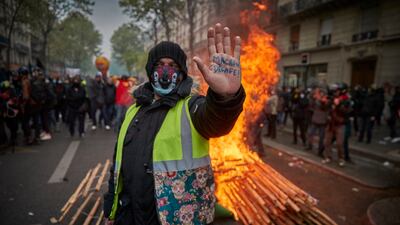
A yellow vest protester stands in front of a burning barricade as May Day protests turn violent near Place de la Republique in May 2021.


He told The National the gilets jaunes revolt inspired a turning point in the president’s socio-fiscal policy.
“The carbon tax that was supposed to increase has been frozen,” he said. “Bonuses intended for the most modest employees have been greatly increased.
“Taxes on the retired, increased at the start of their mandate, have been reduced. Overtime was exempted from income tax. In the end, the measures taken in reaction to the gilets jaunes crisis were numerous.”
Mr Madec also sees a link between the earlier protests and at least part of measures worth €24 billion ($27.21 billion) introduced over the duration of the presidency intended to some extent to improve household budgets.
He said the key difference between rising fuel prices in 2021 and in 2018 was that the cost of oil rather than government action is to blame for increases now.
“That said, the result for the French is the same,” he said, “Despite the many measures taken by the government to support their purchasing power, many French households have great difficulty in getting through the month.
“Likewise, Mr Macron’s five-year term remains marked by the measures taken at the start of his presidency in favour of the wealthiest households. Finally, when prices at the pump increase, the state gets richer through higher collected taxes, which in fact sends a fairly negative signal for households.“
Mr Madec suspects Mr Macron and his ministers will address the question of how to use additional tax revenues “precisely to avoid new social mobilisation a few months before the election”.
Among many of those who supported the movement, actively or merely as observers, there is a feeling that for all the solidarity they inspired, little was won.
One prominent figure from the earlier demonstrations, Maxime Nicolle, said when contacted by The National that he hoped the movement would rise again, perhaps taking different forms, but seemed unconvinced that it would. “We did not achieve very much in the end because the forces of law and government crushed us,” he said.
But the extent to which broad sections of French society looked with sympathy on protests remains impressive.
And in some ways, the voices of relatively uncommitted voters, observing events from the sidelines, offer an important retrospective on France’s outlook on the “forgotten ones”, the title of one of many books written on the movement.
“I thought it was an interesting movement and fully deserved the support it received,” says Jean-Louis Witas, a musician and composer in his mid-60s.
Mr Witas’s empathy with the protesters, at first surprising given his comfortable life in the south of France, is echoed by many other middle-class French people who would not necessarily dream of joining a demonstration.,
Expressing sadness at the way the movement evaporated as the pandemic posed different challenges, he said: “It is very rare for people to stand up and say no, we won’t put up with this any longer. They could see glaring inequality between ordinary people and the rich and powerful. I don’t approve of violence but sometimes people feel otherwise powerless if they realise they are not being listened to. And don’t forget there has been some bad police violence, too.
“I also think it will come back in some form as the higher cost of living leaves people unable to make ends meet.”

