

Mohamed Mezghani, secretary general of the International Association of Public Transport (UITP), participated in the Cop26 climate action talks in Glasgow, Scotland, championing the sector as an answer to the environmental crisis our planet faces. The voice of public transport was heard at public events, meetings, interviews and appearances, and it began and ended with his journey by rail from Paris. But did public transport make its presence felt? And what is the future for its role in climate action? Sharing his thoughts after Cop26, Mr Mezghani remains optimistic.
When the Cop26 started, transport was the sector with the fastest increase of CO2 emissions. Without immediate action, the global share of transport emissions could reach 40 per cent by 2030 versus 24 per cent now. This would be a huge increase in a very short period of time. Moreover, since 70 per cent of the transport emissions take place in urban areas, it’s of the utmost importance for UITP, on behalf of the public transport sector, to have been vocal in Glasgow to explain how our industry can significantly contribute to mitigate climate change.
With colleagues and members, we participated in various events, bilateral meetings and press interviews to convey this message. Also, we met with different profiles of stakeholders: ministers, mayors, leaders of the supplying industry, representatives of international organisations and peers from other professional associations.
I had the opportunity to attend the Transport Ministerial (meeting) which was organised for the first time within the Cop. Although only a few ministers participated, including those from the US, GB, Canada, India, Ireland, Scotland, Ghana, Brazil, New Zealand, Sweden, and the European Commission, the discussion was very informative and confirmed that governments are mainly relying on technology-based solutions and mainly on electric vehicles.
When public transport is mentioned, it's generally towards the end of the statement, not to say as part of "any other business".
My message during this Cop was very clear and direct: technology will certainly help, but will not solve it all. A traffic jam of zero emissions cars is still a traffic jam.
-
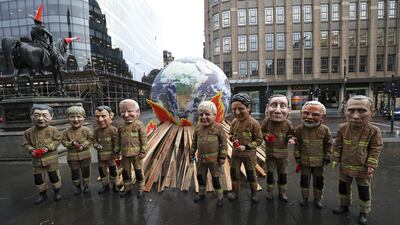
Oxfam campaigners dressed in the roles of 'ineffective fire-fighting world leaders' pose outside the Cop26 Summit in Glasgow, Scotland. AP Photo -
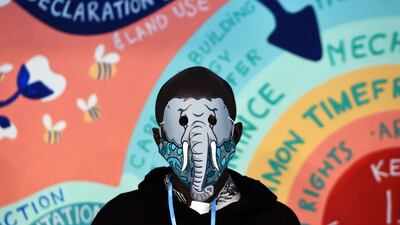
Members of the World Wildlife Fund stage a small protest to hold world leaders to the 1.5 degrees celsius pledge. AFP -

A man walks through the main room in the OVO Hydro building at the summit. Getty Images -
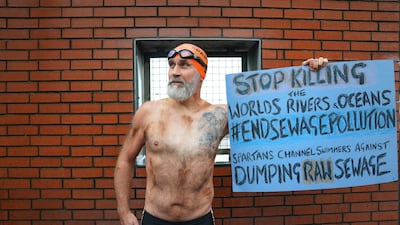
English Channel swimmer Peter Green protests against the dumping of raw sewage into the sea. PA -
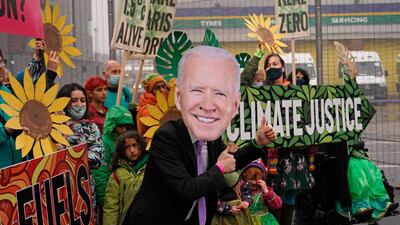
A climate activist wearing a mask of US President Joe Biden takes part in a demonstration against the use of fossil fuels. AP Photo -

Indonesian delegates pose for a picture inside the Blue Zone. PA -
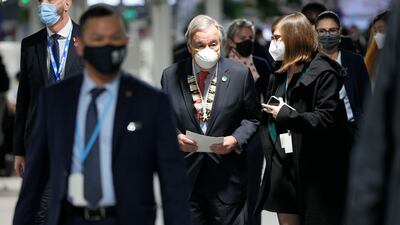
UN Secretary General Antonio Guterres walks through the venue. AP Photo -
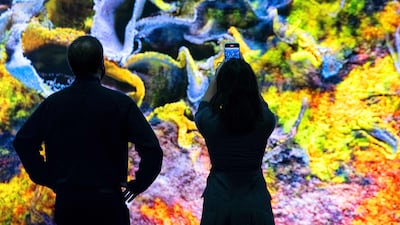
Delegates watch a video wall in the pavilion area. AFP -
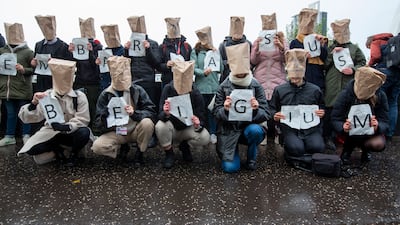
Activists hold placards forming the slogan 'You embarrass us Belgium' during a protest outside the Cop26 venue. EPA


We need solutions that not only contribute to decarbonisation but improve road safety, ensure social inclusion and accessibility for all, reduce congestion, contribute to a healthy lifestyle … Electric cars will not change anything for these issues.
Solutions that focus on people rather than technology will. This is possible with the alliance of public transport, walking and cycling. This was confirmed by Jill Warren and Henk Swarttouw, respectively executive director and president of the European Cycling Federation, with whom we agreed to strengthen our collaboration during Cop.
The focus on people is not only on those travelling but also those designing and delivering the service – those essential workers who make public transport available for all.
Public transport faces challenges to attract the right talents and skills in an evolving market, in particular during this post-coronavirus context. With our friends of the International Transport Workers Federation, Stephen Cotton, Alana Dave and John-Mark Mwanika, we agreed to increase our co-operation to support our members in finding the right people.
I am happy that many stakeholders emphasised similar messages in Glasgow, putting people first.
“Transport ministers are climate ministers,” said Tomas Eneroth, the Swedish Minister for Infrastructure. So let's make sure public transport is on the list of their medical prescriptions. Health is indeed one more benefit of public transport that this Covid pandemic made even more obvious.
In our meeting, Dr Maria Neira, a director at the World Health Organisation, confirmed that public transport is a priority in their approach to healthy mobility.
Not only do we need more public transport, but even better if it is decarbonised. In this regard, it was good to see many bus and rail manufacturers confirming their commitment to produce green vehicles: electric, powered by biogas or hydrogen.
I had the opportunity to talk to the recently appointed chief executive of Scania, Christian Levin, who considers this is a must and not just for rich countries.
For Gonzalo Muñoz, the Cop25 Champion, “The retrofit of existing buses and their conversion into e-buses is a way to reduce time to market and provide affordable solutions.”
Retrofitting applies to rail, too. In this field, Scotland is home to a world premiere: HydroFlex is the first retrofitted train which can run on hydrogen or electricity.
We had the opportunity to ride it and hold a working session on-board. Also, we were happy to have in the UITP delegation, Cécile Texier, sustainability director of Alstom, producer of hydrogen powered trains which are already in operation.
Electricity is, of course better, when produced by renewable sources. There are many examples in the public transport domain. For this very reason, UITP will join Ren21, an association of organisations involved in the field of renewable energies, following a fruitful meeting with Rana Adib, its executive director.
To date, only 30 per cent of national climate plans include public transport. Public transport must appear in all of them. The goals of the Paris Agreement will not be achieved without public transport.
At the end of Cop26, transport still represents 24 per cent of global CO2 emissions, but the strong mobilisation of the many associations and NGOs in Glasgow inspires optimism and confidence despite the conservatism of leading governments and their lack of courage.
I arrived in Glasgow seeing the glass half empty, I left with the glass half full. And I refuse to let my optimism fade.

