

Follow the latest Afghanistan updates
An interpreter who worked with the British Army for many years before its final withdrawal from Afghanistan on Saturday is in hiding in Kabul after his application to enter the UK was rejected.
"Abdul-Ali", not his real name, received a letter from Britain's Interior Ministry, which said he and his family were being refused entry because they were a danger to "national security" and their "presence in the UK would not be conducive to the public good".
The verdict has baffled Abdul-Ali and he pleaded with the British government to reconsider.
"The situation is very dangerous for us right now," he told Sky News. "This is an emergency, it is very critical. The Taliban is killing people like me. Interpreters are the main target for the Taliban. They want to kill us.
"It's not trusted outside, it's dodgy. We are hiding in a basement of my friend's house and outside the Taliban is patrolling on the streets, knocking on people's doors."
The National on Monday disclosed that hundreds of Afghans are being spirited out of the country by an unofficial military veterans' network.
With food supplies in the basement hideout running low, Abdul-Ali and his family's fate now rests in the veterans' hands.
"I feel like we've left a friend behind. He's one of us," Cpl Vance Bacon-Sharratt told Sky News. "I wish there was something we could do for him. I feel like the country is indebted to him and we need to help him.
"There are photos of him in the same uniform as us. He wears a British flag on his arm and he believed in what we believed in. Now he's left in a basement somewhere, hiding for his life."
Cpl Bacon-Sharratt said Abdul-Ali was, in his eyes, unequivocally British.
It is not a belief shared by the UK's Interior Ministry, much to Abdul-Ali's consternation.
"I followed all of the application process for me and my family, including all of our biometric data, but after 20 days they sent it back saying your visa application is rejected," he said.
"It's still not clear why they rejected it. I am not a risk, I don't pose any threat."
Abdul-Ali's plight is not an isolated one: official government figures suggest more than 1,100 eligible Afghans and as many as 150 British passport holders have been unable to board evacuation flights.
Foreign Office minister James Cleverly offered some comfort earlier on Monday when he told the BBC the government would “look at all kind of options” in moving eligible people to safety.
Afghanistan latest - in pictures
-

A Taliban fighter stands near a vehicle that was used to fire rockets at the Hamid Karzai International Airport in Kabul, Afghanistan. EPA -
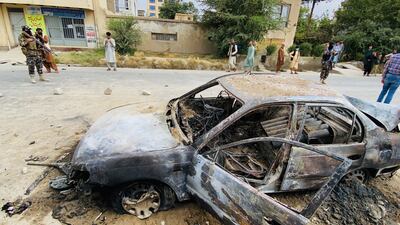
Multiple rockets fired from a car landed near the Kabul airport on Monday. EPA -

People watch remnants of flames after rockets were fired towards Kabul's international airport and intercepted by a missile defence system. Reuters -
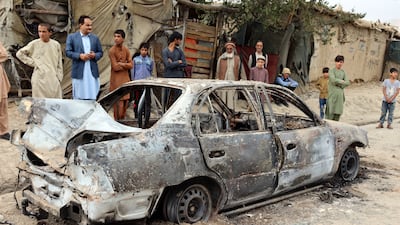
People stand by the shell of a vehicle damaged by a rocket attack. AP -

Remnants of flames from cars where rockets were fired towards Kabul's international airport. Reuters -
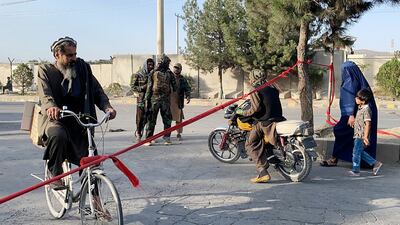
Taliban fighters stand guard outside the Hamid Karzai International Airport in Kabul. EPA -
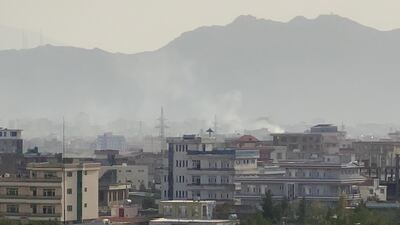
Smoke billows at the scene following an explosion near the airport in Kabul. EPA -
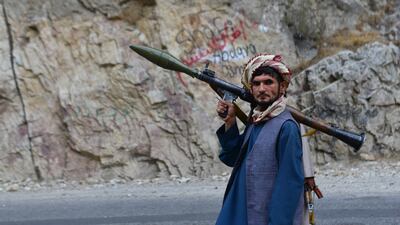
A fighter for anti-Taliban forces patrols along a road in Rah-e Tang, Panjshir province. AFP -
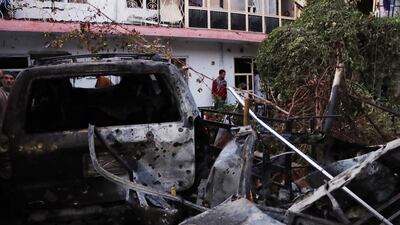
Damage caused by the attack near the airport in Kabul. EPA -

An Afghan resistance movement fighter stands guard on a road in Rah-e Tang. AFP -
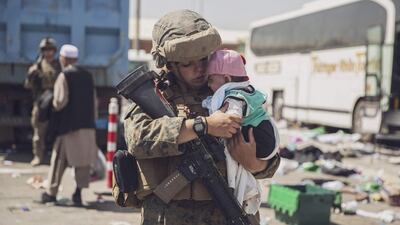
A US Marine carries a baby as the family is processed through the Evacuation Control Centre at the airport in Kabul. AFP -
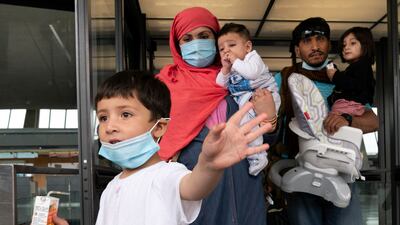
Families flown from Kabul, Afghanistan, arrive at Washington Dulles International Airport, in Chantilly, Virginia. AP -

A fighter for the anti-Taliban forces stands guard in Rah-e Tang, Panjshir province. AFP -
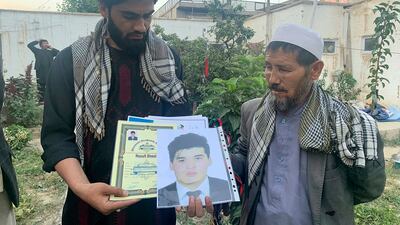
Mohammed Jan Sultani's father, Ali, right, looks at his son's Taekwondo championship certificates along with pictures of him in Kabul. Mr Sultani had clutched his national Taekwondo championship certificates as he waded through the multitudes pushing to get into Kabul airport late last week. AP -

Taliban fighters guard a checkpoint on the main street in Kabul. Reuters -
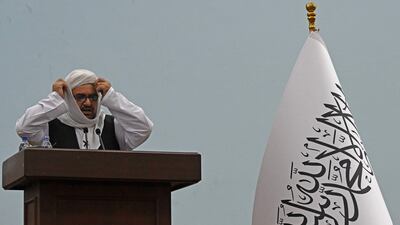
The Taliban's acting Higher Education Minister Abdul Baqi Haqqani gestures while speaking during a consultative meeting on higher education policies at the Loya Jirga Hall in Kabul. AFP -

Militiamen loyal to Ahmad Massoud, son of the late Ahmad Shah Massoud, take part in a training exercise, in Panjshir province, northeastern Afghanistan. AP -

The Panjshir Valley is the last region not under Taliban control following their stunning blitz across Afghanistan. AP -
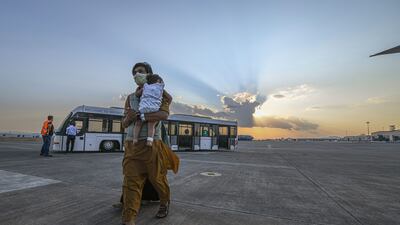
People flown from Afghanistan walk to board a flight bound for the US, at the Naval Air Station Sigonella, in Italy, on Saturday. AP -

Caskets carrying the remains of soldiers killed at Hamid Karzai International Airport in Kabul are placed on board an aircraft for their return to the US. AP



