



An image of self-reflection among the Covid-19 chaos helped London artist Jameisha Prescod scoop a Wellcome Photography Prize.
Ms Prescod won the single image prize with her photograph Untangling in the Managing Mental Health category.
The prize, now in its third year, focused on images that covered mental health, infectious disease and climate change.

“It’s really hard to talk about mental health and I guess it’s especially hard to turn a camera on yourself to expose some of the deepest and darkest [fears], but I’m glad that even taking it, I guess, could touch on something that a lot of us have been going through in this pandemic,” Ms Prescod said.
“I would also like to thank my family and especially my grandfather who bought me my first camera,” she said.
The shortlisted works included images from the California wildfires to the impact of tourism in the Maldives.
Yoppy Pieter won the series image prize in the Fighting Infections category for her Trans Woman: Between Colour and Voice.
“Both the winning entries moved the judges and initiated debate, we couldn’t help but discuss them at length,” said Jeremy Farrar, chairman of the Wellcome Photography Prize. “Covid-19 and mental health are components in both, but what captivated us all was the powerful human stories at the very centre – viewed through a lens of compassion.”
-

Winner of the Health in a Heating World category is 'Climate Cost' by Zakir Hossain Chowdhury. Three months after Cyclone Amphan hit Bangladesh, a man salvages anything still useful from the wreckage of his house. -

Shortlisted for the Health in a Heating World category is 'Eliminating Fossil Fuels in Germany' by Krisztian Bocsi. The Janschwalde lignite power plant in Peitz, Germany. Lignite, also known as brown coal, is one of the most carbon-intensive sources of power. -

Water Scarcity' by Sujan Sarkar was another shortlisted image, in which a nine-year-old girl carries saltwater for her family to use around the house. Since 2009, when Cyclone Aila struck Mousuni Island, off the Indian coast south of Kolkata, the community has struggled. -
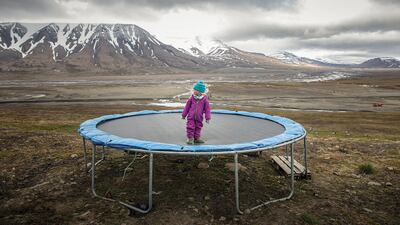
Michael Snyder's 'The Family at the End of the World' was shortlisted in the same category. Here, on the edge of the northernmost town in the world, a little girl plays on a trampoline. Saga Bernlow and her family live on the Norwegian archipelago of Svalbard in the Arctic Ocean, where temperatures are rising fast. -
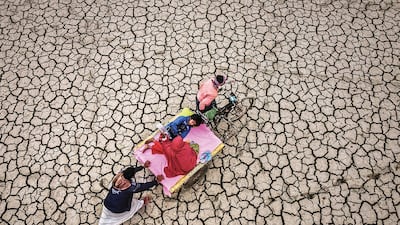
In 'Tears of Drought' by Sharwar Apo, parents take their child to hospital in Rajshahi, Bangladesh, a 16 to 24-kilometre journey across this drought-parched land, the mother holding a saline drip all the way.


The other four category finalists were:
- The Big Fish is an image inspired by Iranian myth.
- The Time of Coronavirus was taken in Wuhan close to where the pandemic began.
- Climate Cost shows a man rescuing belongings from the wreckage of his house in Bangladesh.
- An Elegy for the Death of Hamun shows how Iran’s once-fertile Sistan and Baluchestan region is turning into a desert.

