
A French special forces dog called Leuk, who played a key role in anti-terrorist activity in Mali, was posthumously awarded a British animal charity's top award for gallantry.
The Belgian Malinois saved lives by cornering insurgents during an operation in Mali, creating distractions and dashing through flames under fire.
He served with the K9 division of French Special Forces' Kieffer commando unit after two years of training.
His duties included detecting explosives and neutralising attackers without killing them.
On Friday, he received the posthumous People's Dispensary for Sick Animals Dickin Medal for his bravery during an operation in April 2019, when two armed insurgents were positioned in thick vegetation near troops. The medal is recognised worldwide as the animals’ Victoria Cross.
-

A French special forces dog called Leuk has been awarded the PDSA Dickin Medal after he saved lives by cornering insurgents during an anti-terrorist operation in Mali. AFP -
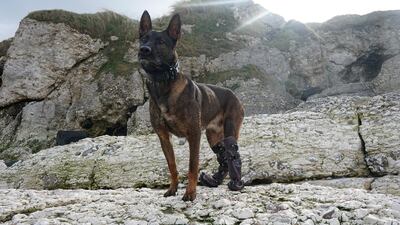
Kuno, a retired military working dog, who suffered life-changing injuries while supporting British Forces fighting Al Qaeda, was awarded the Dicken Medal in November 2020. Courtesy PDSA -
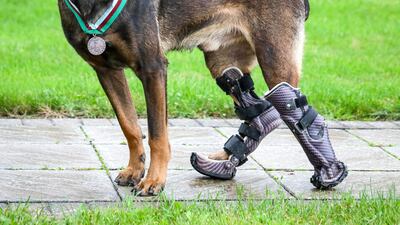
Pinned down by grenade and machine-gun fire from an insurgent, the assault force was unable to move without taking casualties. Without hesitation, Kuno charged through a hail of gunfire to tackle the gunman, breaking the deadlock and changing the course of the attack, allowing the mission to be completed successfully. Courtesy PDSA -

The PDSA Dickin Medal was introduced by Maria Dickin in 1943. Dicken is seen here presenting homing pigeon Winkie with the Dicken Medal in 1944. Winkie delivered a message that contributed to the rescue of a ditched aircrew in 1942. -

Actress Nancy Price giving a speech to the assembled crowd, with a pigeon who received the Dickin Medal, at the dedication of a memorial to the birds who died in active service during the war, London, 1946. Getty Images -

A pigeon named Mercury is awarded the Dickin Medal in 1946. Mercury completed a 480 mile flight from Northern Denmark. Getty Images -

Judy the English Pointer receives a Dickin Medal in 1946. Formerly a ship's dog on board HMS Gnat and HMS Grasshopper, Judy helped save the lives of servicemen after the Grasshopper was sunk. She then spent three and a half years in Japanese prisoner-of-war camps, narrowly escaping death many times. Getty Images -

A Newfoundland named Gander was another Dickin Medal winner. Gander received the medal for his gallant exploits at the battle of Lye Mun, Hong Kong in 1941. The brave Newfoundland was killed by a grenade which it had chased, picked up and carried back towards the Japanese, saving the lives of dozens of Canadian soldiers. Getty Images -

Simon, the ships cat of HMS Amethyst and winner of the Dickin Medal in 1949, received the award for catching rats and protecting food supplies during the time the ship was at war. Getty Images -

Buster helped save the lives of troops and civilians in southern Iraq when he located a hidden cache of arms, explosives and bomb-making equipment. He was awarded the medal in 2003. Getty Images -

Mali, a Belgian Malinois, wearing his Dickin Medal in 2017. Mali took part in an 8 hour assault on Taliban positions in Afghanistan, despite being injured by grenade explosions three times. Getty Images


"Leuk was a very impressive dog ... his skills were just exceptional and we suffer his loss a lot," the troops' commanding officer, named only as Nicolas, said in a PDSA video.
"Leuk ran through flames as the enemy continued to shoot at him and his team," the veterinary charity said.
"He attacked the enemy relentlessly, allowing the unit to successfully neutralise them."
Later in the mission he created a diversion by attacking an insurgent allowing the commandos to neutralise four more.
Then while searching for explosives, he intercepted another armed insurgent.
"Not only did he go in but he engaged the enemy in combat for over five minutes," his handler, named only as Forest, said in video footage with his face concealed.
"Thanks to that, I can talk to you today."
The five-year-old dog, nicknamed Leuk la Chance – Lucky Leuk – died in a subsequent operation in May 2019 when he was killed by an armed insurgent.
He was repatriated with his body covered by the French flag and was received with a guard of honour, like any human casualty of war.
The French unit plans to unveil a memorial on May 2, the second anniversary of his death, in memory of all dogs killed in combat.
The PDSA Dickin Medal has been presented since the Second World War to animals that show exceptional courage and devotion while serving in war and is the highest award of its kind.

It was first awarded in 1943 by the PDSA's founder Maria Dickin. Recipients include dogs, pigeons, horses and a cat. In November, the award was given to a retired military working dog called Kuno who lost his back legs after suffering gunshot wounds while tackling insurgents.
Mali has since 2012 struggled to contain an Islamist insurgency.
France, the former colonial power, intervened in 2013 and now has about 5,000 soldiers deployed across the semi-arid Sahel region.
Leuk is the first French military working dog to receive the medal, which is inscribed "For Gallantry" and "We Also Serve".
A French police dog killed in a security services raid after the 2015 Paris attacks previously won the award. Diesel's death led to the hashtag #JeSuisChien (I Am A Dog) trending on Twitter.
More on the Dickin Medal
Mali the dog wins Dickin prize for animal gallantry
Hero dog Kuno awarded animal world’s Victoria Cross for saving comrades in Al Qaeda firefight

