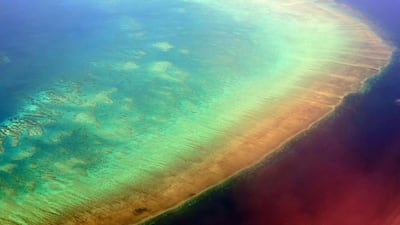
Australia's Great Barrier Reef suffered its most widespread coral bleaching on record, scientists said on April 7, 2020 in a dire warning about the threat posed by climate change to the world's largest living organism. AFP
Australia's Great Barrier Reef suffered its most widespread coral bleaching on record, scientists said on April 7, 2020 in a dire warning about the threat posed by climate change to the world's larges

Great Barrier Reef: coral bleaching again sweeping Australian site


  • English
  • Arabic

An aerial survey of the Great Barrier Reef shows coral bleaching is sweeping across the area off the east of Australia for the third time in five years.

Bleaching has struck all three regions of the world's largest coral reef system and is more widespread than ever, scientists from James Cook University in Queensland said on Tuesday.

The air surveys of 1,036 reefs in the past two weeks found bleached coral in the northern, central and southern areas, James Cook University's Prof Terry Hughes said.

“As summers grow hotter and hotter, we no longer need an El Nino event to trigger mass bleaching at the scale of the Great Barrier Reef,” Prof Hughes said. “Of the five events we have seen so far, only 1998 and 2016 occurred during El Nino conditions.”

El Nino is a climate pattern that starts with a band of warm ocean water in the central and east-central Pacific around the equator and affects global weather.

The Great Barrier Reef is made up of 2,900 separate reefs and 900 islands. It is unable to recover because there is not enough time between bleaching events.

  • This undated handout photo received on April 6, 2020 from the ARC Centre of Excellence for Coral Reef Studies at James Cook University, shows an aerial survey of coral bleaching on the Great Barrier Reef. AFP
    This undated handout photo received on April 6, 2020 from the ARC Centre of Excellence for Coral Reef Studies at James Cook University, shows an aerial survey of coral bleaching on the Great Barrier Reef. AFP
  • This undated handout photo received on April 6, 2020 from the ARC Centre of Excellence for Coral Reef Studies at James Cook University, shows coral bleaching on the Great Barrier Reef. AFP
    This undated handout photo received on April 6, 2020 from the ARC Centre of Excellence for Coral Reef Studies at James Cook University, shows coral bleaching on the Great Barrier Reef. AFP
  • This undated handout photo received on April 6, 2020 from the ARC Centre of Excellence for Coral Reef Studies at James Cook University, shows an aerial survey of coral bleaching on the Great Barrier Reef. AFP
    This undated handout photo received on April 6, 2020 from the ARC Centre of Excellence for Coral Reef Studies at James Cook University, shows an aerial survey of coral bleaching on the Great Barrier Reef. AFP
  • This undated handout photo received on April 6, 2020 from the ARC Centre of Excellence for Coral Reef Studies at James Cook University, shows an aerial survey of coral bleaching on the Great Barrier Reef. AFP
    This undated handout photo received on April 6, 2020 from the ARC Centre of Excellence for Coral Reef Studies at James Cook University, shows an aerial survey of coral bleaching on the Great Barrier Reef. AFP
  • This undated handout photo received on April 6, 2020 from the ARC Centre of Excellence for Coral Reef Studies at James Cook University, shows coral bleaching on the Great Barrier Reef. AFP
    This undated handout photo received on April 6, 2020 from the ARC Centre of Excellence for Coral Reef Studies at James Cook University, shows coral bleaching on the Great Barrier Reef. AFP
  • This undated handout photo received on April 6, 2020 from the ARC Centre of Excellence for Coral Reef Studies at James Cook University, shows coral bleaching on the Great Barrier Reef. AFP
    This undated handout photo received on April 6, 2020 from the ARC Centre of Excellence for Coral Reef Studies at James Cook University, shows coral bleaching on the Great Barrier Reef. AFP
  • This undated handout photo received on April 6, 2020 from the ARC Centre of Excellence for Coral Reef Studies at James Cook University, shows professor Terry Hughes conducting an aerial survey of coral bleaching on the Great Barrier Reef. AFP
    This undated handout photo received on April 6, 2020 from the ARC Centre of Excellence for Coral Reef Studies at James Cook University, shows professor Terry Hughes conducting an aerial survey of coral bleaching on the Great Barrier Reef. AFP
  • Aerial photo in September 2017 of a portion of the Great Barrier Reef off the coast of Cairns, Queensland, Australia. In 2016, bleaching of coral on the Great Barrier Reef killed between 29 and 50 percent of the reef's coral. Getty Images
    Aerial photo in September 2017 of a portion of the Great Barrier Reef off the coast of Cairns, Queensland, Australia. In 2016, bleaching of coral on the Great Barrier Reef killed between 29 and 50 percent of the reef's coral. Getty Images
  • In this Nov. 25, 2016, photo, fish swim along the edges of a coral reef off Great Keppel Island in Australia. The government agency that manages Australia's Great Barrier Reef on Friday, Aug. 30, 2019, downgraded its outlook for the corals' condition from "poor" to "very poor" due to warming oceans. AP
    In this Nov. 25, 2016, photo, fish swim along the edges of a coral reef off Great Keppel Island in Australia. The government agency that manages Australia's Great Barrier Reef on Friday, Aug. 30, 2019, downgraded its outlook for the corals' condition from "poor" to "very poor" due to warming oceans. AP
  • In this December, 1999, file photo, tourists snorkel around Upolu Cay on the Great Barrier Reef near Cairns off the Australian north east coast. An aerial survey of the Great Barrier Reef shows coral bleaching is sweeping across the area off the east of Australia for the third time in five years. Bleaching has struck all three regions of the world’s largest coral reef system and is more widespread than ever, scientists from James Cook University in Queensland state said Tuesday, April 7, 2020. AP
    In this December, 1999, file photo, tourists snorkel around Upolu Cay on the Great Barrier Reef near Cairns off the Australian north east coast. An aerial survey of the Great Barrier Reef shows coral bleaching is sweeping across the area off the east of Australia for the third time in five years. Bleaching has struck all three regions of the world’s largest coral reef system and is more widespread than ever, scientists from James Cook University in Queensland state said Tuesday, April 7, 2020. AP

“We have already seen the first example of back-to-back bleaching — in the consecutive summers of 2016 and 2017,” Mr Hughes said.

The number of reefs spared from bleaching is shrinking as it becomes more widespread.

He said underwater surveys will be carried out later in the year to assess the extent of the damage.

In early March, David Wachenfeld, chief scientist at the Great Barrier Reef Marine Park Authority, said the reef was facing a critical period of heat stress over the coming weeks after the most widespread coral bleaching the natural wonder has ever endured.

The authority, the government agency that manages the coral expanse off northeast Australia, said ocean temperatures over the next month would be crucial to how the reef recovers from heat-induced bleaching.

“The forecasts … indicate that we can expect ongoing levels of thermal stress for at least the next two weeks and maybe three or four weeks,” Mr Wachenfeld said in a weekly update on the reef’s health.

“So this still is a critical time for the reef and it is the weather conditions over the next two to four weeks that will determine the final outcome.”

Ocean temperatures across most of the reef were 0.5°C to 1.5°C above the March average.

In parts of the marine park in the south that avoided the ravages of previous bleachings, ocean temperatures were 2°C to 3°C above average.

The authority had received 250 reports of sightings of bleached coral because of elevated ocean temperatures during an unusually hot February.

The 345,400-square-kilometre coral network has been devastated by four coral bleaching events since 1998. The most deadly were the most recent, in the summers of 2016 and 2017.


The Lost Letters of William Woolf
Helen Cullen, Graydon House 

Ten tax points to be aware of in 2026

1. Domestic VAT refund amendments: request your refund within five years

If a business does not apply for the refund on time, they lose their credit.

2. E-invoicing in the UAE

Businesses should continue preparing for the implementation of e-invoicing in the UAE, with 2026 a preparation and transition period ahead of phased mandatory adoption. 

3. More tax audits

Tax authorities are increasingly using data already available across multiple filings to identify audit risks. 

4. More beneficial VAT and excise tax penalty regime

Tax disputes are expected to become more frequent and more structured, with clearer administrative objection and appeal processes. The UAE has adopted a new penalty regime for VAT and excise disputes, which now mirrors the penalty regime for corporate tax.

5. Greater emphasis on statutory audit

There is a greater need for the accuracy of financial statements. The International Financial Reporting Standards standards need to be strictly adhered to and, as a result, the quality of the audits will need to increase.

6. Further transfer pricing enforcement

Transfer pricing enforcement, which refers to the practice of establishing prices for internal transactions between related entities, is expected to broaden in scope. The UAE will shortly open the possibility to negotiate advance pricing agreements, or essentially rulings for transfer pricing purposes. 

7. Limited time periods for audits

Recent amendments also introduce a default five-year limitation period for tax audits and assessments, subject to specific statutory exceptions. While the standard audit and assessment period is five years, this may be extended to up to 15 years in cases involving fraud or tax evasion. 

8. Pillar 2 implementation 

Many multinational groups will begin to feel the practical effect of the Domestic Minimum Top-Up Tax (DMTT), the UAE's implementation of the OECD’s global minimum tax under Pillar 2. While the rules apply for financial years starting on or after January 1, 2025, it is 2026 that marks the transition to an operational phase.

9. Reduced compliance obligations for imported goods and services

Businesses that apply the reverse-charge mechanism for VAT purposes in the UAE may benefit from reduced compliance obligations. 

10. Substance and CbC reporting focus

Tax authorities are expected to continue strengthening the enforcement of economic substance and Country-by-Country (CbC) reporting frameworks. In the UAE, these regimes are increasingly being used as risk-assessment tools, providing tax authorities with a comprehensive view of multinational groups’ global footprints and enabling them to assess whether profits are aligned with real economic activity. 

Contributed by Thomas Vanhee and Hend Rashwan, Aurifer

Our legal consultant

Name: Hassan Mohsen Elhais

Position: legal consultant with Al Rowaad Advocates and Legal Consultants

Our legal advisor

Ahmad El Sayed is Senior Associate at Charles Russell Speechlys, a law firm headquartered in London with offices in the UK, Europe, the Middle East and Hong Kong.

Experience: Commercial litigator who has assisted clients with overseas judgments before UAE courts. His specialties are cases related to banking, real estate, shareholder disputes, company liquidations and criminal matters as well as employment related litigation. 

Education: Sagesse University, Beirut, Lebanon, in 2005.

Biog:

Age: 34

Favourite superhero: Batman

Favourite sport: anything extreme

Favourite person: Muhammad Ali 

Guardians%20of%20the%20Galaxy%20Vol%203
%3Cp%3E%3Cstrong%3EDirector%3A%20%3C%2Fstrong%3EJames%20Gunn%3C%2Fp%3E%0A%3Cp%3E%3Cstrong%3EStars%3A%3C%2Fstrong%3E%20Chris%20Pratt%2C%20Zoe%20Saldana%2C%20Dave%20Bautista%2C%20Vin%20Diesel%2C%20Bradley%20Cooper%3C%2Fp%3E%0A%3Cp%3E%3Cstrong%3ERating%3A%3C%2Fstrong%3E%204%2F5%3C%2Fp%3E%0A
FINAL LEADERBOARD

1. Jordan Spieth (USA) 65 69 65 69 - 12-under-par
2. Matt Kuchar (USA) 65 71 66 69 - 9-under
3. Li Haotong (CHN) 69 73 69 63 - 6-under
T4. Rory McIlroy (NIR) 71 68 69 67 - 5-under
T4. Rafael Cabrera-Bello (ESP) 67 73 67 68 - 5-under
T6. Marc Leishman (AUS) 69 76 66 65 - 4-under
T6. Matthew Southgate (ENG) 72 72 67 65 - 4-under
T6. Brooks Koepka (USA) 65 72 68 71 - 4-under
T6. Branden Grace (RSA) 70 74 62 70 - 4-under
T6. Alexander Noren (SWE)  68 72 69 67 - 4-under

THE SPECS

2020 Toyota Corolla Hybrid LE

Engine: 1.8 litre combined with 16-volt electric motors

Transmission: Automatic with manual shifting mode

Power: 121hp

Torque: 142Nm

Price: Dh95,900

Florence and the Machine – High as Hope
Three stars

Company profile

Name: Steppi

Founders: Joe Franklin and Milos Savic

Launched: February 2020

Size: 10,000 users by the end of July and a goal of 200,000 users by the end of the year

Employees: Five

Based: Jumeirah Lakes Towers, Dubai

Financing stage: Two seed rounds – the first sourced from angel investors and the founders' personal savings

Second round raised Dh720,000 from silent investors in June this year

Volvo ES90 Specs

Engine: Electric single motor (96kW), twin motor (106kW) and twin motor performance (106kW)

Power: 333hp, 449hp, 680hp

Torque: 480Nm, 670Nm, 870Nm

On sale: Later in 2025 or early 2026, depending on region

Price: Exact regional pricing TBA

COMPANY PROFILE

Name: Lamsa

Founder: Badr Ward

Launched: 2014

Employees: 60

Based: Abu Dhabi

Sector: EdTech

Funding to date: $15 million

Know before you go
  • Jebel Akhdar is a two-hour drive from Muscat airport or a six-hour drive from Dubai. It’s impossible to visit by car unless you have a 4x4. Phone ahead to the hotel to arrange a transfer.
  • If you’re driving, make sure your insurance covers Oman.
  • By air: Budget airlines Air Arabia, Flydubai and SalamAir offer direct routes to Muscat from the UAE.
  • Tourists from the Emirates (UAE nationals not included) must apply for an Omani visa online before arrival at evisa.rop.gov.om. The process typically takes several days.
  • Flash floods are probable due to the terrain and a lack of drainage. Always check the weather before venturing into any canyons or other remote areas and identify a plan of escape that includes high ground, shelter and parking where your car won’t be overtaken by sudden downpours.


Anxiety and work stress major factors

Anxiety, work stress and social isolation are all factors in the recogised rise in mental health problems.

A study UAE Ministry of Health researchers published in the summer also cited struggles with weight and illnesses as major contributors.

Its authors analysed a dozen separate UAE studies between 2007 and 2017. Prevalence was often higher in university students, women and in people on low incomes.

One showed 28 per cent of female students at a Dubai university reported symptoms linked to depression. Another in Al Ain found 22.2 per cent of students had depressive symptoms - five times the global average.

It said the country has made strides to address mental health problems but said: “Our review highlights the overall prevalence of depressive symptoms and depression, which may long have been overlooked."

Prof Samir Al Adawi, of the department of behavioural medicine at Sultan Qaboos University in Oman, who was not involved in the study but is a recognised expert in the Gulf, said how mental health is discussed varies significantly between cultures and nationalities.

“The problem we have in the Gulf is the cross-cultural differences and how people articulate emotional distress," said Prof Al Adawi. 

“Someone will say that I have physical complaints rather than emotional complaints. This is the major problem with any discussion around depression."

Daniel Bardsley

Scores in brief:

Boost Defenders 205-5 in 20 overs
(Colin Ingram 84 not out, Cameron Delport 36, William Somerville 2-28)
bt Auckland Aces 170 for 5 in 20 overs
(Rob O’Donnell 67 not out, Kyle Abbott 3-21).

Chelsea 2 Burnley 3
Chelsea
 Morata (69'), Luiz (88')
Burnley Vokes (24', 43'), Ward (39')
Red cards Cahill, Fabregas (Chelsea)