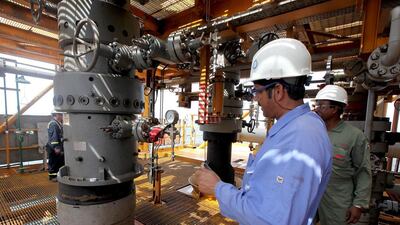
A circular released by Oman's Ministry of Finance and quoted by the official Oman News Agency (ONA) says the government will seek to provide Omanis with more job opportunities in state-owned organisations. The report did not give a time frame for the plan.
Official statistics show that about about 50,000 expatriates are employed by government organisations. More than half of them work in Oman’s oil and gas sectors, which have been hit hard by falling prices. Oman is currently selling its oil at less than $20 per barrel compared with $118 per barrel in 2014. The economy has also been affected by the lockdown imposed to contain its coronavirus outbreak, with 2,483 confirmed cases as of Saturday.
Expatriates make up 48 per cent of Oman’s 4.6 million population but most of them work in the private sector, according to official statistics.
With businesses struggling because of the coronavirus, the government last month barred companies in the private sector businesses from laying off Omanis.
Hashil Al-Saidi, a manpower analyst, said the coronavirus outbreak had "put the government in panic mode about jobs for nationals. But it needs to think carefully how to replace expatriates, especially in the critical sectors of oil and gas that form the backbone of our economy."

Company profile
Name: Tratok Portal
Founded: 2017
Based: UAE
Sector: Travel & tourism
Size: 36 employees
Funding: Privately funded
Will the pound fall to parity with the dollar?
The idea of pound parity now seems less far-fetched as the risk grows that Britain may split away from the European Union without a deal.
Rupert Harrison, a fund manager at BlackRock, sees the risk of it falling to trade level with the dollar on a no-deal Brexit. The view echoes Morgan Stanley’s recent forecast that the currency can plunge toward $1 (Dh3.67) on such an outcome. That isn’t the majority view yet – a Bloomberg survey this month estimated the pound will slide to $1.10 should the UK exit the bloc without an agreement.
New Prime Minister Boris Johnson has repeatedly said that Britain will leave the EU on the October 31 deadline with or without an agreement, fuelling concern the nation is headed for a disorderly departure and fanning pessimism toward the pound. Sterling has fallen more than 7 per cent in the past three months, the worst performance among major developed-market currencies.
“The pound is at a much lower level now but I still think a no-deal exit would lead to significant volatility and we could be testing parity on a really bad outcome,” said Mr Harrison, who manages more than $10 billion in assets at BlackRock. “We will see this game of chicken continue through August and that’s likely negative for sterling,” he said about the deadlocked Brexit talks.
The pound fell 0.8 per cent to $1.2033 on Friday, its weakest closing level since the 1980s, after a report on the second quarter showed the UK economy shrank for the first time in six years. The data means it is likely the Bank of England will cut interest rates, according to Mizuho Bank.
The BOE said in November that the currency could fall even below $1 in an analysis on possible worst-case Brexit scenarios. Options-based calculations showed around a 6.4 per cent chance of pound-dollar parity in the next one year, markedly higher than 0.2 per cent in early March when prospects of a no-deal outcome were seemingly off the table.
Bloomberg
Brief scores:
Juventus 3
Dybala 6', Bonucci 17', Ronaldo 63'
Frosinone 0
WHAT IS A BLACK HOLE?
1. Black holes are objects whose gravity is so strong not even light can escape their pull
2. They can be created when massive stars collapse under their own weight
3. Large black holes can also be formed when smaller ones collide and merge
4. The biggest black holes lurk at the centre of many galaxies, including our own
5. Astronomers believe that when the universe was very young, black holes affected how galaxies formed
More from Rashmee Roshan Lall
PROFILE OF STARZPLAY
Date started: 2014
Founders: Maaz Sheikh, Danny Bates
Based: Dubai, UAE
Sector: Entertainment/Streaming Video On Demand
Number of employees: 125
Investors/Investment amount: $125 million. Major investors include Starz/Lionsgate, State Street, SEQ and Delta Partners
RACE CARD
6.30pm Maiden (TB) Dh82.500 (Dirt) 1,400m
7.05pm Handicap (TB) Dh87,500 (D) 1,400m
7.40pm Handicap (TB) Dh92,500 (Turf) 2,410m
8.15pm Handicap (TB) Dh105,000 (D) 1,900m
8.50pm UAE 2000 Guineas Trial (TB) Conditions Dh183,650 (D) 1,600m
9.25pm Dubai Trophy (TB) Conditions Dh183,650 (T) 1,200m
10pm Handicap (TB) Dh102,500 (T) 1,400m
Key figures in the life of the fort
Sheikh Dhiyab bin Isa (ruled 1761-1793) Built Qasr Al Hosn as a watchtower to guard over the only freshwater well on Abu Dhabi island.
Sheikh Shakhbut bin Dhiyab (ruled 1793-1816) Expanded the tower into a small fort and transferred his ruling place of residence from Liwa Oasis to the fort on the island.
Sheikh Tahnoon bin Shakhbut (ruled 1818-1833) Expanded Qasr Al Hosn further as Abu Dhabi grew from a small village of palm huts to a town of more than 5,000 inhabitants.
Sheikh Khalifa bin Shakhbut (ruled 1833-1845) Repaired and fortified the fort.
Sheikh Saeed bin Tahnoon (ruled 1845-1855) Turned Qasr Al Hosn into a strong two-storied structure.
Sheikh Zayed bin Khalifa (ruled 1855-1909) Expanded Qasr Al Hosn further to reflect the emirate's increasing prominence.
Sheikh Shakhbut bin Sultan (ruled 1928-1966) Renovated and enlarged Qasr Al Hosn, adding a decorative arch and two new villas.
Sheikh Zayed bin Sultan (ruled 1966-2004) Moved the royal residence to Al Manhal palace and kept his diwan at Qasr Al Hosn.
Sources: Jayanti Maitra, www.adach.ae
