

The Iraqi government’s decision this month to propose a new National Day has drawn lukewarm responses in a nation grappling with a worsening economic, health and political situation.
National Day is a contentious issue in post-Saddam Iraq. For decades it was celebrated on July 17, marking the day the Baath party came to power in 1968, but after the US-led invasion overthrew the former dictator, it was abolished entirely.
Now, Prime Minister Mustafa Al Kadhimi wants to select a new date to bring it back and restore some of the country’s shattered national pride in the process.
Last Tuesday, the Iraqi Cabinet finally agreed on October 3, the day Iraq gained independence from Britain in 1932 and became the 57th member of the League of Nations.
However, many ordinary Iraqis are more concerned with the pressing social and economic challenges facing the country today than celebrating the successes of the past.
“Even if I read about the government decision, I would forget it because it’s not important to me at least at this period of time,” Dr Al Zahraa Hussam, a medical school graduate from the southern city of Basra, says.
-
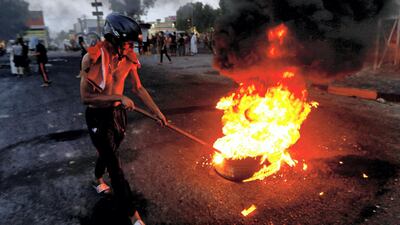
An Iraqi demonstrator burns tyres to block the road during a protest over poor public services in Najaf, Iraq. Reuters -
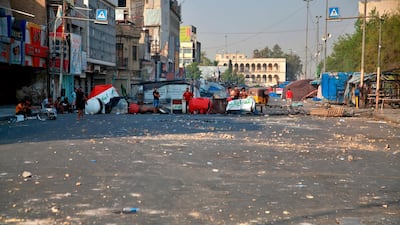
Anti-government protesters gather by barriers near Tahrir square, Baghdad on Monday. AP -
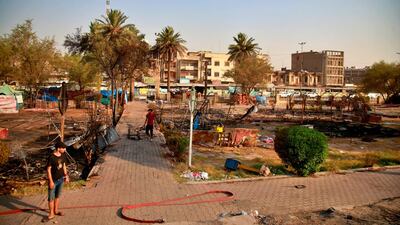
Protesters inspect burned tents near Tahrir Square, Baghdad. AP -

Iraqi demonstrators gesture during a protest over poor public services, in Najaf, Iraq. Reuters -
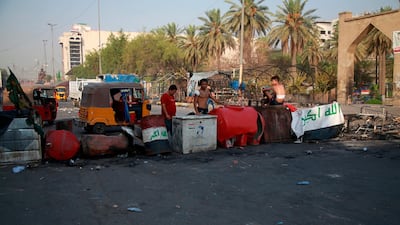
Fresh violence erupted between demonstrators and Iraqi security forces in central Baghdad on Monday, following months of quiet in the wake of the coronavirus pandemic. AP -
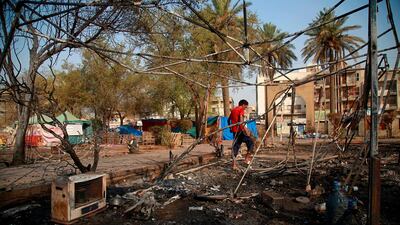
A protester inspects burned tents near Tahrir Square, Baghdad, Iraq. AP -
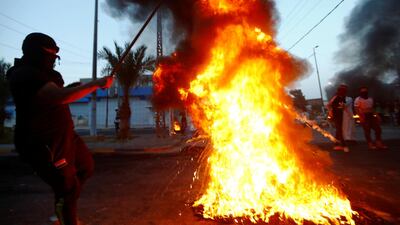
An Iraqi demonstrator burns tyres to block the road during a protest over poor public services in Najaf, Iraq. Reuters -
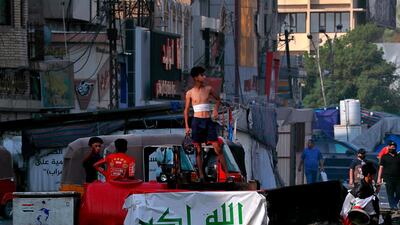
Fresh violence erupted between demonstrators and Iraqi security forces in central Baghdad on Monday. AP -
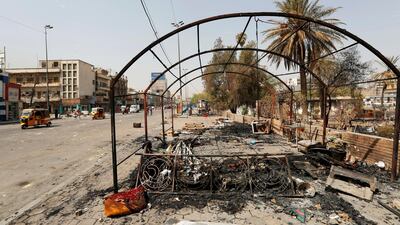
Two protesters died during the demonstrations. Reuters -
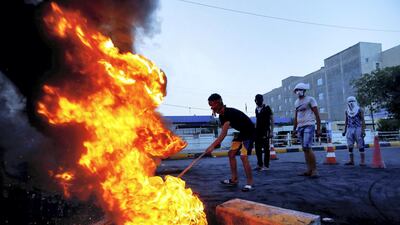
Iraqi demonstrators burn tyres to block the road during a protest over poor public services in the holy city of Najaf. Reuters


Since widespread protests broke out in October last year, life in Iraq has become ever more turbulent.
Protests in central and southern cities across the country have seen disgruntled youths rise up against a political elite that has been in place since the 2003 toppling of Saddam Hussein’s regime. Thousands have filled the streets daily, demanding jobs, better services, an end to endemic corruption and an overhaul of the political system.
The protests forced the government to resign and, after months of political wrangling, an interim government took over. This government’s main mission now is to prepare for an early election, with June 2021 suggested as a possible date.
In the meantime, Mr Al Kadhimi wants to strengthen Iraq’s national identity, torn apart by the division and sectarianism that has come to define Iraqi society. Disagreement over the date has highlighted this, with political parties each suggesting a day that advances their political and religious ideologies.
Other Iraqis say a new National Day is simply not a priority. "We have a lot of problems now that the government needs to focus on other than the National Day issue,” Ms Hussam says.
Alongside the unstable political situation, a severe economic crisis has hit the country’s oil-dependent economy due to the drop in oil prices. And with confirmed cases of coronavirus hitting a new high, the country's Health Ministry has warned that medical institutions may “lose control in the coming days”.
Ms Hussam is among thousands of recent medicine graduates who have been denied government jobs due to lack of funding. On Sunday, she travelled from her hometown of Basra to Baghdad to join hundreds of fellow graduates in a protest to demand the same jobs that have been handed to previous generations working in Iraq’s bloated public sector.
“As a graduate, I’m looking for a solution for the problem of my employment, and as a resident of Basra, I want better services,” she says. “We are not living a comfortable life. People are infected with coronavirus, others unemployed and poverty is hitting new records."
But Mr Al Kadhimi's government is pressing ahead with plans to introduce the new public holiday, telling The National in a recent interview that he is tackling sectarianism while promoting patriotism and nationalism as part of his reform programme.
A draft law is yet to be prepared and approved by the Cabinet before the final parliamentary endorsement, a process that could take weeks or months, or see the bill shelved.
Sameaa Mohammed Al Ghalab, who chairs the parliament’s culture, tourism and archaeology committee, says they will seek clarification from the Culture Minister on the justification for selecting October 3 as the new date.
"There are different points of view regarding this issue inside parliament," Ms Al Ghalab told The National. "There will be discussions in the coming days in order to reach results that are accepted by all," she added.
Iraqis are divided on the issue. Blogger Saleh Al Hamadani hails the decision as “proper for a National Day that will be celebrated by all Iraqis” and believes that “it will not be disputed” by anyone.
But for Ali Al Nashmi, a professor of history at Al Mustansiriyah University in Baghdad, choosing that date “is a shame in the history of patriotism in Iraq because it was a black and ominous day”.
He suggests considering the 1920 Revolution against the British occupiers that instituted a national rule in the country.
The Prime Minister at the time, Nuri Al Said, agreed with Britain that membership in the League of Nations would bring into effect a 1930 treaty granting Britain unlimited rights to station and move military forces in Iraq – as well as full control of its oil resources.
“The 1920 Revolution was a national one in which all Iraqis took part,” Mr Al Nashmi says. “Which event is most patriotic, a revolution or enforcing an unfair treaty?”
Hadi Jalo Marie, chairman of the Political Decision Centre think tank in Baghdad sees October 3 as a compromise.
“It sounds like the government believes that such a date will not anger either Sunnis or Shiites as it is linked to a state led by Sunnis and a Hashemite King accepted by Shiites,” Mr Marie said.
“The government wants to send a positive message to the people with the symbolism of this date during the current situation,” he adds.

