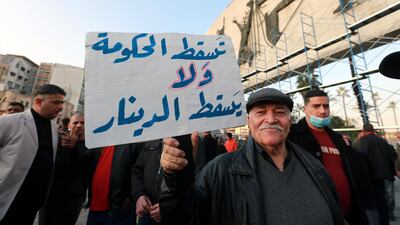
Iraq's parliament called an emergency session on Tuesday to discuss the latest implications of the currency devaluation as protests against the decision broke out across the country .
The move was intended to close the gap in the 2021 budget inflation after a collapse in global oil prices, which is a major source of the country’s financial resources.
"We are pushing for the session to take place because there is great concern the decision will mean a rise in the price of goods, which will have a huge impact on middle and lower classes," Jaber Al Jaberi, a member of parliament, told The National.
The exchange rate ranged from 1,200 to 1,240 dinars against the dollar before the announcement was made – that rate will soon hit 1,400 dinars.
The parliamentary session, which is expected to take place on Wednesday, will call for debate Prime Minister Mustafa Al Kadhimi, Finance Minister Ali Allawi and Mustafa Al Ghaleb, the governor of the central bank of Iraq.
"We want to discuss reasons for lowering the exchange rate, how the new financial policy will be implemented and failures in the government's performance," according to a statement signed by the MPs and seen by The National said.
“We want to ensure that the government takes direct responsibility for failing to save the economy from collapsing and entering a dark tunnel,” said the statement put forward by
deputy parliament speaker Hassan Al Kaabi and signed by more than 80 members of parliament.
Ala Talabani, an MP, said she was one of the first to push for the request because of her "parliamentary responsibility towards the poor, vulnerable and households of low income".
Angry protesters stormed the streets of Baghdad and other southern cities demanding the government change tack on its decision.
Protesters are furious at the first devaluation in half a decade.
"The government should collapse before the dinar," read a sign held by a young protester in Baghdad.
Iraqi security forces and anti-riot police were stationed over the weekend near central bank headquarters, state banks and other financial offices in Baghdad.
Hundreds of people took to the streets of Kut, a city in the east close to the border with Iran, where businessmen said imports would be hit because they used dollars to buy goods from outside.
Mr Al Galeb said that the central bank agreed to the devaluation on the condition reforms are carried out in the finance ministry.
The draft 2021 budget includes plans for an income tax, lower tariffs on electricity and other ways to try to cut spending, in addition to the devaluation.
Nationwide protests erupted last year against the government's inability to provide adequate public services and employment opportunities.
It resulted in the killing, arrests and forced disappearances of hundreds of people whose families are still waiting for news of their fate.
Since the start of the protest movement, demonstrators say they will not leave the streets until their demands are met. These include the establishment of a new government independent from foreign influence, government institutions that are funded internally and implement just laws, accountability for criminal acts within government and the end of foreign militias in Iraq.

Mercer, the investment consulting arm of US services company Marsh & McLennan, expects its wealth division to at least double its assets under management (AUM) in the Middle East as wealth in the region continues to grow despite economic headwinds, a company official said.
Mercer Wealth, which globally has $160 billion in AUM, plans to boost its AUM in the region to $2-$3bn in the next 2-3 years from the present $1bn, said Yasir AbuShaban, a Dubai-based principal with Mercer Wealth.
“Within the next two to three years, we are looking at reaching $2 to $3 billion as a conservative estimate and we do see an opportunity to do so,” said Mr AbuShaban.
Mercer does not directly make investments, but allocates clients’ money they have discretion to, to professional asset managers. They also provide advice to clients.
“We have buying power. We can negotiate on their (client’s) behalf with asset managers to provide them lower fees than they otherwise would have to get on their own,” he added.
Mercer Wealth’s clients include sovereign wealth funds, family offices, and insurance companies among others.
From its office in Dubai, Mercer also looks after Africa, India and Turkey, where they also see opportunity for growth.
Wealth creation in Middle East and Africa (MEA) grew 8.5 per cent to $8.1 trillion last year from $7.5tn in 2015, higher than last year’s global average of 6 per cent and the second-highest growth in a region after Asia-Pacific which grew 9.9 per cent, according to consultancy Boston Consulting Group (BCG). In the region, where wealth grew just 1.9 per cent in 2015 compared with 2014, a pickup in oil prices has helped in wealth generation.
BCG is forecasting MEA wealth will rise to $12tn by 2021, growing at an annual average of 8 per cent.
Drivers of wealth generation in the region will be split evenly between new wealth creation and growth of performance of existing assets, according to BCG.
Another general trend in the region is clients’ looking for a comprehensive approach to investing, according to Mr AbuShaban.
“Institutional investors or some of the families are seeing a slowdown in the available capital they have to invest and in that sense they are looking at optimizing the way they manage their portfolios and making sure they are not investing haphazardly and different parts of their investment are working together,” said Mr AbuShaban.
Some clients also have a higher appetite for risk, given the low interest-rate environment that does not provide enough yield for some institutional investors. These clients are keen to invest in illiquid assets, such as private equity and infrastructure.
“What we have seen is a desire for higher returns in what has been a low-return environment specifically in various fixed income or bonds,” he said.
“In this environment, we have seen a de facto increase in the risk that clients are taking in things like illiquid investments, private equity investments, infrastructure and private debt, those kind of investments were higher illiquidity results in incrementally higher returns.”
The Abu Dhabi Investment Authority, one of the largest sovereign wealth funds, said in its 2016 report that has gradually increased its exposure in direct private equity and private credit transactions, mainly in Asian markets and especially in China and India. The authority’s private equity department focused on structured equities owing to “their defensive characteristics.”
West Indies v India - Third ODI
India 251-4 (50 overs)
Dhoni (78*), Rahane (72), Jadhav (40)
Cummins (2-56), Bishoo (1-38)
West Indies 158 (38.1 overs)
Mohammed (40), Powell (30), Hope (24)
Ashwin (3-28), Yadav (3-41), Pandya (2-32)
India won by 93 runs
Company profile
Name: The Concept
Founders: Yadhushan Mahendran, Maria Sobh and Muhammad Rijal
Based: Abu Dhabi
Founded: 2017
Number of employees: 7
Sector: Aviation and space industry
Funding: $250,000
Future plans: Looking to raise $1 million investment to boost expansion and develop new products
SPECS
%3Cp%3E%3Cstrong%3EEngine%3A%3C%2Fstrong%3E%201.5-litre%204-cylinder%3Cbr%3E%3Cstrong%3EPower%3A%3C%2Fstrong%3E%20101hp%3Cbr%3E%3Cstrong%3ETorque%3A%3C%2Fstrong%3E%20135Nm%3Cbr%3E%3Cstrong%3ETransmission%3C%2Fstrong%3E%3A%20Six-speed%20auto%3Cbr%3E%3Cstrong%3EPrice%3A%3C%2Fstrong%3E%20From%20Dh79%2C900%3Cbr%3E%3Cstrong%3EOn%20sale%3A%3C%2Fstrong%3E%20Now%3C%2Fp%3E%0A
QUALIFYING RESULTS
1. Max Verstappen, Netherlands, Red Bull Racing Honda, 1 minute, 35.246 seconds.
2. Valtteri Bottas, Finland, Mercedes, 1:35.271.
3. Lewis Hamilton, Great Britain, Mercedes, 1:35.332.
4. Lando Norris, Great Britain, McLaren Renault, 1:35.497.
5. Alexander Albon, Thailand, Red Bull Racing Honda, 1:35.571.
6. Carlos Sainz Jr, Spain, McLaren Renault, 1:35.815.
7. Daniil Kvyat, Russia, Scuderia Toro Rosso Honda, 1:35.963.
8. Lance Stroll, Canada, Racing Point BWT Mercedes, 1:36.046.
9. Charles Leclerc, Monaco, Ferrari, 1:36.065.
10. Pierre Gasly, France, Scuderia Toro Rosso Honda, 1:36.242.
Eliminated after second session
11. Esteban Ocon, France, Renault, 1:36.359.
12. Daniel Ricciardo, Australia, Renault, 1:36.406.
13. Sebastian Vettel, Germany, Ferrari, 1:36.631.
14. Antonio Giovinazzi, Italy, Alfa Romeo Racing Ferrari, 1:38.248.
Eliminated after first session
15. Antonio Giovinazzi, Italy, Alfa Romeo Racing Ferrari, 1:37.075.
16. Kimi Raikkonen, Finland, Alfa Romeo Racing Ferrari, 1:37.555.
17. Kevin Magnussen, Denmark, Haas Ferrari, 1:37.863.
18. George Russell, Great Britain, Williams Mercedes, 1:38.045.
19. Pietro Fittipaldi, Brazil, Haas Ferrari, 1:38.173.
20. Nicholas Latifi, Canada, Williams Mercedes, 1:38.443.
The five stages of early child’s play
From Dubai-based clinical psychologist Daniella Salazar:
1. Solitary Play: This is where Infants and toddlers start to play on their own without seeming to notice the people around them. This is the beginning of play.
2. Onlooker play: This occurs where the toddler enjoys watching other people play. There doesn’t necessarily need to be any effort to begin play. They are learning how to imitate behaviours from others. This type of play may also appear in children who are more shy and introverted.
3. Parallel Play: This generally starts when children begin playing side-by-side without any interaction. Even though they aren’t physically interacting they are paying attention to each other. This is the beginning of the desire to be with other children.
4. Associative Play: At around age four or five, children become more interested in each other than in toys and begin to interact more. In this stage children start asking questions and talking about the different activities they are engaging in. They realise they have similar goals in play such as building a tower or playing with cars.
5. Social Play: In this stage children are starting to socialise more. They begin to share ideas and follow certain rules in a game. They slowly learn the definition of teamwork. They get to engage in basic social skills and interests begin to lead social interactions.
