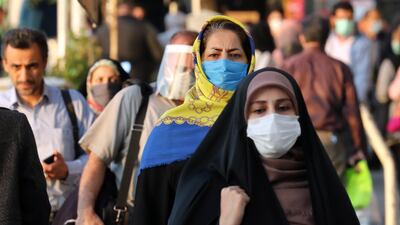
Iran's on Tuesday logged a new record of 5,000 Covid-19 infections in a single day, officials said, as death rates remain high and the country's health minister warned he is unable to stop the pandemic alone.
Health Ministry spokeswoman Sima Lari said the country had registered a record 5,039 new infections in the previous 24 hours, bringing the total number to 539,670.
Iran’s health ministry also reported that 322 people had died from the virus, pushing the death toll over 31,000.
The new infection count on Tuesday eclipsed the previous high of 4,830 last week, shining a light on the nation’s floundering efforts to combat the virus.
Health minister Saeed Namaki made a dramatic appeal for people to follow health guidance measures, saying that without public help, “the pandemic in this country will not get better and we’ll have to collect the bodies", semi-official Isna news agency reported.
“People, be aware. I, as the health minister, cannot fix this epidemic and the situation alone,” he said.
Iran, which emerged early on as a centre of the virus, has seen its worst wave of deaths from the illness in recent weeks. Monday’s death toll shattered its previous single-day record, prompting state news outlets to declare it a “black day".
-
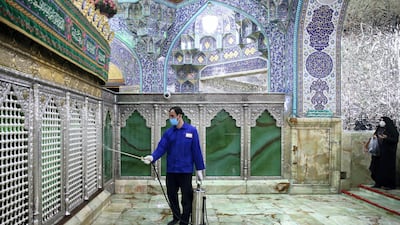
An Iranian sanitary worker disinfects Qom's Masumeh shrine on February 25, 2020 to prevent the spread of the coronavirus. AFP -
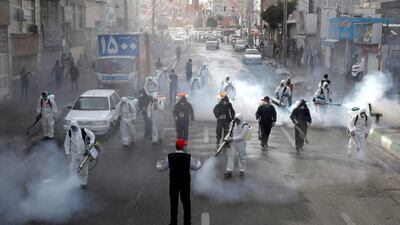
Iranian Firefighters disinfect streets in the capital Tehran in a bid to halt the wild spread of coronavirus on March 13, 2020. AFP -
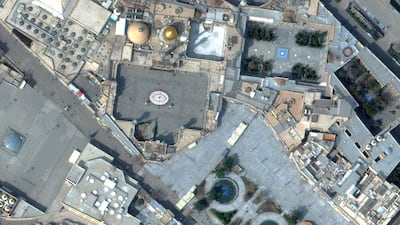
A nearly empty Hazrat Masumeh Shrine in Qom, Iran on March 1, 2020. AFP -
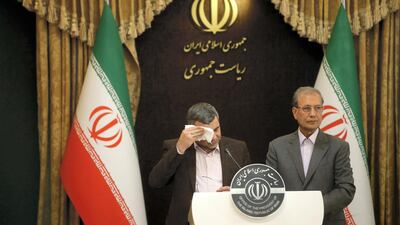
Iranian Deputy Health Minister Iraj Harirchi (left) wipes the sweat off his face, during a press conference with the Islamic republic's government spokesman Ali Rabiei in the capital Tehran on February 24, 2020. AFP -

An image grab of footage obtained from Iranian State TV IRINN on February 25, 2020, shows Iran's deputy health minister Iraj Harirchi speaking in a video apparently shot by himself, regarding being infected with coronavirus. AFP -
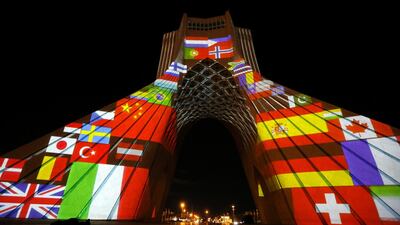
Iran's Azadi (Freedom) Tower is lit up with flags and messages of hope in solidarity with all the countries affected by the coronavirus pandemic, in Tehran on March 31, 2020. AFP -
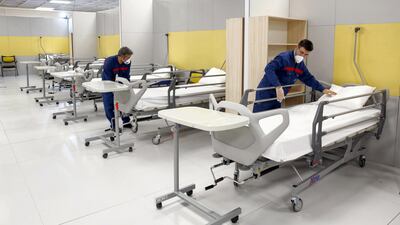
Iranian workers set up a makeshift hospital inside the Iran Mall, northwest of Tehran, on March 21, 2020 amid the coronavirus outbreak. - Iran said that 123 more people had died from coronavirus, raising the official death toll to 1,556 in the Islamic republic, one of the world's worst affected countries. AFP -
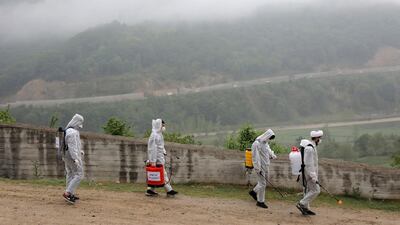
Volunteers wearing protective clothing, take part in disinfecting a village during the coronavirus outbreak, in the outskirts of the city of Ghaemshahr, in north of Iran, on Wednesday, April 29, 2020. AP Photo -
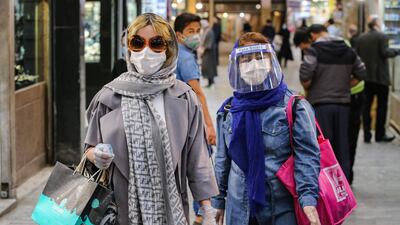
Shoppers clad in protective gear, including face masks and shields and latex gloves, due to the coronavirus pandemic, walk through the Tajrish Bazaar in Iran's capital Tehran on April 25, 2020. AFP -
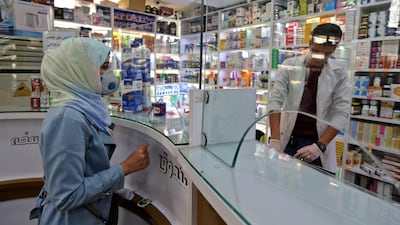
A customer wears a protective masks at a pharmacy in the Iranian capital Tehran on February 24, 2020. AFP -

A Tehran Municipality worker cleans a bus to avoid the spread of Covid-19 on February 26, 2020. AFP -
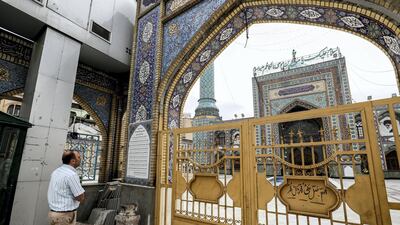
A man stands by the closed gate outside the Imamzadeh Saleh in the Iranian capital Tehran's Shemiran district on April 25, 2020 . AFP -

Labourers unloading medical equipment and coronavirus testing kits provided by the World Health Organisation, from a UAE military transport plane upon their arrival at Mehrabad International Airport in Iran's capital Tehran. AFP


Hospitals in the hard-hit capital of Tehran are overflowing. Last week, health officials announced that the city had run out of intensive care beds for virus patients.
Government spokesman Ali Rabii said that "the spread of the virus is rising in 12 provinces including Tehran, and nine provinces are on alert". He urged co-operation to curb its transmission.
Hamidreza Azizi, deputy head of the Iranian nurses’ organisation, announced on Tuesday that 31,000 nurses have been infected with the coronavirus in the country.
Mr Azizi said 6,000 were sick and staying home from work, and 54 died.
He said the organisation would send more than 7,600 nurses to compensate for dire staff shortages across the country’s hospitals.
Such official tolls are widely considered to understate the true dimensions of the outbreak among medical staff and nationwide.
Iranians packed cafes and restaurants at vacation spots during recent national holidays, and after schools reopened last month.
The government has resisted a total lockdown because it does not want to further weaken an economy already devastated by US sanctions.
The Trump administration reimposed economic sanctions on Iran after withdrawing in 2018 from Tehran’s nuclear accord with world powers.
With the death toll skyrocketing, authorities are now starting to impose more restrictions.
The government closed museums, libraries, beauty salons, schools and universities in Tehran this month, and imposed a mask mandate outdoors.
Police will fine those caught without a mask, but enforcement remains a challenge in the sprawling city of 10 million. Months into the pandemic, fatigue and frustration have set in.
Mr Namaki criticised authorities on Tuesday for failing to implement new antivirus measures, promoted on state-run media but frequently forgotten on Tehran’s bustling streets.
“We asked for fines to be collected from anyone who doesn’t wear a mask but go and find out how many people were fined,” he said. “We said close roads, and yet how many did they close?”

