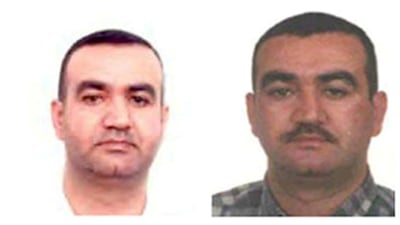
Photos of Salim Ayyash released by the Special Tribunal for Lebanon in 2011. Ayyash is the only person convicted for the 2005 assassination of Lebanese prime minister Rafik Hariri. Special Tribunal for Lebanon / Reuters
Photos of Salim Ayyash released by the Special Tribunal for Lebanon in 2011. Ayyash is the only person convicted for the 2005 assassination of Lebanese prime minister Rafik Hariri. Special Tribunal fo

Hariri assassination: international court sentences Hezbollah operative to life in prison


Aya Iskandarani
  • English
  • Arabic

The Special Tribunal for Lebanon on Friday sentenced Hezbollah operative Salim Ayyash to five counts of life in prison over the assassination of prime minister Rafik Hariri 15 years ago.

Ayyash was tried in his absence and is unlikely to ever serve the prison term. He received the maximum sentence for each of the five counts in the indictment. He can still appeal his sentence.

The tribunal found Ayyash guilty in August of all charges brought against him for the assassination of Hariri, including conspiracy to commit a terrorist act and the attempted intentional homicide of 226 people who were injured during the blast.

“The crimes are so serious as to attract the maximum sentence,” Judge David Re said. “The offences are so serious that very few circumstances could equate to mitigating features that could reduce the appropriate sentence. There are none here.”

Three other Hezbollah operatives were cleared by the tribunal for lack of evidence. All four suspects had been tried in their absence and Ayyash is still on the run as Hezbollah refuses to hand him over to justice.

The international court was set up in 2009 by the UN at the request of the Lebanese government to investigate the killing of prime minister Rafik Hariri. The terror attack destabilised the country and was followed by a string of high-profile targeted killings.

On February 14, 2005 a truck carrying 2,500 to 3,000 kilograms of TNT detonated as Hariri’s convoy passed by on the Beirut corniche, killing him and 21 others. The explosion was so strong it left a crater 11 metres wide and 2 metres deep in the road and was heard miles away.

Ayyash has evaded justice since being indicted in 2011 and Lebanese authorities have been unable to locate him.

“Those shielding Ayyash from justice should surrender him to the tribunal,” Judge Re said. Hezbollah leader Hassan Nasrallah has publicly defended Ayyash and the other suspects at the time, describing them as "honourable" men and said he would not hand them over to justice.

The trial chamber has issued a new arrest warrant for Ayyash, transmitted to authorities in Lebanon and the Netherlands, where the tribunal is located. A red notice will also be issued to Interpol to be sent to authorities worldwide to arrest Ayyash.

Despite the lack of direct evidence, Ayyash is believed to have acted jointly with the Syrian regime to eliminate Hariri, who opposed Syria's control of Lebanon at the time of his killing.

“This political attack was aimed at eliminating a political obstacle or opponent. Although there is no direct evidence it most probably must have involved state actors. The state with the most to gain from Hariri’s elimination most likely was Syria,” Judge Janet Nosworthy said.

The Syrian regime had a heavy military presence in Lebanon and effectively controlled the country’s politics at the time of the assassination.

Hezbollah and Syria deny involvement in the killing, pointing to an Israeli conspiracy instead.

The Tribunal recommended that victims of the terrorist attack should be compensated through the establishment of a dedicated fund managed by the Tribunal and funded by international donors.

“This is achievable," said Judge Re.

The hearing on August 18 was overshadowed by the blast at Beirut port two weeks earlier, which killed more than 200 people and wounded at least 6,500.


The biog

Job: Fitness entrepreneur, body-builder and trainer

Favourite superhero: Batman

Favourite quote: We must become the change we want to see, by Mahatma Gandhi.

Favourite car: Lamborghini

The stats

Ship name: MSC Bellissima

Ship class: Meraviglia Class

Delivery date: February 27, 2019

Gross tonnage: 171,598 GT

Passenger capacity: 5,686

Crew members: 1,536

Number of cabins: 2,217

Length: 315.3 metres

Maximum speed: 22.7 knots (42kph)

Mercer, the investment consulting arm of US services company Marsh & McLennan, expects its wealth division to at least double its assets under management (AUM) in the Middle East as wealth in the region continues to grow despite economic headwinds, a company official said.

Mercer Wealth, which globally has $160 billion in AUM, plans to boost its AUM in the region to $2-$3bn in the next 2-3 years from the present $1bn, said Yasir AbuShaban, a Dubai-based principal with Mercer Wealth.

Within the next two to three years, we are looking at reaching $2 to $3 billion as a conservative estimate and we do see an opportunity to do so,” said Mr AbuShaban.

Mercer does not directly make investments, but allocates clients’ money they have discretion to, to professional asset managers. They also provide advice to clients.

“We have buying power. We can negotiate on their (client’s) behalf with asset managers to provide them lower fees than they otherwise would have to get on their own,” he added.

Mercer Wealth’s clients include sovereign wealth funds, family offices, and insurance companies among others.

From its office in Dubai, Mercer also looks after Africa, India and Turkey, where they also see opportunity for growth.

Wealth creation in Middle East and Africa (MEA) grew 8.5 per cent to $8.1 trillion last year from $7.5tn in 2015, higher than last year’s global average of 6 per cent and the second-highest growth in a region after Asia-Pacific which grew 9.9 per cent, according to consultancy Boston Consulting Group (BCG). In the region, where wealth grew just 1.9 per cent in 2015 compared with 2014, a pickup in oil prices has helped in wealth generation.

BCG is forecasting MEA wealth will rise to $12tn by 2021, growing at an annual average of 8 per cent.

Drivers of wealth generation in the region will be split evenly between new wealth creation and growth of performance of existing assets, according to BCG.

Another general trend in the region is clients’ looking for a comprehensive approach to investing, according to Mr AbuShaban.

“Institutional investors or some of the families are seeing a slowdown in the available capital they have to invest and in that sense they are looking at optimizing the way they manage their portfolios and making sure they are not investing haphazardly and different parts of their investment are working together,” said Mr AbuShaban.

Some clients also have a higher appetite for risk, given the low interest-rate environment that does not provide enough yield for some institutional investors. These clients are keen to invest in illiquid assets, such as private equity and infrastructure.

“What we have seen is a desire for higher returns in what has been a low-return environment specifically in various fixed income or bonds,” he said.

“In this environment, we have seen a de facto increase in the risk that clients are taking in things like illiquid investments, private equity investments, infrastructure and private debt, those kind of investments were higher illiquidity results in incrementally higher returns.”

The Abu Dhabi Investment Authority, one of the largest sovereign wealth funds, said in its 2016 report that has gradually increased its exposure in direct private equity and private credit transactions, mainly in Asian markets and especially in China and India. The authority’s private equity department focused on structured equities owing to “their defensive characteristics.”

RESULTS

1.30pm Handicap (PA) Dh 50,000 (Dirt) 1,400m

Winner AF Almomayaz, Hugo Lebouc (jockey), Ali Rashid Al Raihe (trainer)

2pm Handicap (TB) Dh 84,000 (D) 1,400m

Winner Karaginsky, Tadhg O’Shea, Satish Seemar.

2.30pm Maiden (TB) Dh 60,000 (D) 1,200m

Winner Sadeedd, Ryan Curatolo, Nicholas Bachalard.

3pm Conditions (TB) Dh 100,000 (D) 1,950m

Winner Blue Sovereign, Clement Lecoeuvre, Erwan Charpy.

3.30pm Handicap (TB) Dh 76,000 (D) 1,800m

Winner Tailor’s Row, Royston Ffrench, Salem bin Ghadayer.

4pm Maiden (TB) Dh 60,000 (D) 1,600m

Winner Bladesmith, Tadhg O’Shea, Satish Seemar.

4.30pm Handicap (TB) Dh 68,000 (D) 1,000m

Winner Shanaghai City, Fabrice Veron, Rashed Bouresly.