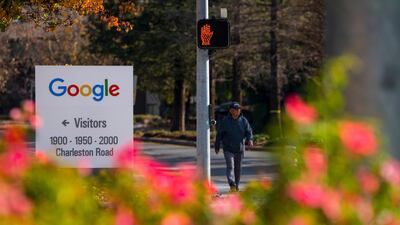
The Google campus in Mountain View, California, US. Bloomberg

'Surveillance capitalism' to 'infocommunism': the big tech battle


  • English
  • Arabic

It has been quite an extraordinary year for big tech. Giants of the technology sector cannily leveraged the expanding economic opportunities thrown up by the pandemic. But now they find themselves in the crosshairs of regulatory authorities in Europe, America, the UK and China. Will 2020 come to be seen as an inflection point, when traffic lights are finally erected on the digital highway, along with speed bumps, mandatory lay-bys and enforced idling zones? Perhaps.

Around the world, unease about so-called “surveillance capitalism” is throwing up common themes on tech regulation. Mostly, these appear to demand accountability and docility from digital companies, which one senior European official recently described as having grown “too big to care”.

Accordingly, regulators have been busy the past month and it has been pretty brutal for tech companies. In mid-December, the European Commission published drafts of two ambitious pieces of legislation that would force big tech companies to take more responsibility for policing content and to refrain from anticompetitive practices. Transgressors would face heavy fines and the threat of being broken up. Amazon, for instance, might have to pay nearly $30 billion.

Britain followed suit on the same day with proposed laws to fine Facebook, Twitter and TikTok up to 10 per cent of global revenue if they fail to remove and limit the spread of illegal content.

A Facebook employee walks by a sign displaying the "like" sign at Facebook's corporate headquarters campus in Menlo Park, California. AFP

The week before Europe and Britain took aim at digital companies, the US Federal Trade Commission accused Facebook of unfair competition and asked a federal court to break it up. And just days ago, prosecutors in 38 US states and territories accused Google of illegally arranging its search results to push out smaller rivals. This was also the month China levied fines on its own tech leaders Alibaba and Tencent over antitrust violations.

The whole point of regulating big tech is to reassert ownership of knowledge

All of this shades a picture – which began to be sketched years ago – of profound governmental mistrust and the alleged malpractice by tech giants. The warning shots were arguably fired back in October, when the US Congress published a lengthy report on how to update competition law and the US Department of Justice subsequently launched a lawsuit against Google over alleged abuses of its monopoly in search advertising. In theory then, Europe’s proposed Digital Services Act (DSA) and Digital Markets Act (DMA), are not starting a new debate. They are simply turning up the volume on a long-running one.

The logos of Google, Apple, Facebook, Amazon and Microsoft displayed on a mobile phone with an EU flag in the background. AFP

Quite so. Consider the reception afforded to Harvard Business School professor emeritus Shoshana Zuboff's 2019 book The Age of Surveillance Capitalism. It explained her premise that tech companies were unilaterally claiming private human experience as raw material for data, which would be computed and "packaged as prediction products". Ms Zuboff's formulation hit a nerve. At the very least, it chimed with the overwrought emotions of people who reported being "swamped with Google and Facebook ads for beds and bedding" right after they purchased a bedroom bundle – a mattress, bed base, pillows and sheets. In the past few years, the netizen has increasingly described the feeling of being hunted down by companies like Facebook and Google that provide free online services. It is not surprising then that governments are paying attention.

A worker cleans a trash receptacle on the Google campus in Mountain View, California, US, December 16. Bloomberg

Europe’s plans will take years of debate before they become law. But as our networked world goes into its third decade and now that more than half the planet’s population is online, it is worth thinking about what the proposed digital rules might mean.

What do regulators and netizens want to achieve by corralling big tech? And what can tech companies do differently to stay in business while staying in touch with the zeitgeist?

These questions have particular resonance during the coronavirus crisis, when educational institutions have been relying on Google services to teach students during lockdown. In the circumstances, a closure – even partial – of the digital highway may not be a good idea.

By all accounts, that is not on the cards anyway. Instead, regulators across the US, UK and EU are agreed on the need for more digital champions – many small, nimble companies – not just a few big beasts in the tech jungle. Europe’s proposed DMA would ban tech companies from preferential treatment of their own products on their platforms and impose a greater obligation for large firms to share data with smaller companies and to ensure interoperability with their own software and hardware.

European Commission vice president Margrethe Vestager, who presides over the bloc's digital policies, has likened the new proposals to the "first-ever traffic light that brought order in the (online) streets". That is an evocative image. In practice, the new order would mean new community habits and new ways of sharing. Search engines such as Google would need to provide their ranking, query, click and view data to rival search engines such as Qwant, a French firm. In a sense, tech regulation would land squarely along the financial sector, in order to curb abusive monopoly behaviour.

In Dave Eggers' 2013 novel The Circle, a giant eponymous California tech company bears a "do no evil" philosophy somewhat like Google in its early phase. But the fictional company's overall creed according to one of Egger's characters is "infocommunism", the belief that no one is entitled to privacy, "secrets are lies (and) and sharing is caring". This subverts the idea of a person's right to control dissemination of their data.

The whole point of regulating big tech is to reassert ownership of knowledge and data and limit licenses for its use.

There is much to be said for the effort.

Rashmee Roshan Lall is a columnist for The National

Who are the Soroptimists?

The first Soroptimists club was founded in Oakland, California in 1921. The name comes from the Latin word soror which means sister, combined with optima, meaning the best.

The organisation said its name is best interpreted as ‘the best for women’.

Since then the group has grown exponentially around the world and is officially affiliated with the United Nations. The organisation also counts Queen Mathilde of Belgium among its ranks.

How%20champions%20are%20made
%3Cp%3E%0D%3Cstrong%3EDiet%3C%2Fstrong%3E%20%0D%3Cbr%3E7am%20-%20Protein%20shake%20with%20oats%20and%20fruits%0D%3Cbr%3E10am%20-%205-6%20egg%20whites%0D%3Cbr%3E1pm%20-%20White%20rice%20or%20chapati%20(Indian%20bread)%20with%20chicken%0D%3Cbr%3E4pm%20-%20Dry%20fruits%20%0D%3Cbr%3E7.30pm%20-%20Pre%20workout%20meal%20%E2%80%93%20grilled%20fish%20or%20chicken%20with%20veggies%20and%20fruits%0D%3Cbr%3E8.30pm%20to%20midnight%20workout%0D%3Cbr%3E12.30am%20%E2%80%93%20Protein%20shake%20%0D%3Cbr%3E%3Cstrong%3ETotal%20intake%3A%3C%2Fstrong%3E%204000-4500%20calories%20%0D%3Cbr%3E%3Cstrong%3ESaidu%E2%80%99s%20weight%3A%3C%2Fstrong%3E%20110%20kg%0D%3Cbr%3E%3Cstrong%3EStats%3A%3C%2Fstrong%3E%20Biceps%2019%20inches.%20Forearms%2018%20inches%3C%2Fp%3E%0A
Getting%20there%20and%20where%20to%20stay
%3Cp%3EFly%20with%20Etihad%20Airways%20from%20Abu%20Dhabi%20to%20New%20York%E2%80%99s%20JFK.%20There's%2011%20flights%20a%20week%20and%20economy%20fares%20start%20at%20around%20Dh5%2C000.%3Cbr%3EStay%20at%20The%20Mark%20Hotel%20on%20the%20city%E2%80%99s%20Upper%20East%20Side.%20Overnight%20stays%20start%20from%20%241395%20per%20night.%3Cbr%3EVisit%20NYC%20Go%2C%20the%20official%20destination%20resource%20for%20New%20York%20City%20for%20all%20the%20latest%20events%2C%20activites%20and%20openings.%3Cbr%3E%3C%2Fp%3E%0A
BULKWHIZ PROFILE

Date started: February 2017

Founders: Amira Rashad (CEO), Yusuf Saber (CTO), Mahmoud Sayedahmed (adviser), Reda Bouraoui (adviser)

Based: Dubai, UAE

Sector: E-commerce 

Size: 50 employees

Funding: approximately $6m

Investors: Beco Capital, Enabling Future and Wain in the UAE; China's MSA Capital; 500 Startups; Faith Capital and Savour Ventures in Kuwait

Villains
Queens of the Stone Age
Matador

The burning issue

The internal combustion engine is facing a watershed moment – major manufacturer Volvo is to stop producing petroleum-powered vehicles by 2021 and countries in Europe, including the UK, have vowed to ban their sale before 2040. The National takes a look at the story of one of the most successful technologies of the last 100 years and how it has impacted life in the UAE. 

Read part four: an affection for classic cars lives on

Read part three: the age of the electric vehicle begins

Read part two: how climate change drove the race for an alternative 

Ten tax points to be aware of in 2026

1. Domestic VAT refund amendments: request your refund within five years

If a business does not apply for the refund on time, they lose their credit.

2. E-invoicing in the UAE

Businesses should continue preparing for the implementation of e-invoicing in the UAE, with 2026 a preparation and transition period ahead of phased mandatory adoption. 

3. More tax audits

Tax authorities are increasingly using data already available across multiple filings to identify audit risks. 

4. More beneficial VAT and excise tax penalty regime

Tax disputes are expected to become more frequent and more structured, with clearer administrative objection and appeal processes. The UAE has adopted a new penalty regime for VAT and excise disputes, which now mirrors the penalty regime for corporate tax.

5. Greater emphasis on statutory audit

There is a greater need for the accuracy of financial statements. The International Financial Reporting Standards standards need to be strictly adhered to and, as a result, the quality of the audits will need to increase.

6. Further transfer pricing enforcement

Transfer pricing enforcement, which refers to the practice of establishing prices for internal transactions between related entities, is expected to broaden in scope. The UAE will shortly open the possibility to negotiate advance pricing agreements, or essentially rulings for transfer pricing purposes. 

7. Limited time periods for audits

Recent amendments also introduce a default five-year limitation period for tax audits and assessments, subject to specific statutory exceptions. While the standard audit and assessment period is five years, this may be extended to up to 15 years in cases involving fraud or tax evasion. 

8. Pillar 2 implementation 

Many multinational groups will begin to feel the practical effect of the Domestic Minimum Top-Up Tax (DMTT), the UAE's implementation of the OECD’s global minimum tax under Pillar 2. While the rules apply for financial years starting on or after January 1, 2025, it is 2026 that marks the transition to an operational phase.

9. Reduced compliance obligations for imported goods and services

Businesses that apply the reverse-charge mechanism for VAT purposes in the UAE may benefit from reduced compliance obligations. 

10. Substance and CbC reporting focus

Tax authorities are expected to continue strengthening the enforcement of economic substance and Country-by-Country (CbC) reporting frameworks. In the UAE, these regimes are increasingly being used as risk-assessment tools, providing tax authorities with a comprehensive view of multinational groups’ global footprints and enabling them to assess whether profits are aligned with real economic activity. 

Contributed by Thomas Vanhee and Hend Rashwan, Aurifer

UK's plans to cut net migration

Under the UK government’s proposals, migrants will have to spend 10 years in the UK before being able to apply for citizenship.

Skilled worker visas will require a university degree, and there will be tighter restrictions on recruitment for jobs with skills shortages.

But what are described as "high-contributing" individuals such as doctors and nurses could be fast-tracked through the system.

Language requirements will be increased for all immigration routes to ensure a higher level of English.

Rules will also be laid out for adult dependants, meaning they will have to demonstrate a basic understanding of the language.

The plans also call for stricter tests for colleges and universities offering places to foreign students and a reduction in the time graduates can remain in the UK after their studies from two years to 18 months.

Global institutions: BlackRock and KKR

US-based BlackRock is the world's largest asset manager, with $5.98 trillion of assets under management as of the end of last year. The New York firm run by Larry Fink provides investment management services to institutional clients and retail investors including governments, sovereign wealth funds, corporations, banks and charitable foundations around the world, through a variety of investment vehicles.

KKR & Co, or Kohlberg Kravis Roberts, is a global private equity and investment firm with around $195 billion of assets as of the end of last year. The New York-based firm, founded by Henry Kravis and George Roberts, invests in multiple alternative asset classes through direct or fund-to-fund investments with a particular focus on infrastructure, technology, healthcare, real estate and energy.


The%20specs
%3Cp%3E%3Cstrong%3EPowertrain%3A%20%3C%2Fstrong%3ESingle%20electric%20motor%0D%3Cbr%3E%3Cstrong%3EPower%3A%20%3C%2Fstrong%3E201hp%0D%3Cbr%3E%3Cstrong%3ETorque%3A%20%3C%2Fstrong%3E310Nm%0D%3Cbr%3E%3Cstrong%3ETransmission%3A%20%3C%2Fstrong%3ESingle-speed%20auto%0D%3Cbr%3E%3Cstrong%3EBattery%3A%20%3C%2Fstrong%3E53kWh%20lithium-ion%20battery%20pack%20(GS%20base%20model)%3B%2070kWh%20battery%20pack%20(GF)%0D%3Cbr%3E%3Cstrong%3ETouring%20range%3A%20%3C%2Fstrong%3E350km%20(GS)%3B%20480km%20(GF)%0D%3Cbr%3E%3Cstrong%3EPrice%3A%20%3C%2Fstrong%3EFrom%20Dh129%2C900%20(GS)%3B%20Dh149%2C000%20(GF)%0D%3Cbr%3E%3Cstrong%3EOn%20sale%3A%3C%2Fstrong%3E%20Now%3C%2Fp%3E%0A

Leap of Faith

Michael J Mazarr

Public Affairs

Dh67
 

The Pope's itinerary

Sunday, February 3, 2019 - Rome to Abu Dhabi
1pm: departure by plane from Rome / Fiumicino to Abu Dhabi
10pm: arrival at Abu Dhabi Presidential Airport


Monday, February 4
12pm: welcome ceremony at the main entrance of the Presidential Palace
12.20pm: visit Abu Dhabi Crown Prince at Presidential Palace
5pm: private meeting with Muslim Council of Elders at Sheikh Zayed Grand Mosque
6.10pm: Inter-religious in the Founder's Memorial


Tuesday, February 5 - Abu Dhabi to Rome
9.15am: private visit to undisclosed cathedral
10.30am: public mass at Zayed Sports City – with a homily by Pope Francis
12.40pm: farewell at Abu Dhabi Presidential Airport
1pm: departure by plane to Rome
5pm: arrival at the Rome / Ciampino International Airport

The%20Super%20Mario%20Bros%20Movie
%3Cp%3E%3Cstrong%3EDirectors%3A%3C%2Fstrong%3E%20Aaron%20Horvath%20and%20Michael%20Jelenic%0D%3Cbr%3E%3Cstrong%3EStars%3A%3C%2Fstrong%3E%20Chris%20Pratt%2C%20Anya%20Taylor-Joy%2C%20Charlie%20Day%2C%20Jack%20Black%2C%20Seth%20Rogen%20and%20Keegan-Michael%20Key%0D%3Cbr%3E%3Cstrong%3ERating%3A%3C%2Fstrong%3E%201%2F5%3C%2Fp%3E%0A
Profile

Company: Justmop.com

Date started: December 2015

Founders: Kerem Kuyucu and Cagatay Ozcan

Sector: Technology and home services

Based: Jumeirah Lake Towers, Dubai

Size: 55 employees and 100,000 cleaning requests a month

Funding:  The company’s investors include Collective Spark, Faith Capital Holding, Oak Capital, VentureFriends, and 500 Startups.
