


Saad Hariri, son of former Lebanese prime minister Rafik Hariri, said he “will not rest until punishment is served” after an international tribunal convicted a Hezbollah member for his father’s 2005 assassination.
After the conviction of Salim Ayyash at the Special Lebanon Tribunal in the Netherlands on Tuesday, Mr Hariri, also a former Lebanese prime minister, said he had accepted the court’s verdict but wished to see justice done.
"Hezbollah is the one that should make sacrifices today," he said.
Ayyash, the lead conspirator in the 2005 assassination, was convicted of all charges against him.
The UN-backed tribunal said it established clear evidence he was a member of the Iran-backed militant group Hezbollah.
His co-accused – Hassan Merhi, Hussein Oneissi and Assad Sabra – were acquitted on all charges. All were tried in their absence.
Before the verdicts were read by Judge David Re, the court knocked down a key pillar of the prosecution’s case, explaining that three suspects could not be sufficiently linked to a fake claim of responsibility after the 2005 lorry bombing.
“The prosecution has therefore not proved its case beyond reasonable doubt [of their] participation in the false claim of responsibility for the attack on Hariri,” Judge Janet Nosworthy said.
Despite Ayyash’s links to the militant group, there is no evidence that the leadership of the Iran-backed militant group Hezbollah and the Syrian government are involved in the assassination, a judge said.

“The trial chamber is of the view that Syria and Hezbollah may have had motives to eliminate Hariri and some of his political allies,” presiding Judge David Re said.
“However, there was no evidence that this Hezbollah leadership had any involvement in Hariri’s murder and there is no direct evidence of Syrian involvement in it."
The hearing delivering verdicts in the trial of the four Hezbollah members over the 2005 killing of Hariri began in the Netherlands on Tuesday.
Lebanon has waited 15 years for some kind of justice after Hariri’s death, although the trial began in 2014.
The tribunal in Leidschendam, near The Hague, heard from 297 witnesses and spanned 415 days of hearings.
Key to the evidence used by the UN-backed court in judging the case is mobile phone communications during the planning of the suicide bombing.
The court said Ayyash used a mobile phone that was key in the bomb blast that killed Hariri
Judge Janet Nosworthy said judgment could open the door for compensation to be paid to the victims from a national court.
“Terrorism remains one of the most serious and heinous crimes,” Ms Nosworthy said. “Direct and indirect victims suffered harm.”
Twenty-one people were killed alongside Hariri and another 220 were wounded after an explosion tore through his armour-plated car on Beirut’s Corniche.
The four men were tried in their absence after the powerful Hezbollah vowed never to hand them over.
A fifth suspect, Mustafa Badreddinne, described as a key figure in the plot and a veteran Hezbollah member with close ties to the group’s leadership, was killed in Syria in 2016.
-
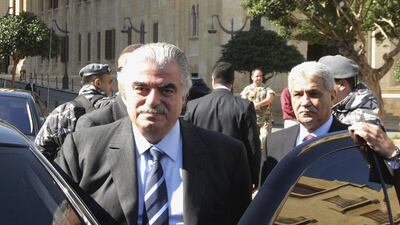
Rafik Hariri, left, and his bodyguard Yahya Arab, leave the Parliament in Beirut, Lebanon in 2005. Minutes later, Hariri and several of his bodyguards were killed in a massive bomb explosion. AP -
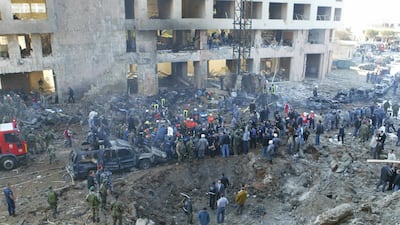
The site of devastation where former Lebanon prime minister Hariri was assassinated in the blast in Beirut on February 14, 2005. AFP -
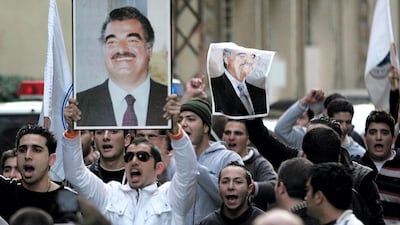
Supporters of former Lebanese prime minister Hariri after Hariri's death outside his house in Beirut. AFP -
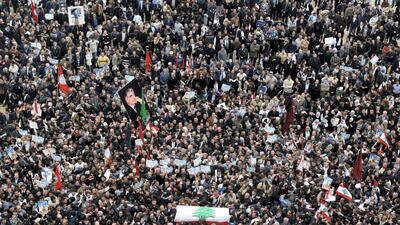
The national flag-draped coffin of Hariri is carried to his final resting place in central Beirut two days after the killing. AFP -
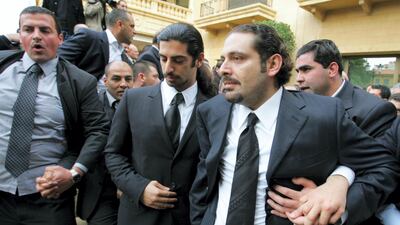
Saad Hariri and other family members leave their family home to join the funeral procession. AFP -
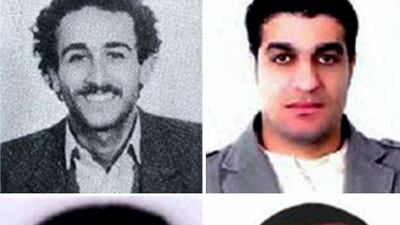
A combination of handout pictures obtained on July 29, 2011 from the website of the Special Tribunal for Lebanon shows four Hezbollah suspects indicted in the assassination case of Hariri, (from top left to right) Mustafa Amine Badreddine, Assad Hassan Sabra, Hussein Hassan Oneissi and Salim Jamil Ayyash. AFP -
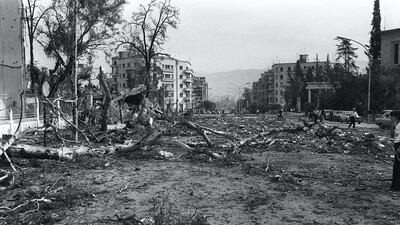
An avenue in central Beirut destroyed by 18 months of civil war is pictured, November 15, 1976. AFP -
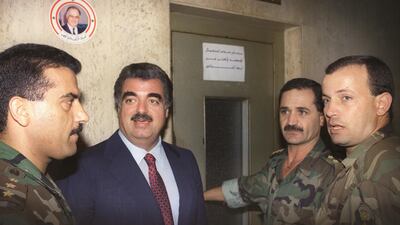
Hariri on October 22, 1992 in Beirut, after being nominated as prime minister by then president Elias Hrawi. AFP -

Hariri and his wife Nazic on September 1, 1996 in their villa in Beirut. AFP -
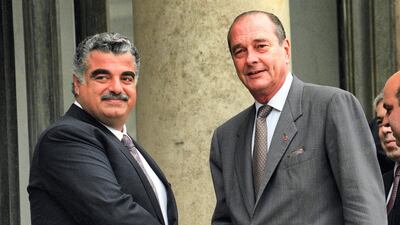
Then French president Jacques Chirac greets Hariri at the Elysee Palace in Paris, September 28, 1996. AFP -
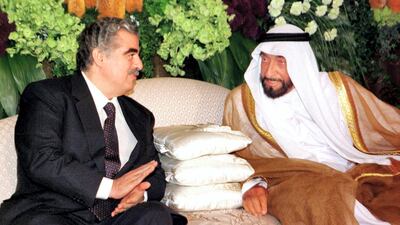
Sheikh Zayed, the Founding Father, meets Hariri in Dubai on March 17, 1999. Hariri was in Dubai for a three-day official visit. AFP -
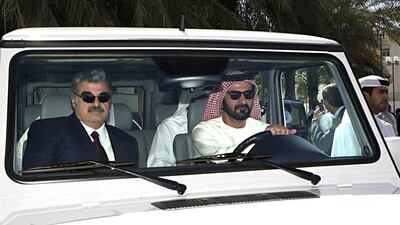
Sheikh Mohammed bin Rashed, then Crown Prince of Dubai, drives Hariri in Dubai on March 6, 2000. AFP -
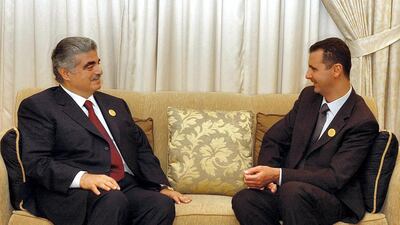
Hariri meets Syrian President Bashar al Assad on the sidelines of the Arab summit in Beirut, March 27, 2002. AFP -
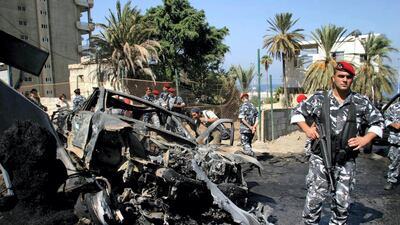
Lebanese policemen gather at the site where outgoing economy and trade minister Marwan Hamadeh's car was targeted by a bomb in Beirut on October 1, 2004. AFP -
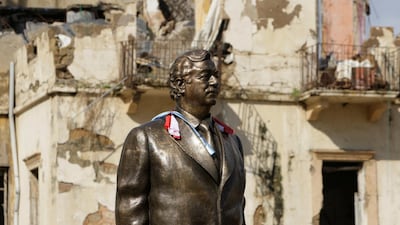
The Hariri monument in Beirut. Reuters


The attack on Hariri, Lebanon’s pre-eminent Sunni politician, sent shockwaves through Lebanese society.
Anger, as more than a million protesters took to the streets, was focused on Hezbollah and its ally, Syria.
Syrian troops had maintained a strong presence in Lebanon for three decades in a legacy of the country’s bitter civil war.
Months before his death, Hariri had quit as prime minister over Syria’s continued influence on Lebanon.
He had clashed with Syrian President Bashar Al Assad over the long intervention.
The outpouring of public outrage over Hariri’s death forced the withdrawal of Syria from Lebanon.
But justice in the courts over the assassination has been limited.
Hearings will be held at a later date to determine Ayyash's sentence. The UN-backed court has no death penalty so the maximum sentence is life imprisonment.
Prosecutors and defence lawyers can appeal against the verdicts.
The verdicts were delayed by nearly two weeks as a mark of respect for victims of the Beirut port explosion, in which 2,750 tonnes of ammonium nitrate stored at Beirut’s port was detonated.
The blast killed at least 177 people, injured more than 6,000 and left a quarter of a million with homes unfit to live in.
Lebanon, a nation suffering economic and social malaise, was plunged deeper into crisis.
The verdict in the Netherlands could reignite anger in Lebanon, where many have pointed fingers at Hezbollah over the port explosion on August 4.

