
France, Germany, Britain, Italy and Spain are deeply concerned about Israeli plans to build thousands of new settler homes in the occupied West Bank, the countries said in a joint statement.
Israel on Thursday said it was pressing ahead with over 2,000 more homes and on Wednesday said they would build 2,166 new homes in existing settlements, deemed illegal by almost every country in the world under international law.
"We are deeply concerned by the decision taken by the Israeli authorities to advance more than 4,900 settlement building units in the occupied West Bank," the joint statement said.
"The expansion of settlements violates international law and further imperils the viability of a two-state solution to bring about a just and lasting peace to the Israeli-Palestinian conflict," it said.
Most countries view settlements Israel has built in territory captured in the 1967 Middle East war as illegal and as an obstacle to peace with the Palestinians. The United States and Israel dispute this. The Palestinians claim all of the West Bank, alongside other areas, as the core of its future independent state.
The Palestinians hope to build part of a future state in the West Bank, while Israel cites historical and biblical links to the area and around 450,000 of its settlers live there, among 3 million Palestinians.
Occupation of Palestine – In photos
-
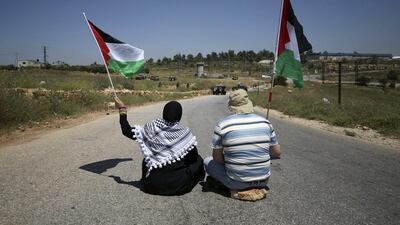
Palestinian protesters wave flags as Israeli troops take position during a protest against Jewish settlements in the West Bank village of Nabi Saleh, near Ramallah. Reuters -
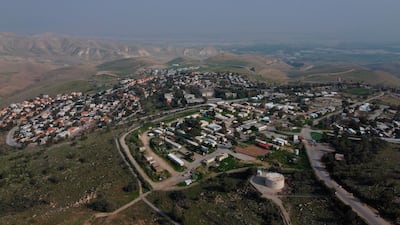
Now that Prime Minister Benjamin Netanyahu has secured a new term in office, there’s little to prevent him from annexing large parts of the West Bank as early as this summer. AP -
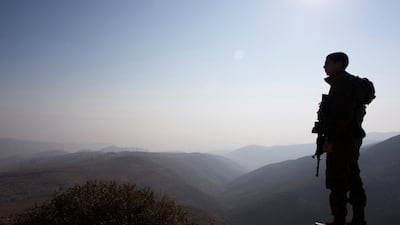
An Israeli soldier stands guard during a tour made by Israeli parliament members in the Jordan Valley near the Jewish settlement of Maale Efrayim. Reuters -
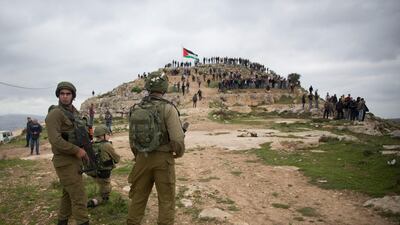
Israeli soldiers take position as Palestinian demonstrators gather during a protest against expansion of Israeli settlements in the West Bank. AP -
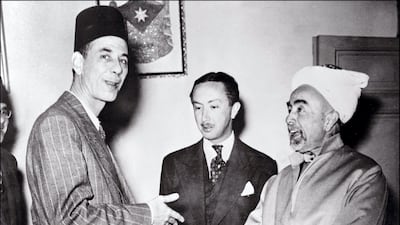
King Abdullah (r) of Transjordan on May 13, 1948 in Amman with Abed Al Rahman Azzam, the secretary general of the Arab League and Abd Al Elah Ibn Ali, the Prince Regent of Iraq, the day before the beginning of the first Arab-Israeli War. AFP -
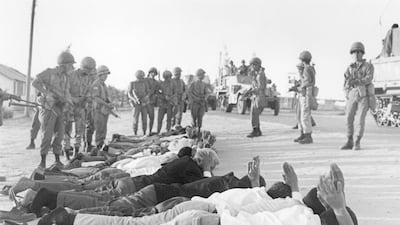
Palestinians surrender to Israeli soldiers in June 1967 in the occupied territory of the West Bank after Israel launched a pre-emptive attack on Egypt and Syria and seized the Gaza Strip, Sinai Peninsula and the Golan Heights in Syria as well as the West Bank and Arab East Jerusalem. AFP -
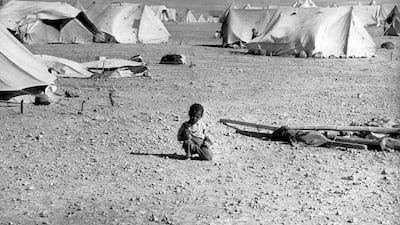
A Palestinian child plays in a refugee camp in Jordan on June 23, 1967. AFP -
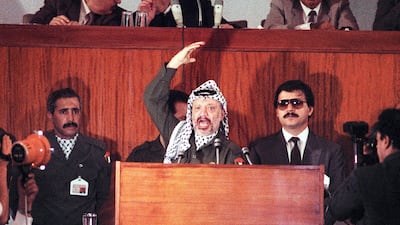
PLO chairman Yasser Arafat delivers a speech to the Palestine National Council meeting to make the historic proclamation of a Palestinian state in the Israeli-occupied territories and to recognize Israel in the Palace of Nations conference hall on November 12, 1988, in Algiers. AFP -

US President Bill Clinton stands between PLO leader Yasser Arafat and Israeli Prime Minister Yitzahk Rabin as they shake hands for the first time on September 13, 1993 at the White House. AFP -
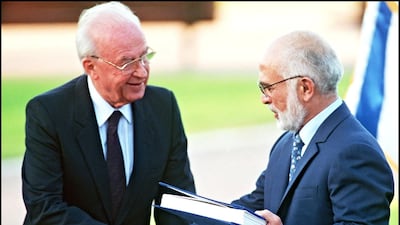
Hussein Ibn Talal, King of Jordan and Israeli Premier Yitzhak Rabin shake hands after they exchanged the documents of the Peace Treaty at Beit Gabriel conference centre on November 10, 1994 on the southern shore of the Sea of Galilee. AFP -
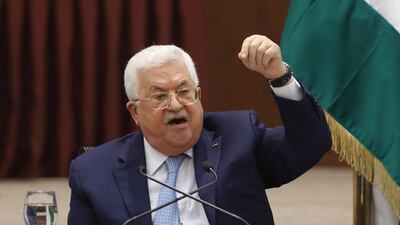
Palestinian President Mahmoud Abbas speaks during the Palestinian leadership meeting and threatened to end security coordination with Israel and the United States, saying Israeli annexation would ruin chances for peace. AFP -
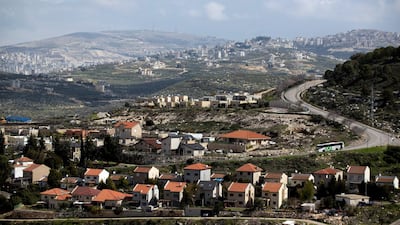
Houses in the Israeli settlement of settlement of Kedumim are seen in the foreground as part of the Palestinian city of Nablus is seen in the background (far left) in the Israeli-occupied West Bank. Reuters -
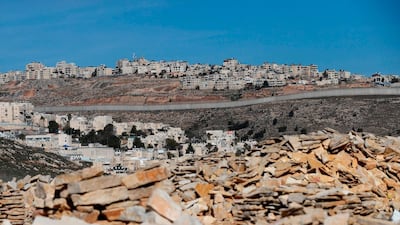
Israel's controversial concrete barrier (C) separating the Jewish settlement of Neve Yaakov (foreground) in the northern part of east Jerusalem and the Palestinian area of al-Ram (background) in the occupied West Bank. AFP -
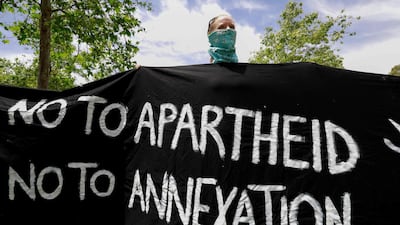
An Israeli activist holds a banner during a protest against the US peace plan for the Middle East, in front of the US ambassador's residence in Jerusalem, on May 15, 2020, as Palestinians commemorate the 72nd anniversary of the 1948 Nakba or "catastrophe". AFP -
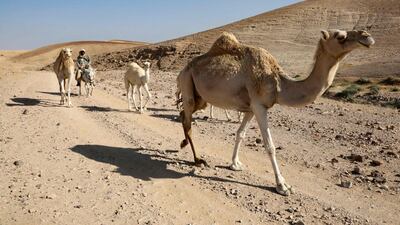
A Palestinian shepherd tends to his camels on arid land considered to be in "Area C" (under Israeli security and administrative control), southeast of Yatta town in the southern West Bank district of Hebron. AFP -
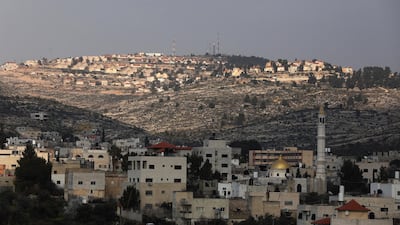
A general view of the Israeli settlement of Elon Moreh, as seen from the Palestinian village of Azmout near the West Bank City of Nablus. EPA -
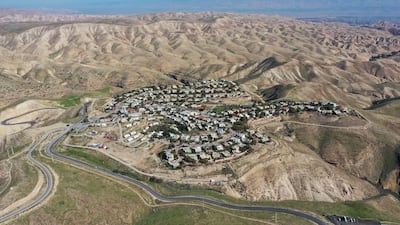
The West Bank Jewish settlement of Maale Michmash. AP


But Israel’s plans to advance the building of settlement units in the occupied West Bank brings 2020 to a record high for expansions of illegal settlements.
The European partners said that it undermined the “positive development” brought by the UAE-Israel agreement to establish ties in exchange for halting annexation of occupied territories.
“It is also a counterproductive move in light of the positive developments of normalisation agreements reached between Israel, the United Arab Emirates and Bahrain,” it added, referring to the Abraham Accords.
Ayman Al Safadi, Jordan’s foreign minister, called for international pressure on Israel to stop the building of new settlements. On Thursday, the top diplomat of the European Union also condemned the latest Israeli decision.
“Settlements are illegal under international law. As stated consistently, the EU will not recognise any changes to the pre-1967 borders, including with regard to Jerusalem, other than those agreed by the parties,” the bloc’s foreign relations chief Josep Borrell said.
The latest Israeli approvals are part of a building boom that has gained steam during the presidency of Donald Trump. It also comes months after Israel promised to put on hold plans to annex parts of the West Bank in exchange for a US-brokered normalisation deal with the UAE.
The approvals raised the number of settlement homes to be advanced this year to more than 12,150, according to Peace Now, a settlement watchdog group. It is by far the highest number of approvals since Trump took office in early 2017 and the highest since Peace Now began recording the figures in 2012.
Also Friday, Palestinians clashed with Israeli troops and settlers in the West Bank village of Burqa, east of the city of Ramallah, while trying to get to their olive groves near a Jewish settler outpost and harvest the olives. Harvest time is often a flashpoint between the sides.
Israeli troops fired teargas and stun grenades to try to disperse the crowd. The military said in a statement that dozens of Palestinians threw stones at the troops, which the military said were there in co-ordination with the farmers.
Later, both Jewish settlers and Palestinian farmers fought fires in the olive groves caused by Israeli police’s teargas canisters.

