


In less than six months, more than 10 million coronavirus cases have been reported and the virus has now killed more than half a million people.
Official cases exceeded 10 million on Sunday, according to tallies by Reuters and Johns Hopkins University, but the real toll of Covid-19 is thought to be many times higher.
In the early hours of Monday, the death toll officially reached 500,000, Johns Hopkins recorded.
The number of cases is roughly double the number of severe influenza illnesses recorded annually, according to the World Health Organisation.
At the start of the pandemic, most countries were slow to test widely. But as health systems and emergency responses adapted, the number of positive cases increased and now better reflect the scale.
In much of the world, however, testing is still limited and even in those places carrying out thousands of screenings a day, it is still hard to ascertain the true extent of the virus. Many people experience mild symptoms and do not come into contact with doctors.
Health experts said that virus continues to spread, as many countries open up and remove lockdown measures introduced to prevent this.
From the first cases in early January, it took until the middle of May for 4.5 million cases to be reported. In the five weeks from May 16, the number of worldwide cases doubled.
More than a million new cases were recorded in the past seven days.
As countries ease restrictions and try to adapt to a new reality, there has been a resurgence of cases in several places, leading to new outbreak clusters.
Even China, where the virus was first detected, has been engaged in whack-a-mole responses as new clusters of infections are detected, despite bringing national cases to zero only weeks after the outbreak began in Wuhan.
In Beijing, where hundreds of new cases were linked to an agricultural market, testing capacity has been increased to up to 300,000 a day.
Countries including China, New Zealand and Australia have had new outbreaks in the past month, despite largely quashing local transmission.
This recurring pattern of opening up and then reintroducing lockdown measures is likely to endure for the next few years until a vaccine is discovered, experts said.
North America, Latin America and Europe each account for about 25 per cent of cases, while Asia and the Middle East have about 11 per cent and 9 per cent, according to the Reuters tally, which uses government reports.
The half a million deaths linked to the disease so far is roughly the same as the number of influenza deaths reported annually.
Health authorities in China’s Wuhan first reported a cluster of pneumonia cases on December 31 and then on January 10, the WHO issued technical guidelines with all the information they had at that time on the new virus.
Since then, it has spread to almost every country around the world.
Europe was hit hard and early by the virus, with areas like northern Italy reporting huge death tolls and most of the region closing borders, ordering people to stay home and preparing for wave of infections.
While much of Europe has brought cases down and is looking to reopen their economies, outbreaks in India and Brazil have grown. Both countries are recording more than 10,000 cases a day, putting major strains on resources.
The two countries accounted for over a third of all new cases in the past week.
Brazil reported a record 54,700 new cases on June 19.
Coronavirus in the Middle East
-
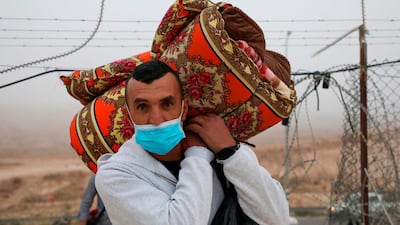
A Palestinian labourer, carrying a mattress, crosses illegally into Israeli areas through a hole in Israel's illegal barrier wall near the Mitar checkpoint in the occupied West Bank city of Hebron. AFP -
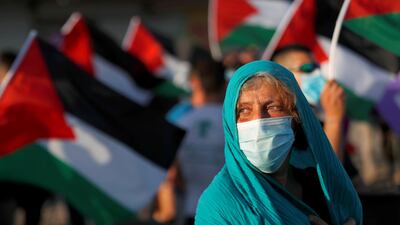
Peace activists take part in a protest against Israel's plan to annex parts of the Israeli-occupied West Bank, in the Palestinian town of Jericho. Reuters -

A man stands behind a screen depicting Liverpool player Mohamed Salah at a cafe, after months of lockdown, in Cairo, Egypt. Reuters -

A Kuwaiti health ministry worker conducts a random test for the novel coronavirus in Kuwait City. AFP -
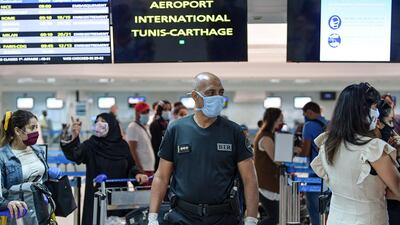
A mask-clad member of Tunisia's Rapid Intervention Brigade walks past passengers queuing to check-in their luggage before boarding departing flights at Tunis-Carthage International Airport in the Tunisian capital. AFP -

Lebanese director Carol Mansour uses her phone to film pigeons flying while wearing a face mask, in the centre of the capital Beirut. AFP -
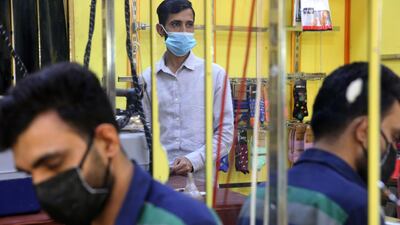
Pakistani and Bengali workers clad in face masks work as tailors at a small factory in Karrada, in the central area of the Iraqi capital Baghdad. AFP


Some researchers said the death toll in Latin America could rise to more than 380,000 by October, from about 100,000 this week.
The US's 2.5 million cases is the most of any country. It managed to slow the spread of the virus in May, only to have it expand in recent weeks to rural areas and other places that were previously unaffected.
More Americans have now died of the virus than in every US war since Korea in 1950, and more than were killed in the First World War.
In some countries with limited testing capabilities, case numbers reflect a small proportion of total infections. Roughly half of reported infections are known to have recovered.
Worryingly, a small study of just under 100 people in China looked at lasting immunity from those who have had the virus and found those with mild symptoms get very little lasting protection.
The majority of virus patients display relatively minor signs of infection, and a small proportion show no symptoms at all.
Very little is known about this second group, given that they are far less likely to be tested than those who go on to develop severe symptoms, including respiratory problems. But more countries are looking into antibody tests to ascertain who may have had the virus without knowing.
The researchers analysed blood samples from a group who had shown symptoms and a group who had not. They found that only 62.2 per cent of the asymptomatic group had short-term antibodies, compared with 78.4 per cent of symptomatic patients.
After eight weeks of convalescence, antibody presence had fallen in 81.1 per cent of asymptomatic patients, compared with 62.2 per cent of symptomatic patients.
The authors of the study, which was published in Nature Medicine, said their findings called into question the idea that everyone who has had coronavirus is immune to future infection.
"These data might indicate the risks of using Covid-19 'immunity passports' and support the prolongation of public health interventions, including social distancing, hygiene, isolation of high-risk groups and widespread testing," they wrote.

