
The UAE relationship with Germany has long been shaped by strong economic links but widening diplomatic and cultural ties have come to the fore through a strategic partnership.
As Sheikh Mohamed bin Zayed's official visit to Germany moved into a second day on Wednesday, experts spoke of the advantages to be derived for both sides in strengthening those ties.
Developments in the global economy driven by artificial intelligence and technological innovation means Germany is an attractive partner for the UAE as it seeks to develop and grow a diversified economy.
The rising influence of both sides in key global strategic issues ranked as a priority for the visiting UAE delegation, which held a series of meetings to swap positions with their Berlin-based counterparts.
“Germany has much to offer the UAE but there is also changing perceptions in Berlin that the UAE has a very significant role in the region and elsewhere,” Sebastian Sons, associate fellow of the Middle East and North Africa programme on the German Council on Foreign Relations. “This forces the understanding from a German perspective of how much foreign policy needs to broaden and be more diversified to recognise an influential player.”
-

Sheikh Mohamed bin Zayed, Crown Prince of Abu Dhabi and Deputy Supreme Commander of the UAE Armed Forces, is received by Angela Merkel, Chancellor of Germany, at the Chancellor's Office in Berlin, Germany in June 2019. Courtesy Ministry of Presidential Affairs -

Sheikh Mohamed bin Zayed meets with Angela Merkel at the Chancellor's Office. Seen with Sheikh Mansour bin Zayed, Deputy Prime Minister and Minister of Presidential Affairs, left, in June 2019. Courtesy Ministry of Presidential Affairs -
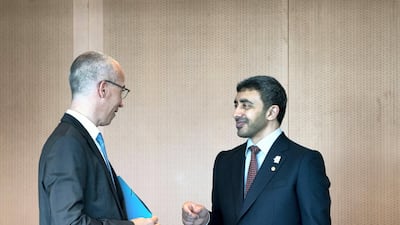
Sheikh Abdullah bin Zayed, Minister of Foreign Affairs and International Co-operation, right, speaks with a German delegate prior a meeting with Angela Merkel, in June 2019. Courtesy Ministry of Presidential Affairs -

Angela Merkel bids farewell to Sheikh Mohamed bin Zayed after a meeting at the Chancellor's Office, in June 2019. Ministry of Presidential Affairs -
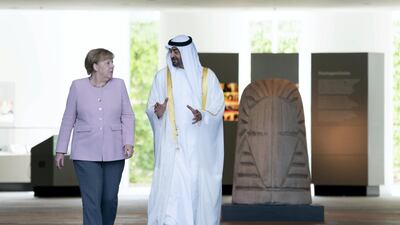
Angela Merkel bids farewell to Sheikh Mohamed bin Zayed after a meeting at the Chancellor's Office in June 2019. Ministry of Presidential Affairs -

Sheikh Mohamed bin Zayed meets with Peter Altmaier, Minister for Economic Affairs and Energy of Germany in Berlin in June 2019. Courtesy Ministry of Presidential Affairs -

Sheikh Mohamed bin Zayed meets with representatives of German companies from various sectors, in Berlin. Seen with Mohamed Mubarak Al Mazrouei, Undersecretary of the Crown Prince Court of Abu Dhabi; Sheikh Abdullah bin Zayed; Dr Sultan Ahmed Al Jaber, UAE Minister of State, Chairman of Masdar and CEO of ADNOC Group; and Mr. Altmaier in June 2019. Courtesy Ministry of Presidential Affairs -

Sheikh Mohamed bin Zayed meets with representatives of German companies from various sectors. Seen with Dr Sultan Ahmed Al Jaber in June 2019. Courtesy Ministry of Presidential Affairs -

Sheikh Mohamed bin Zayed meets with representatives of German companies from various sectors in June 2019. Courtesy Ministry of Presidential Affairs -

Sheikh Abdullah bin Zayed speaks with representatives of German companies from various sectors, in Berlin. Courtesy Ministry of Presidential Affairs -

Mohamed Mubarak Al Mazrouei and Sheikh Abdullah bin Zayed attend a meeting with representatives of German companies from various sectors. Courtesy Ministry of Presidential Affairs -

Sheikh Mohamed bin Zayed speaks with Emirati students who are studying in Germany. Courtesy Ministry of Presidential Affairs -

Sheikh Mohamed bin Zayed greets the Emirati students who are studying in Germany. Courtesy Ministry of Presidential Affairs -

Sheikh Abdullah bin Zayed greets Emirati students who are studying in Germany. Courtesy Ministry of Presidential Affairs -

Sheikh Abdullah bin Zayed and Sheikh Mansour bin Zayed stand for a photograph with an Emirati student who is studying in Germany. Seen with Ali Al Ahmed, UAE Ambassador to Germany, right. Courtesy Ministry of Presidential Affairs -

Sheikh Mohamed bin Zayed stands for a photograph with Emirati students who are studying in Germany. Courtesy Ministry of Presidential Affairs


The might of the German industrial base means the country is the UAE’s fourth largest trading partner after India, China and the USA. It had a total trade volume of $13.3 billion (Dh 48.85 billion) in 2018.
Germany supplies the UAE with cars, aircraft and in return, aluminium goods and petrochemicals are imported from this region. “The UAE has been the largest trade partner of Germany in the Middle East for more than 10 years, with 30 per cent of German trade with Arab countries passing through the UAE,'' said Ali Abdullah Al Ahmed, the UAE ambassador to Germany.
Germany currently holds a seat on the United Nations Security Council and last week, its delegation welcomed a strong statement of support for the Secretary General’s Yemen envoy, Martin Griffiths. The statement was a development that UAE diplomats supported in the lead up to the meeting.
The two countries have appointed special envoys to work on issues surrounding restrictions on German’s exports of military-related equipment earlier this year. That decision came after warnings that the German stance could interrupt shipments to members of the Arab Coalition.
According to Mr Sons, the issue should be viewed within the deepening complexity of the bilateral relationship. It has shown it is necessary for the UAE to recognise that the German system has many stakeholders on the issue. Deeper engagement with cross-party groups like the Bundestag’s Foreign Affairs committee members can only help allay concerns.
Ultimately believes Mr Sons, the issue resides with Germany’s internal political debate and the willingness of the political establishment to take on populist arguments.
“It’s critical this issue of military sales does not overshadow more pragmatic discussions with all the GCC and we able to open up the discussion to other topics where we can see the other’s point of view,” he said. “Frankly this is a domestic discussion about our foreign policy and the resolution lies in talking to a domestic audience.”
A trip to the region by Heiko Maas, the German foreign minister, largely failed to paper over differences with Tehran about Europe’s efforts to maintain the 2015 nuclear agreement. The foreign minister visited the UAE and met Sheikh Mohamed for discussions on the rising regional tensions.
To Mr Sons, there is long tradition of Germany attempting to act as a mediator in the region and there are many reasons why the impact of the current efforts is limited.
“The UAE has a different stance to Iran and the [deal] and it is a positive sign that both sides talk to each other about it. The truth is that Germany does not have much to offer Iran and its impact has not been as high as it was when it negotiated the agreement. Both sides could play a role in bridging the gap with the US over the issue,” he said.
As part of regular contacts, the two countries cooperate on security and their armies meet every year and half, with the last meeting held in Berlin in March. Energy is another focus of the relationship. The renewable ventures operated by Masdar are closely followed in Germany.
The UAE is among Germany’s main oil suppliers and Adnoc has a joint venture with the German Linde Group. In November 2018, Adnoc awarded Germany’s biggest energy producer Wintershall a 10 per cent stake in a major gas concession. But ties extend beyond trade and energy.

